Fast implementation of a maximum likelihood algorithm for the estimation of target motion parameters

a maximum likelihood algorithm and target motion technology, applied in the direction of instruments, measurement devices, using reradiation, etc., can solve the problems of improving the estimation of target motion parameters, requiring an exceedingly large number of computations, and requiring limited success in searching for the global maximum of the 3d function

a maximum likelihood algorithm and target motion technology, applied in the direction of instruments, measurement devices, using reradiation, etc., can solve the problems of improving the estimation of target motion parameters, requiring an exceedingly large number of computations, and requiring limited success in searching for the global maximum of the 3d function

US20100259442A1Active Publication Date: 2010-10-14RAYTHEON CO

Image

Smart Image Click on the blue labels to locate them in the text.
Viewing Examples
Smart Image
  • Fast implementation of a maximum likelihood algorithm for the estimation of target motion parameters
  • Fast implementation of a maximum likelihood algorithm for the estimation of target motion parameters
  • Fast implementation of a maximum likelihood algorithm for the estimation of target motion parameters

Examples

Experimental program
Comparison scheme
Effect test

Embodiment Construction

[0026]In the following detailed description, only certain exemplary embodiments of the present invention are shown and described, by way of illustration. As those skilled in the art would recognize, the invention may be embodied in many different forms and should not be construed as being limited to the embodiments set forth herein. Like reference numerals designate like elements throughout the specification.

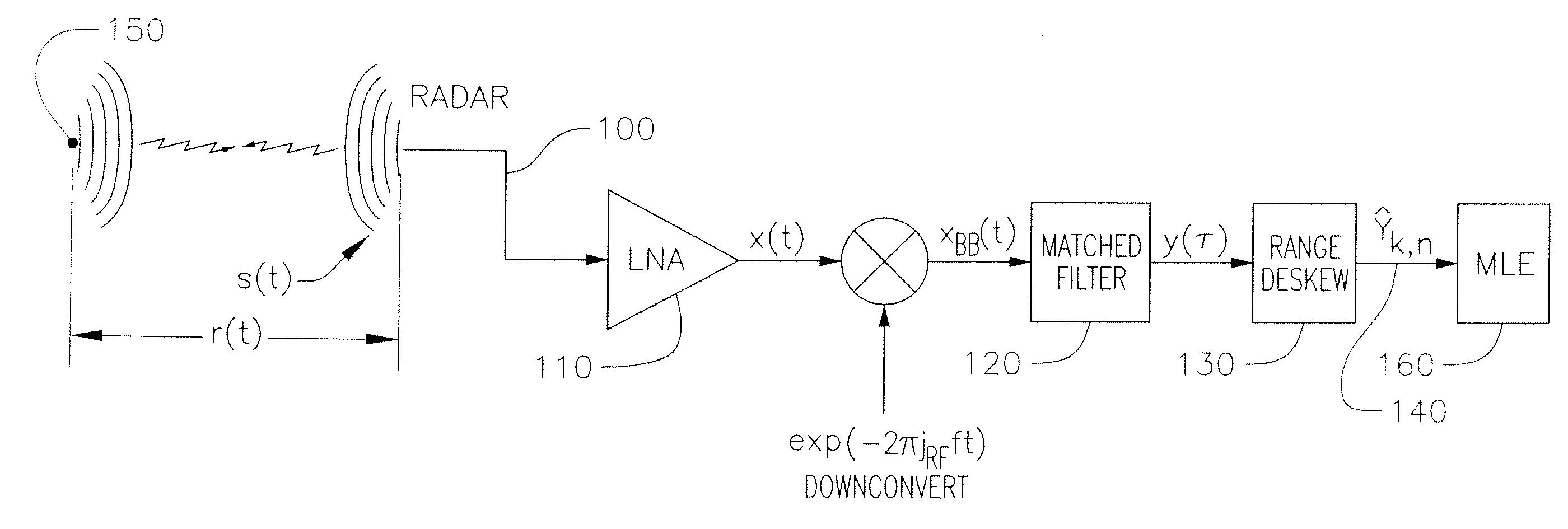
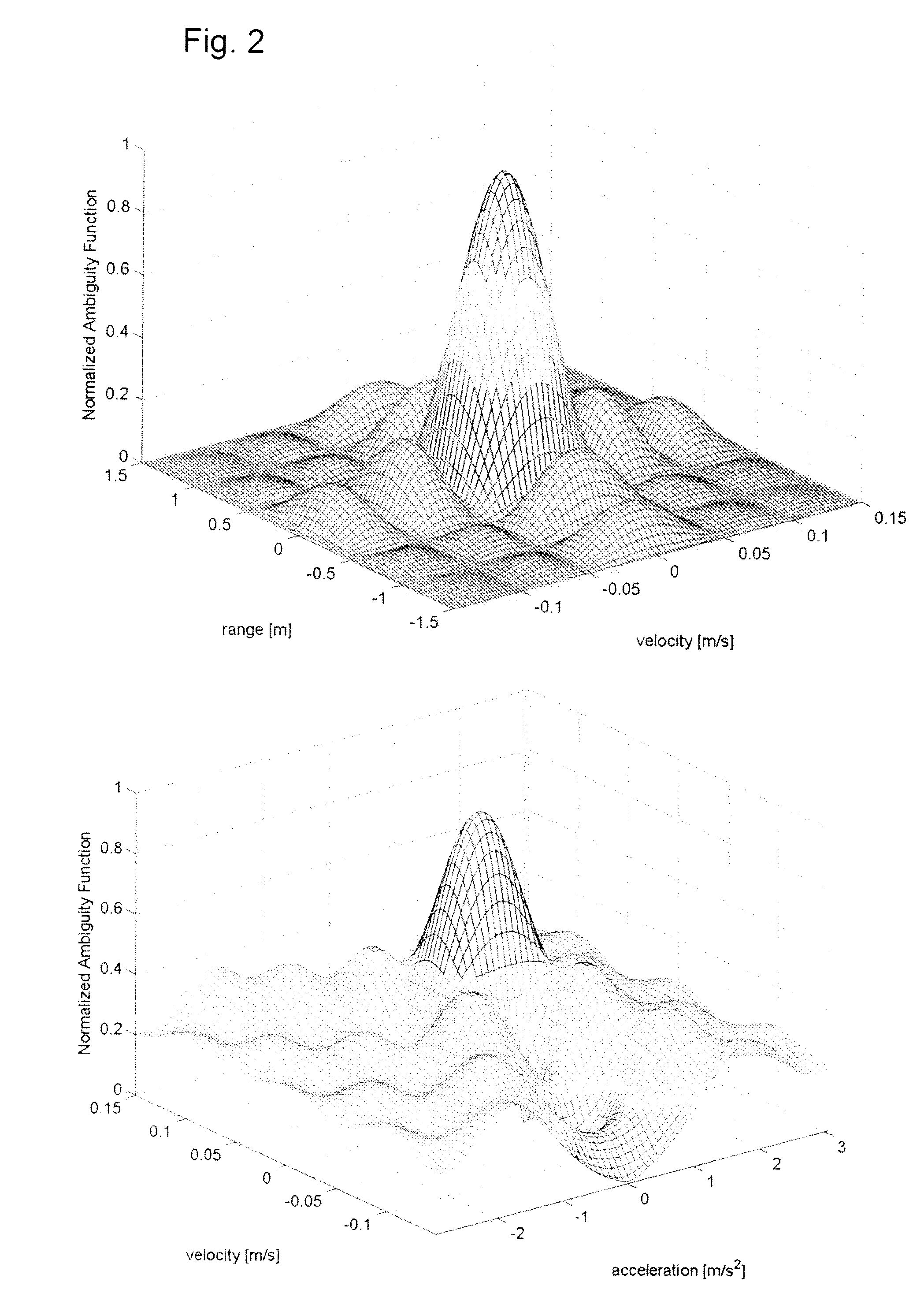
[0027]In an exemplary embodiment of the invention, a pulse doppler radar transmits a signal and receives a return signal reflected from a scatterer, or a target. The phase of the return signal (the “real phase”) is correlated with the phase of a model signal (e.g., a signal generated by a matched filter), and due to doppler shifts in the return signal, the result of the correlation results in an ambiguity function Ψ of three dimensions, representing target motion parameters (i.e., range, range rate, and acceleration). The maximum value of the ambiguity function Ψ is then calcula...

the structure of the environmentally friendly knitted fabric provided by the present invention; figure 2 Flow chart of the yarn wrapping machine for environmentally friendly knitted fabrics and storage devices; image 3 Is the parameter map of the yarn covering machine
Login to View More

PUM

No PUM Login to View More

Abstract

A system and method for implementing a maximum likelihood estimator for making a joint estimation of range, range rate, and acceleration of a target utilizing a pulse doppler radar. The MLE of target motion parameters are determined by keystone processing a baseband signal, and generating a first estimate of the motion parameters based on the processed signal. The first estimate is utilized to set up sampling intervals for the performance of a coarse search. Then a fine search is performed using Newton's method to determine the MLE.

Description

STATEMENT REGARDING FEDERALLY SPONSORED RESEARCH OR DEVELOPMENT[0001]The U.S. Government has a paid-up license in this invention and the right in limited circumstances to require the patent owner to license others on reasonable terms as provided for by the terms of Contract No. F33615-02-D-1116-0007 awarded by the Air Force Research Laboratory.BACKGROUND OF THE INVENTION[0002]The present invention is generally related to signal processing for a radar system for motion compensation and target focusing.[0003]The fast and accurate estimation of target range, range rate (i.e., radial velocity), and acceleration from sampled radar return signals is necessary for some radar applications. Joint estimation of these target motion parameters is an important precursor to motion compensation for high resolution spectral analysis of targets and synthetic aperture radar (SAR) or inverse synthetic aperture radar (ISAR) processing. The joint estimation of target motion parameters is also applicable...

Claims

the structure of the environmentally friendly knitted fabric provided by the present invention; figure 2 Flow chart of the yarn wrapping machine for environmentally friendly knitted fabrics and storage devices; image 3 Is the parameter map of the yarn covering machine
Login to View More

Application Information

Patent Timeline
14 Oct 2010
Publication
US20100259442A1
IPC
G01S13/90
CPC
G01S13/282; G01S2013/9064; G01S13/9035; G01S13/9029; G01S13/9019; G01S13/904; G01S13/9064
Inventors
ABATZOGLOU, THEAGENIS J.; GONZALEZ, JOHAN ENMANUEL