
Idiotypic vaccine
a technology of immunoglobulin and idiotypic vaccine, which is applied in the field of recombinant clonotypic immunoglobulin, can solve the problems of complexity and high cost of producing idiotypic ig for each patient, and place significant limits on the application of this vaccination strategy for a large population of subjects, and achieve significant cross-reactivity, efficacy, treatment and/or prophylaxis in lymphoproliferative pathologies
- Summary
- Abstract
- Description
- Claims
- Application Information
AI Technical Summary
Benefits of technology
Problems solved by technology
Method used
Image

Examples
example 1
Isolation, Preparation, In Vitro Characterisation of Recombinant Clonotypic Ig
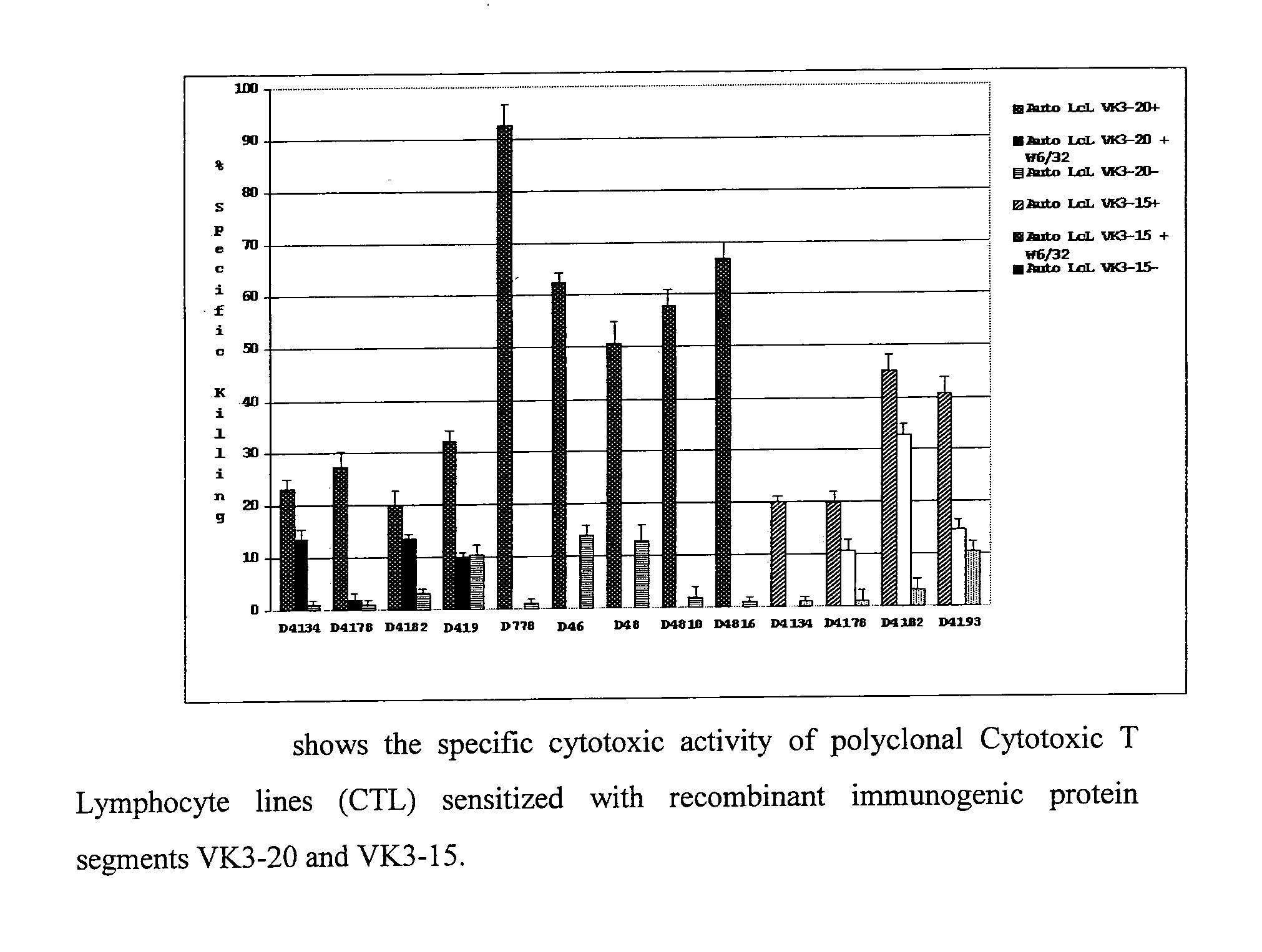
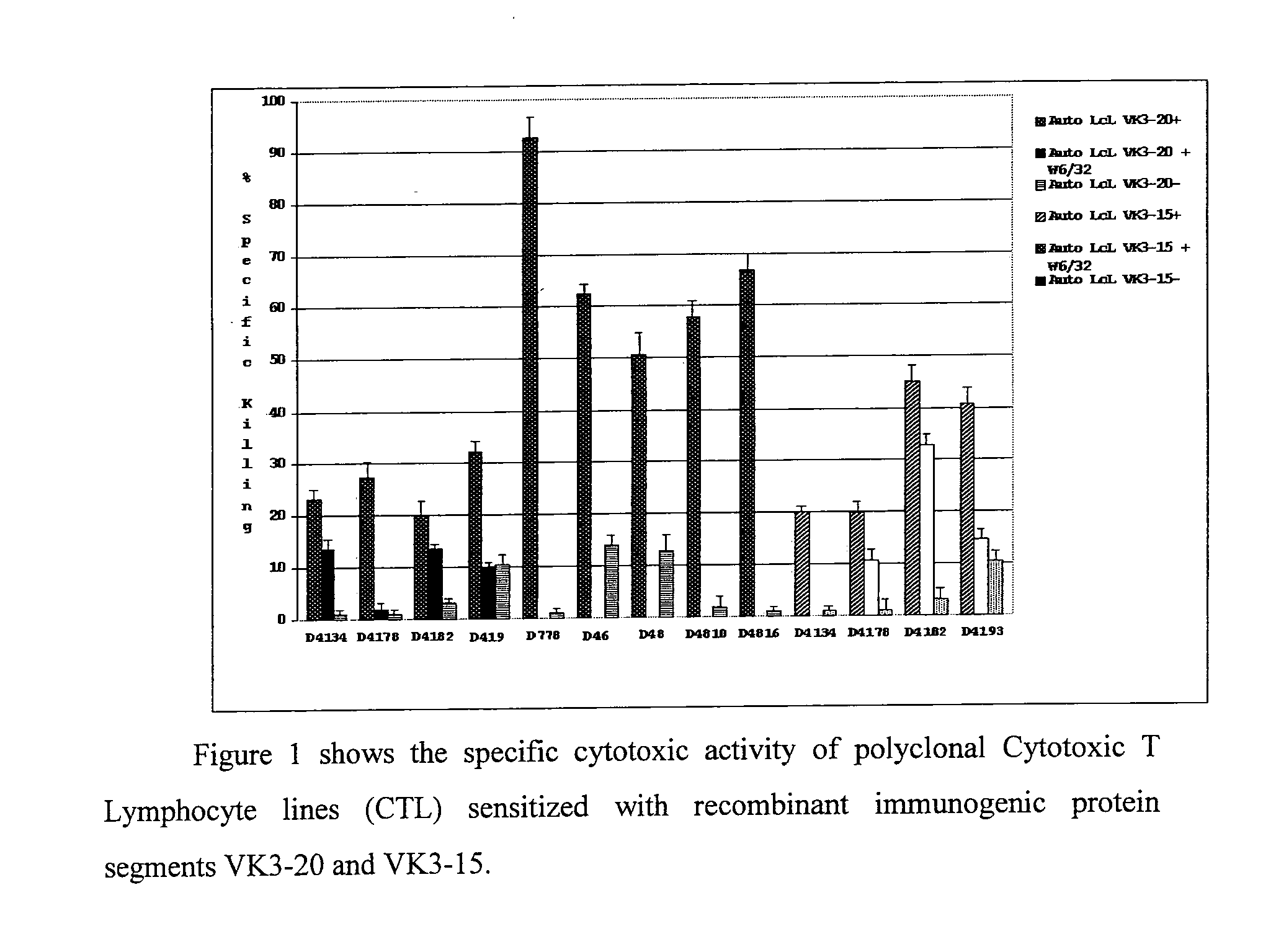
[0060]The VH and VK regions of six HCV patients infected with type II mixed cryoglobulinemia and concomitant NHL-B were inserted and reproduced in vitro and the single-filament proteins (ScFv) deriving from these sequences were produced and purified by affinity.
[0061]Only the proteins derived from the VK chain of two patients, VK3-20 (VK-gal) and VK3-15 (VK-gent), were further immunologically characterised in vitro. The DNA was extracted respectively from the tumour cells obtained from a hepatic biopsy and from bone marrow cells, both tissues were involved by a low-malignity non-Hodgkin lymphoma of a lymphoplasmacytic-lymphoplasmacytoid type according to the Kiel classification. In both cases the VK region was amplified as reported previously (De Re V, and col. Blood. 2000; 96:3578-84). The genes that form the variable regions of the immunoglobulin light chain are: VK3-20 / JK1*01 and VK3-15 / JK1*01. The VK s...
example 2
Cross-Recognition of Recombinant Idiotypic Proteins
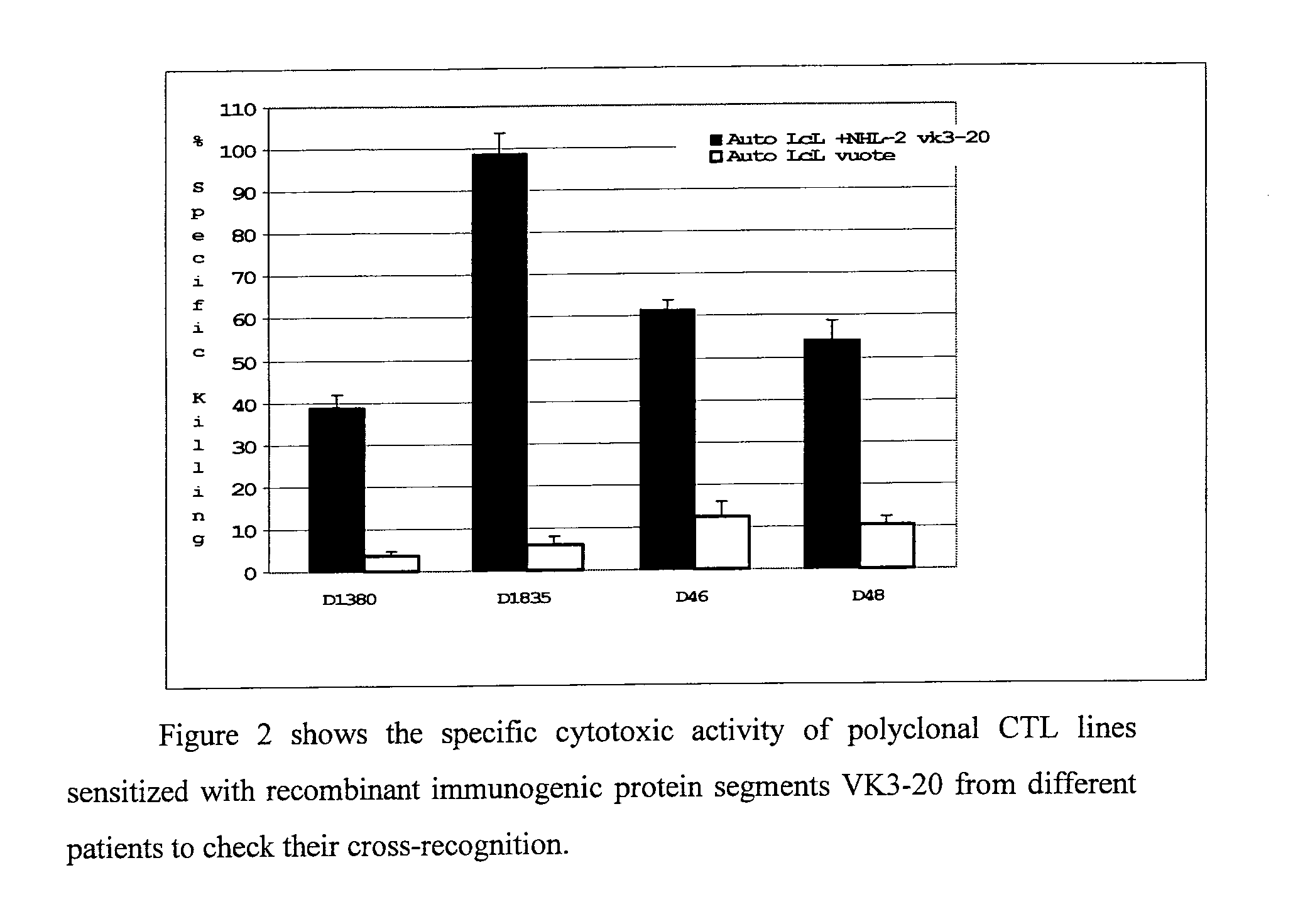
[0063]It has been observed that the cytotoxic responses stimulated by a prototypical light chain VK3-20, derived from an HCV-related lymphoma, present a cross-reactivity even with regard to an idiotypic VK protein codified from the same gene (VK3-20) but derived from the lymphoma of a different patient (FIG. 2). The data in FIG. 2, obtained from four unrelated donors and distinguished by different HLA class I haplotypes, show how the cytotoxic immune responses induced by a recombinant prototype protein VK3-20 have a significant immunotherapeutic potential also in non related patients affected by lymphomas expressing idiotypic immunoglobulins including light chains VK3-20.
example 3
Assessment of the Cross-Reactivity of VK3-20- and VK3-15-Specific CTL
[0064]Further experiments were carried out to assess the capability of VK3-20- and VK3-15-specific CTL to recognise and kill both autologous matched targets, or rather charged with the corresponding protein used for the generation of the CTL, and autologous mismatched targets, or rather charged with the molecularly related protein VK3. In the considered three donors, as shown in FIG. 3, the VK3-20- and VK3-15-specific CTL are able to kill with Class I-restricted mode even targets charged respectively with VK3-15 and VK3-20 (mismatched targets). In fact the two VK3 proteins possess a sequence homology greater than 80% and this justifies their cross-reactivity. This provides the rational for using these recombinant proteins as vaccines for the treatment and prevention of lymphoproliferations expressing molecularly related idiotypes. It has also been shown how VK3-20-specific CTL recognise and kill in Class I-restrict...
PUM
| Property | Measurement | Unit |
|---|---|---|
| Temperature | aaaaa | aaaaa |
| Fraction | aaaaa | aaaaa |
| Time | aaaaa | aaaaa |
Abstract
Description
Claims
Application Information
 Login to View More