Unlock instant, AI-driven research and patent intelligence for your innovation.

Method of deriving progenitor cell line

a progenitor cell and stem cell technology, applied in the field of cell biology, molecular biology and genetics, can solve the problems of heterogeneous cell populations, inefficient protocols, and inability to generate other cell types that may have a deleterious effect on tissue repair and regeneration, and achieve the effect of promoting or retarding the self-renewal or differentiation of stem cells

Inactive Publication Date: 2011-01-13
AGENCY FOR SCI TECH & RES
View PDF4 Cites 6 Cited by
  • Summary
  • Abstract
  • Description
  • Claims
  • Application Information

AI Technical Summary

Benefits of technology

The present invention provides methods for deriving and maintaining progenitor cell lines from embryonic stem cells. These methods involve selecting against somatic cells and promoting self-renewal and differentiation of the embryonic stem cells through the use of specific conditions. The resulting progenitor cell lines have reduced potential for tumorigenicity and can be used for regenerative therapy and the development of pharmaceutical compositions for the treatment of various diseases. The methods also involve exposing the embryonic stem cells to conditions that enhance differentiation to specific lineages, resulting in the formation of embryoid bodies which can be further manipulated to produce specific types of cells.

Problems solved by technology

However, this very property of embryonic stem cells also poses a unique challenge, i.e. generating the appropriate cell types for the treatment of a specific diseased or injured tissue in sufficient quantity and homogeneity to ensure therapeutic efficacy, and inhibiting the generation of other cell types that may have a deleterious effect on the tissue repair and regeneration.
At present, protocols that either enhance differentiation of embryonic stem cells towards specific lineages and / or enrich for specific tissue cell types are too inefficient and generally yield heterogeneous cell populations that might be tumorigenic (Keller, Genes Dev. 2005; 19:1129-1155; Wobus and Boheler, Physiol Rev. 2005; 85:635-678).

Method used

the structure of the environmentally friendly knitted fabric provided by the present invention; figure 2 Flow chart of the yarn wrapping machine for environmentally friendly knitted fabrics and storage devices; image 3 Is the parameter map of the yarn covering machine
View more

Image

Smart Image Click on the blue labels to locate them in the text.
Viewing Examples
Smart Image
  • Method of deriving progenitor cell line
  • Method of deriving progenitor cell line
  • Method of deriving progenitor cell line

Examples

Experimental program
Comparison scheme
Effect test

example 1

Methods: Derivation of E-RoSH Cell Lines

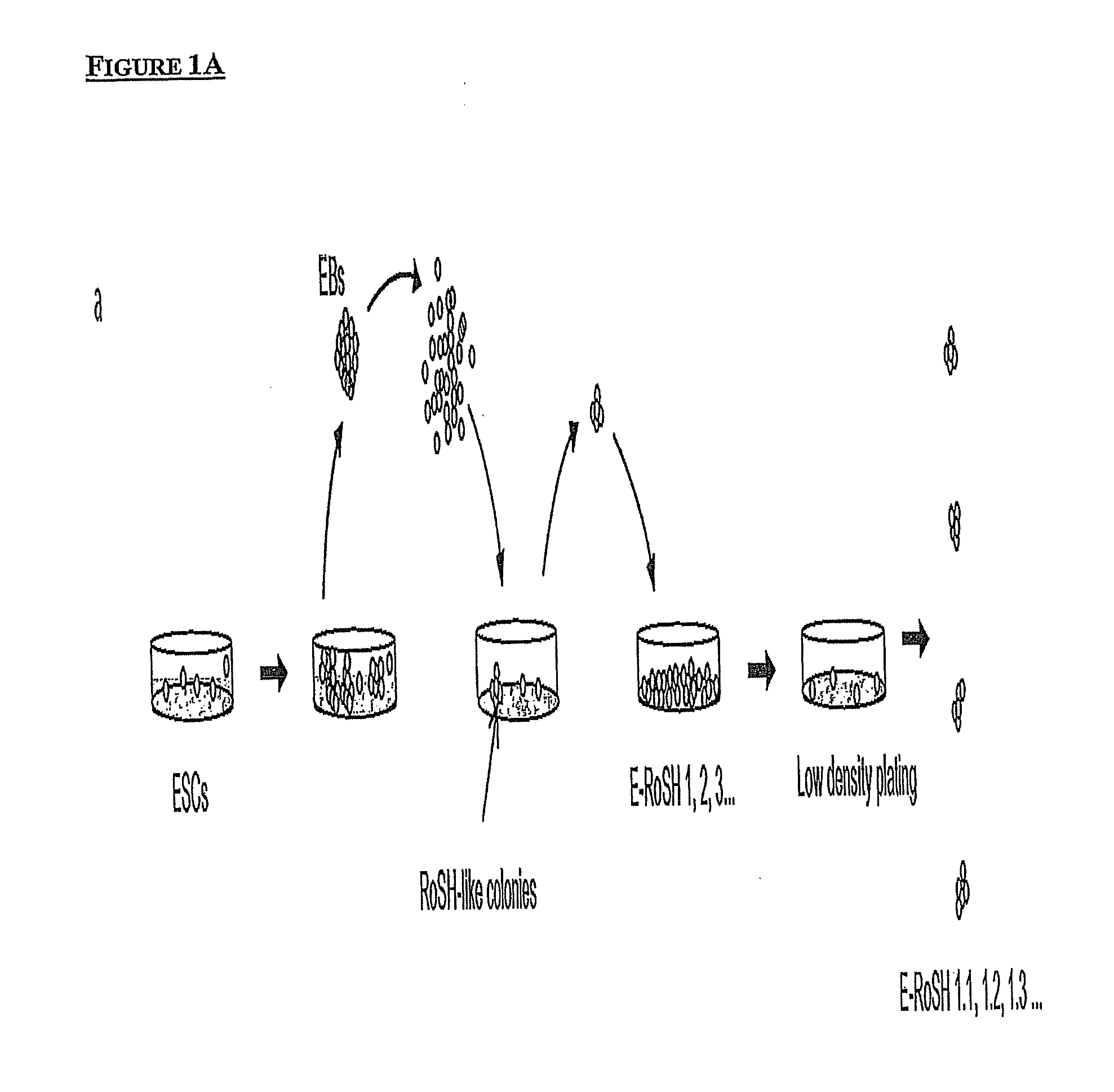
[0204]Embryonic stem cells (ESCs) are induced to differentiate to form embryoid bodies (Ebs) using the methycellulose-based approach described in Lim et al, Blood. 1997; 90:1291-1299)

[0205]Day 3 to day 6 embryoid bodies are harvested, dissociated into single cell suspensions by collagenase digestion (Robertson E J. Embryo-derived stem cell lines. In: Robertson E J, ed. Teratocarcinomas and embryonic stem cells: a practical approach. Oxford: IRL Press Limited; 1987:71-112) and plated on at a density of 1-5×10⁵ cells per 10 cm feeder plate. After about a week, the cells proliferated and differentiated into a complex mixture of cell types.

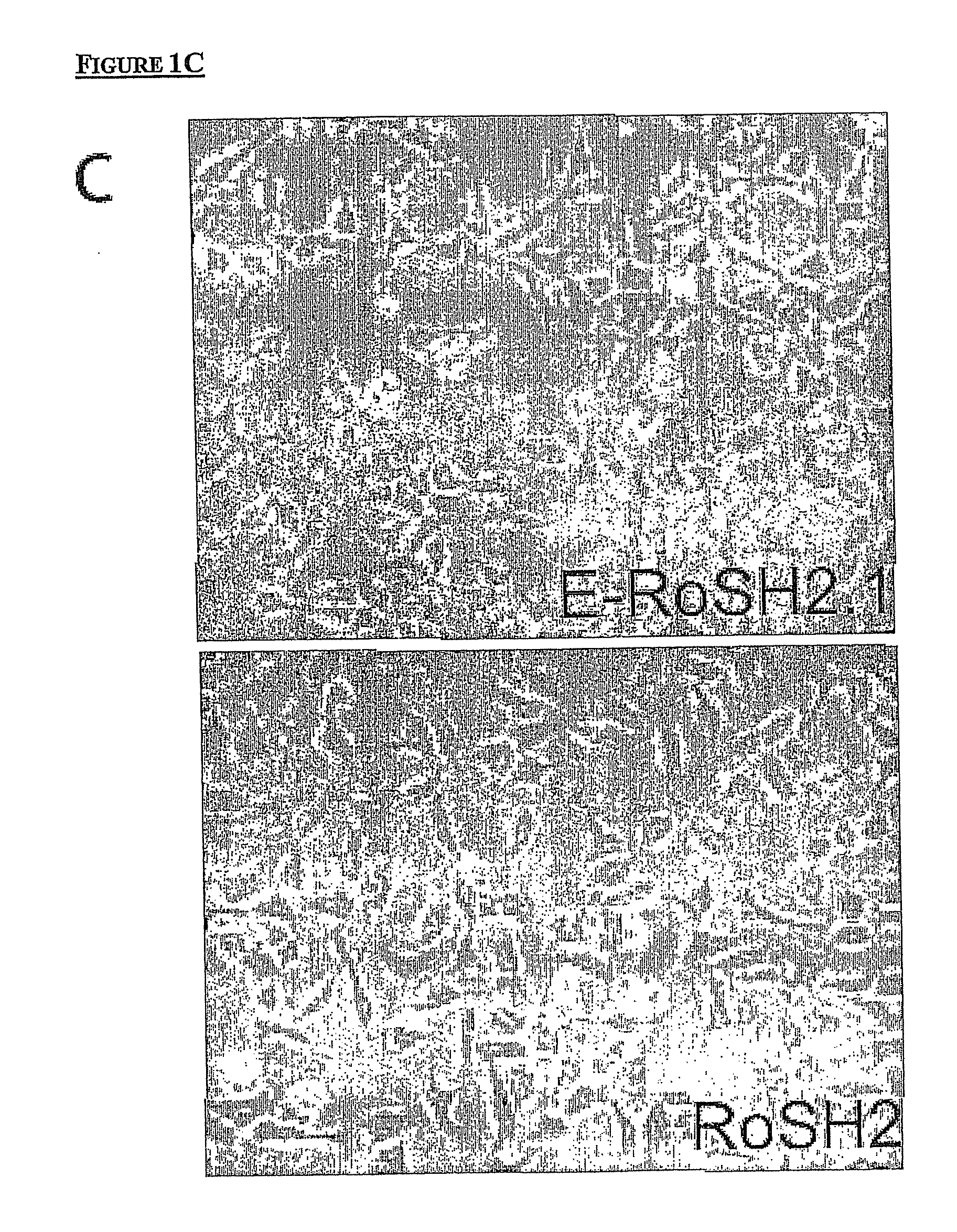
[0206]Colonies of rapidly dividing cells resembling embryo-derived RoSH cells are picked and expanded sequentially to a 48-well plate, 24-well plate, 6-well plate and then a 10 cm plate. The culture from each colony is named E-RoSH1, 2, 3 . . . in the sequence in which each culture is established.

[0207]Each of t...

example 2

Methods: Derivation of HuES9.E Mesenchymal Stem Cell (MSC)-Like Cell Lines

[0209]HuES9 cells are cultured as previously described in Cowan et al, N Engl J Med. 2004; 350:1353-1356.

[0210]To derive HuES9.E MSC-like cells, HuES9 cells are split 1:4 onto gelatinized feeder-free plates in using HuES9 culture media. Confluent cultures are typsinized and split 1:4. Differentiation into adipocytes, and osteocytes is performed as previously described (Barberi et al, PLoS Med. 2005; 2:e161).

[0211]BM MSCs are prepared as previously described in Pittenger et al, Science. 1999; 284:143-147.

[0212]Genomic PCR for mouse- and human-specific repeat sequences are performed as previously described in Que et al, In Vitro Cell Dev Biol Anim. 2004; 40:143-149.

example 3

Methods: RT-PCR Analysis

[0213]Total RNA is prepared using standard protocols and are quantified using, respectively, the RiboGreen RNA Quantification kit and the PicoGreen dsDNA Quantification kit (Molecular Probes, Eugene, Oreg.).

[0214]Quantitative RT-PCR is performed using TaqMan® primers (Applied Biosystems, Foster City, Calif.).

the structure of the environmentally friendly knitted fabric provided by the present invention; figure 2 Flow chart of the yarn wrapping machine for environmentally friendly knitted fabrics and storage devices; image 3 Is the parameter map of the yarn covering machine
Login to View More

PUM

PropertyMeasurementUnit
thicknessaaaaaaaaaa
concentrationaaaaaaaaaa
diameteraaaaaaaaaa
Login to View More

Abstract

We disclose a method comprising: (a) providing an embryonic stem (ES) cell; and (b) establishing a progenitor cell line from the embryonic stem cell; in which the progenitor cell line is selected based on its ability to self-renew. Preferably, the method selects against somatic cells based on their inability to self-renew. Preferably, the progenitor cell line is derived or established in the absence of co-culture, preferably in the absence of feeder cells, which preferably selects against embryonic stem cells. Optionally, the method comprises (d) deriving a differentiated cell from the progenitor cell line.

Description

[0001]Reference is made to U.S. provisional application Ser. No. 60 / 713,992 filed Sep. 2, 2005.[0002]The foregoing application, and each document cited or referenced in each of the present and foregoing applications, including during the prosecution of each of the foregoing application (“application and article cited documents”), and any manufacturer's instructions or catalogues for any products cited or mentioned in each of the foregoing application and articles and in any of the application and article cited documents, are hereby incorporated herein by reference. Furthermore, all documents cited in this text, and all documents cited or reference in documents cited in this text, and any manufacturer's instructions or catalogues for any products cited or mentioned in this text or in any document hereby incorporated into this text, are hereby incorporated herein by reference. Documents incorporated by reference into this text or any teachings therein may be used in the practice of th...

Claims

the structure of the environmentally friendly knitted fabric provided by the present invention; figure 2 Flow chart of the yarn wrapping machine for environmentally friendly knitted fabrics and storage devices; image 3 Is the parameter map of the yarn covering machine
Login to View More

Application Information

Patent Timeline
no application Login to View More
Patent Type & Authority Applications(United States)
IPC IPC(8): A61K35/12C12N5/00C12Q1/02A61P25/28A61P25/16A61P35/00A61P3/10C12N5/0775
CPCC12N2501/115C12N2501/135G01N33/5044C12N5/0662C12Q1/6809C12N2506/02A61P17/00A61P17/02A61P25/16A61P25/28A61P35/00A61P35/02A61P9/00A61P3/10C12N5/0606C12N5/00G01N33/50C12N5/0603C12N2501/734C12N2502/1352
Inventor LIM, SAI KIANGLYE, ELIAS
Owner AGENCY FOR SCI TECH & RES