Devices and Methods for Tissue Engineering

a tissue engineering and fibrous technology, applied in the field of porous fibrous medical implants, can solve the problems of increasing the risk of infection and unnecessary pain and discomfort at the harvest site, raising the risk of infection, and affecting the quality of life of the patient,

a tissue engineering and fibrous technology, applied in the field of porous fibrous medical implants, can solve the problems of increasing the risk of infection and unnecessary pain and discomfort at the harvest site, raising the risk of infection, and affecting the quality of life of the patient,

US20110106272A1Active Publication Date: 2011-05-05NOVUM MEDICAL INC

Image

Smart Image Click on the blue labels to locate them in the text.
Viewing Examples
Smart Image
  • Devices and Methods for Tissue Engineering
  • Devices and Methods for Tissue Engineering
  • Devices and Methods for Tissue Engineering

Examples

Experimental program
Comparison scheme
Effect test

examples

[0083]The following examples are provided to further illustrate and to facilitate the understanding of the disclosure. These specific examples are intended to be illustrative of the disclosure and are not intended to be limiting in an way.

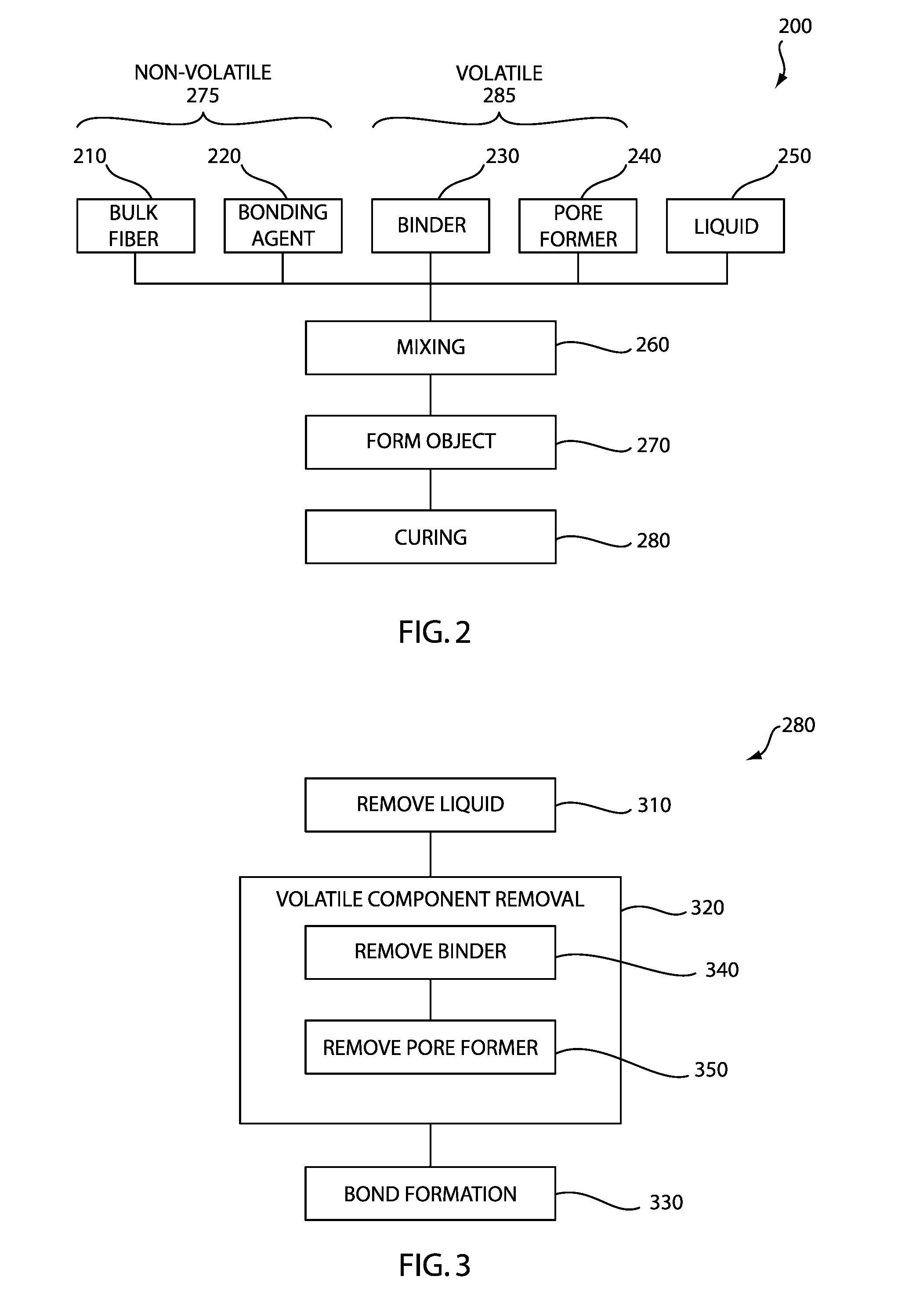
[0084]In a first exemplary embodiment a resorbable scaffold is formed from 13-93 fiber by mixing 75 grams of 13-93 fiber having an average diameter of approximately 34 μm obtained from Mo-Sci Corporation, Rolla, Mo. 65401, in bulk form, as the non-volatile components with 16 grams of HPMC as an organic binder and 20 grams of PMMA with a particle size of 25-30 μm as a pore former and approximately 40 grams of deionized water, adjusted as necessary to provide a plastically formable mixture. The mixture was extruded into a 14 mm diameter rod and dried in a microwave dryer. The volatile components were burned out in an air-purged oven and then heat treated at 720° C. for one hour to bond and fuse the 13-93 fiber into the bioresorbable tissue scaffold. ...

the structure of the environmentally friendly knitted fabric provided by the present invention; figure 2 Flow chart of the yarn wrapping machine for environmentally friendly knitted fabrics and storage devices; image 3 Is the parameter map of the yarn covering machine
Login to View More

PUM

PropertyMeasurementUnit
porosityaaaaaaaaaa
porosityaaaaaaaaaa
pore sizeaaaaaaaaaa
Login to View More

Abstract

A resorbable tissue scaffold fabricated from bioactive glass fiber forms a rigid three-dimensional porous matrix having a bioactive composition. Porosity in the form of interconnected pore space is provided by the space between the bioactive glass fiber in the porous matrix. Strength of the bioresorbable matrix is provided by bioactive glass that fuses and bonds the bioactive glass fiber into the rigid three-dimensional matrix. The resorbable tissue scaffold supports tissue in-growth to provide osteoconductivity as a resorbable tissue scaffold, used for the repair of damaged and / or diseased bone tissue.

Description

CROSS REFERENCE TO RELATED APPLICATIONS[0001]This application claims the benefit of Provisional Application No. 61 / 224,675, filed Jul. 10, 2009 and Provisional Application No. 61 / 234,768, filed Aug. 18, 2009, both of which are incorporated herein by reference.FIELD OF THE INVENTION[0002]The present invention relates generally to the field of porous fibrous medical implants. More specifically, the invention relates to a bioactive fibrous implant having osteostimulative properties in applications of in vivo environments.BACKGROUND OF THE INVENTION[0003]Prosthetic devices are often required for repairing defects in bone tissue in surgical and orthopedic procedures. Prostheses are increasingly required for the replacement or repair of diseased or deteriorated bone tissue in an aging population and to enhance the body's own mechanism to produce rapid healing of musculoskeletal injuries resulting from severe trauma or degenerative disease.[0004]Autografting and allografting procedures hav...

Claims

the structure of the environmentally friendly knitted fabric provided by the present invention; figure 2 Flow chart of the yarn wrapping machine for environmentally friendly knitted fabrics and storage devices; image 3 Is the parameter map of the yarn covering machine
Login to View More

Application Information

Patent Timeline
05 May 2011
Publication
US20110106272A1
IPC
A61F2/28; B29C31/00
CPC
A61F2/28; A61F2/44; A61F2/4465; A61F2002/30062; A61F2002/3092; A61F2002/30968; A61F2002/4495; A61F2210/0004
Inventors
LIU, JAMES JENG