

Planar light source device
- Summary
- Abstract
- Description
- Claims
- Application Information
AI Technical Summary
Benefits of technology
Problems solved by technology
Method used
Image

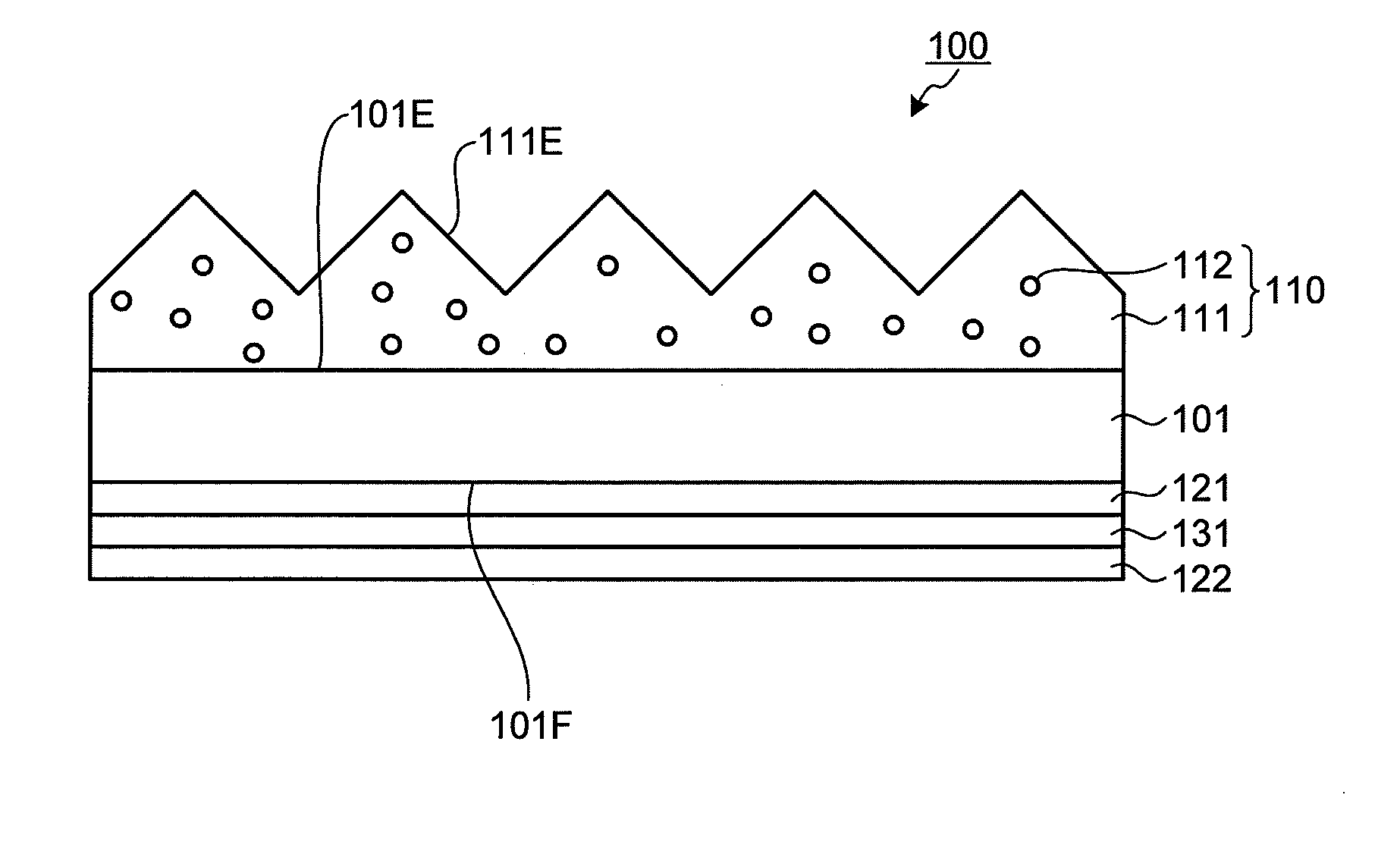
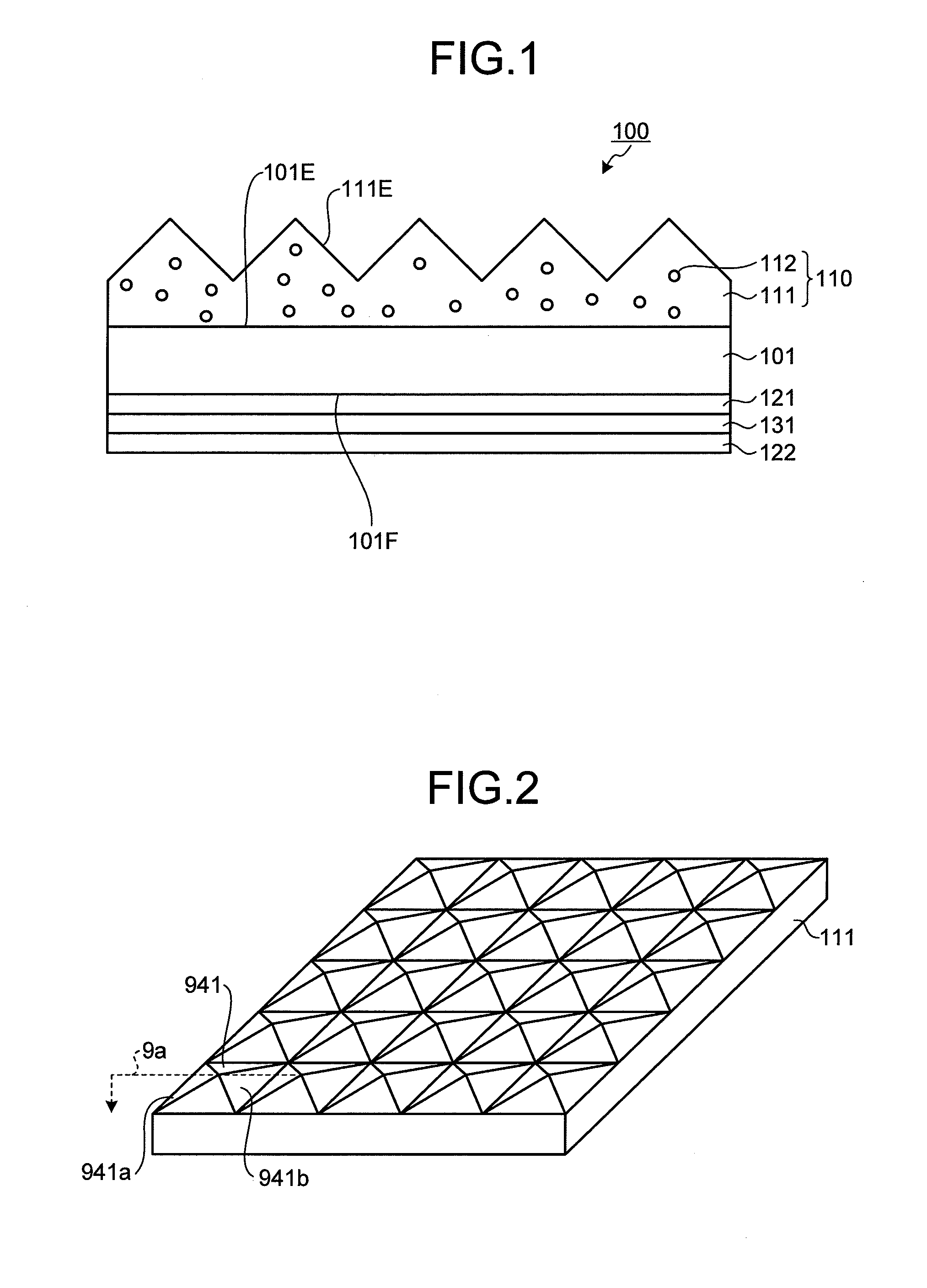
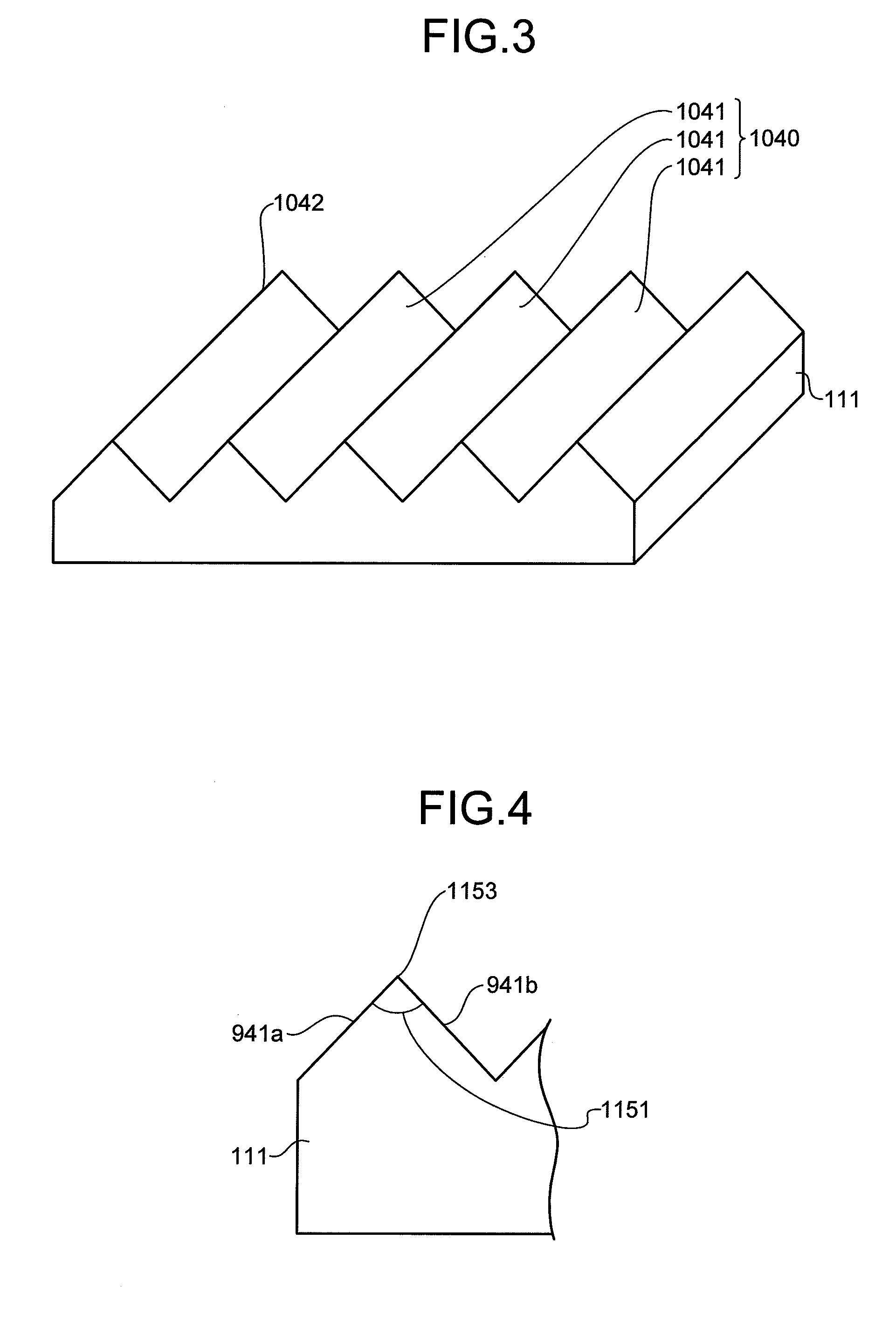
Examples
example 1
[0099]Spherical SiO2 particles (n=1.43) having a diameter of 2 μm were added to a UV (ultraviolet ray) curable urethane acrylic resin (refractive index after curing: n=1.53) in an amount of 3 wt % based on the total amount of the composition. The mixture was stirred to disperse the particles, and a resin composition was thereby obtained.
[0100]The obtained resin composition was applied to a glass substrate to a thickness of 100 μm. Then a metal mold having a predetermined shape was pressed against the resin composition, and the resin composition was irradiated through the glass substrate with UV rays at an accumulated light quantity of 1,000 mJ / cm2 to form a concavo-convex structure layer on the substrate. In this concavo-convex structure, quadrangular pyramids each having a square bottom shape of 50 μm side and a apex angle of 90° were arranged without gaps therebetween. The angle between the light emitting surface and the inclined surfaces of the quadrangular pyramids was 45°. The ...
example 2-1
(2-1-1: Concavo-Convex Structure Layer)
[0121]Spherical SiO2 particles (n=1.43) having a diameter of 2 μm were added to a UV (ultraviolet ray) curable urethane acrylic resin (refractive index after curing: n=1.53) in an amount of 3 wt % based on the total amount of the composition. The mixture was stirred to disperse the particles, and a resin composition was thereby obtained.
[0122]The obtained resin composition was applied to a transparent film (product name “ZEONOR Film,” product of ZEON Corporation, thickness: 180 μm) to a thickness of 100 μm. Then a metal mold having a predetermined shape was pressed against the resin composition, and the resin composition was irradiated through the transparent film with UV rays at an accumulated light quantity of 5,000 mJ / cm2 to form a concavo-convex structure layer on the transparent film, whereby a layered stack having a layer structure of (the transparent film)-(the concavo-convex structure layer) was obtained. In the concavo-convex structure...
example 2-2
(2-2-1: Concavo-Convex Structure Layer)
[0135]A layered stack having a layer structure of (the transparent film)-(the concavo-convex structure layer) was obtained by the same procedure as in (2-1-1) of Example (2-1) except that the shape of the metal mold was changed. In the concavo-convex structure of this concavo-convex structure layer, quadrangular pyramid-shaped recesses each having a square bottom shape of 50 μm side and a apex angle of 90° were arranged without gaps therebetween. The angle between the light emitting surface and the inclined surfaces of the quadrangular pyramids was 45°.
(2-2-2: Planar Light Source Device)
[0136]A planar light source device was produced and evaluated by the same procedure as in (2-1-2) and (2-1-3) in Example (2-1) except that a stack obtained in (2-2-1) was used instead of the stack obtained in (2-1-1). The results are shown in FIG. 15.
PUM
 Login to View More
 Abstract
Description
Claims
Application Information
 Login to View More