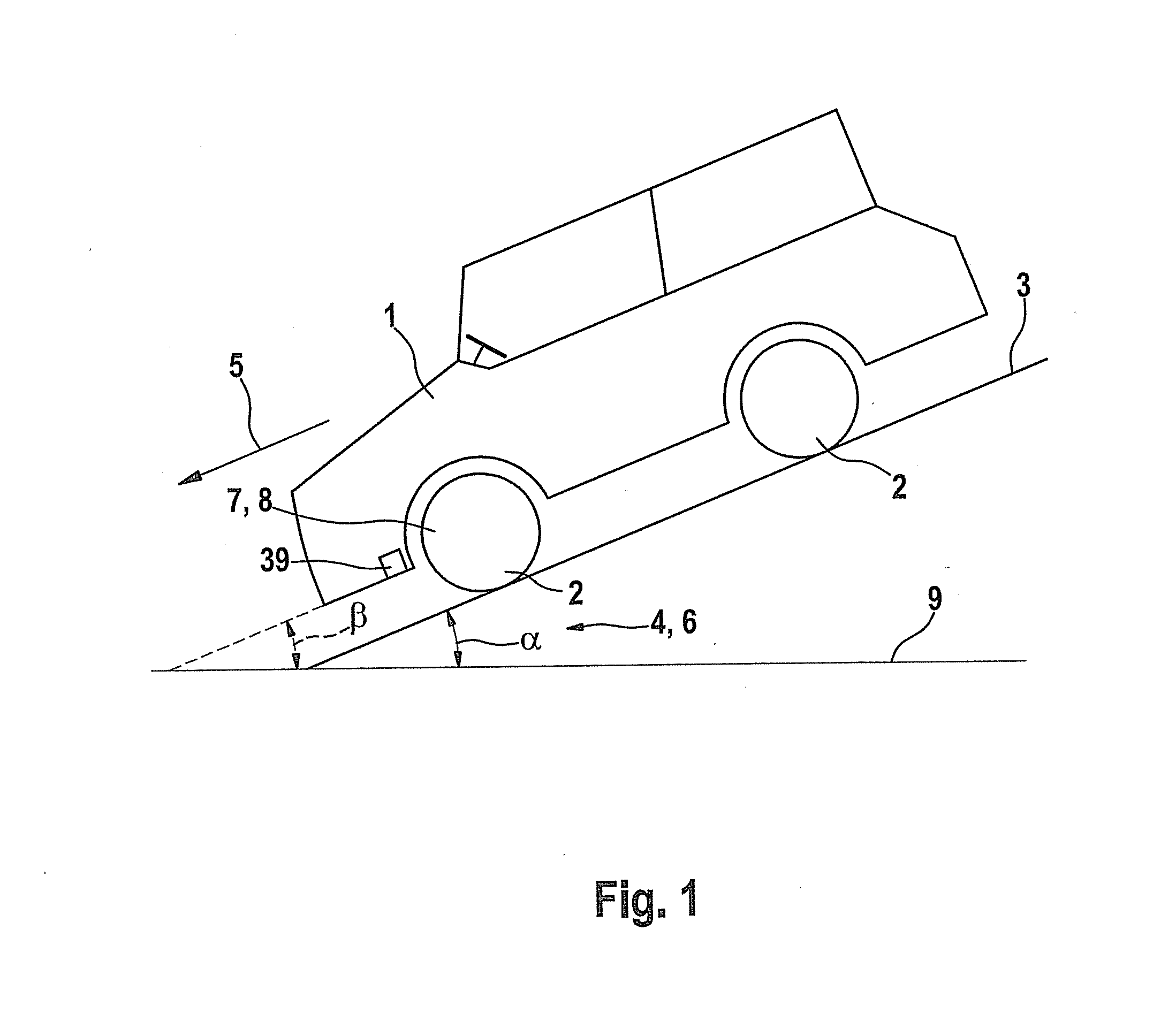
[0004]The method according to the present invention makes possible, in a far more inclusive manner, the secure parking of motor vehicles on a longitudinally inclined roadway, and in doing so, takes into account the different circumstances of the most varied surroundings conditions, in the most inclusive manner.
[0010]For this purpose, the surroundings situation of the motor vehicle is ascertained by at least one sensor. By surroundings situation one should understand, in this instance, the direct surroundings of the motor vehicle, in the widest meaning of the term. For example, one may ascertain whether there are obstacles, for instance, other motor vehicles, in front of, or behind the motor vehicle, particularly in the direction of the longitudinal inclination (downhill gradient). For, when the vehicle starts to roll, the avoidance of which is the purpose of the method, the turned
steering angle is not only supposed to prevent the rolling away of the motor vehicle, but preferably also to prevent the motor vehicle from rolling into an obstacle, such as a motor vehicle parked ahead of it, and damaging it. The wheel angle is always selected, in this instance, in such a way that rolling away of the motor vehicle, especially onto the roadway, is avoided in the same way as an undesired rolling of the motor vehicle into obstacles which could lead to damage.
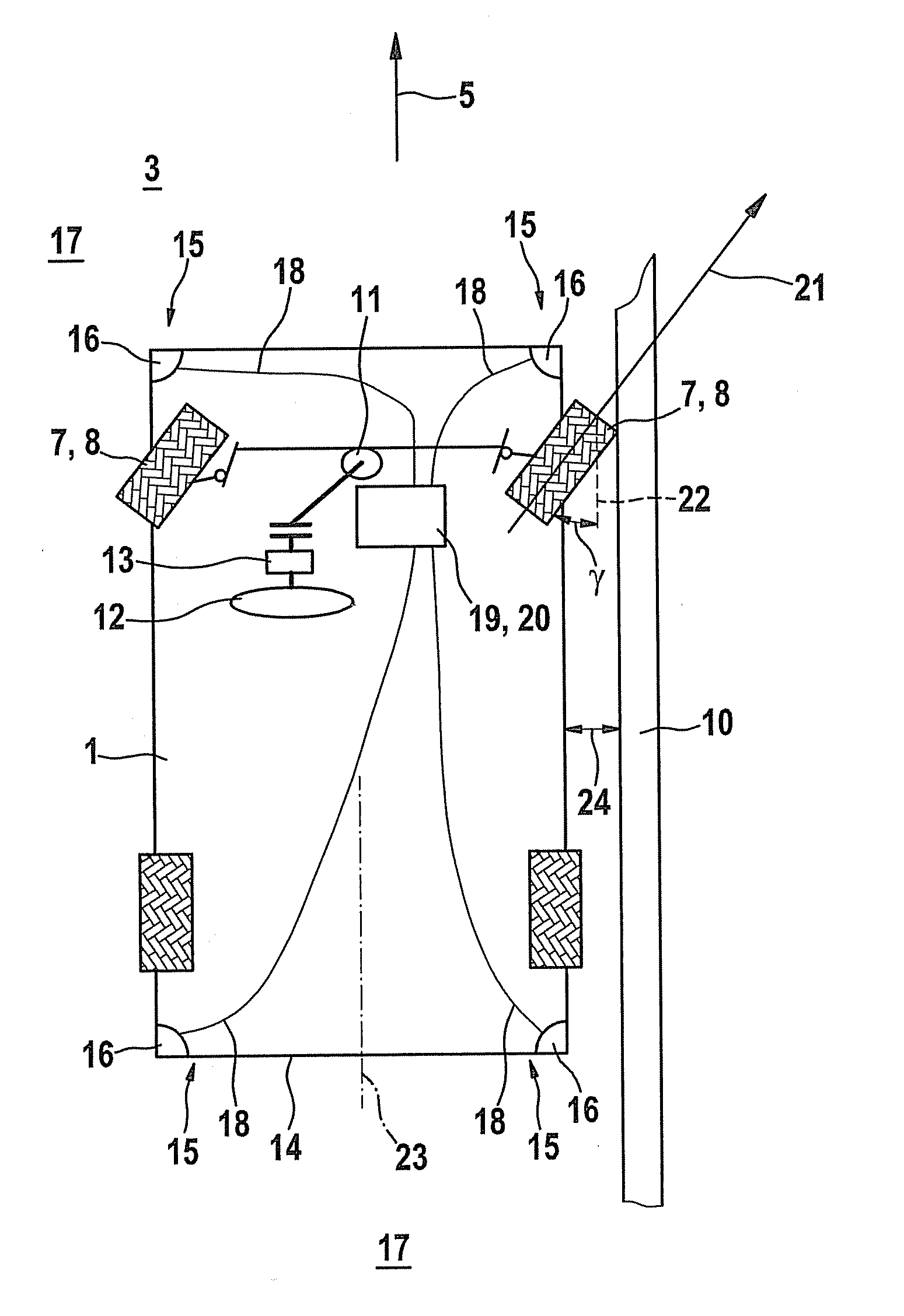
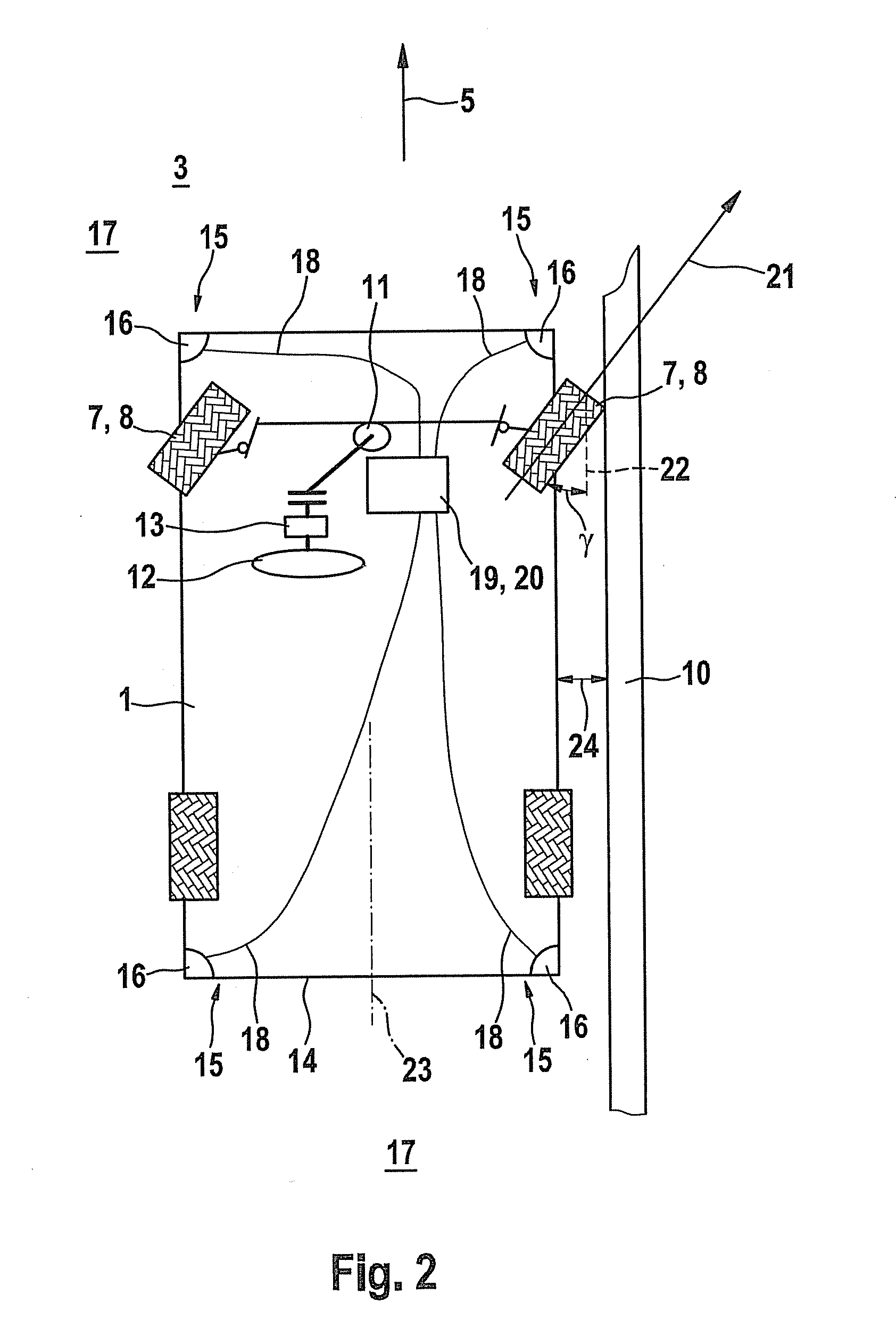
[0014]In a further preferred specific embodiment, while ascertaining the surroundings situation, it is detected what the
diameter is of the wheel of the vehicle facing the curb. As was described before, in that way one is able to ascertain in that manner the wheel angle at which most favorably the rolling over the curb can be avoided, which is used as the path
limiter for the vehicle that may perhaps start to roll. The detection of the wheel
diameter takes place, in this instance, with the aid of the actually mounted wheels, and not from values stored in a table, for example. This is made possible, for example, by clear communication means between the wheel and the motor vehicle, perhaps by contact-giving alignments, message transfer means, such as RFID chips mounted on the wheels and corresponding receivers on the motor vehicle, or other devices making possible unequivocal signaling. In this way it is ensured that the wheel angle, ascertained as being favorable, constantly takes into account the actually given, constructional specifications of the vehicle. In particular, when wheels are changed, for instance, from summer to winter wheels, which frequently have a lower
diameter than summer wheels, the favorable wheel angle is thus ascertained newly and reliably, in an advantageous manner.
[0015]In one additional advantageous specific embodiment, it is detected, during the ascertaining of the surroundings situation, on which side of the vehicle the curb is located. A
safer functioning of the method is thereby even ensured if the vehicle parks counter to the travel direction, and the curb expected by the
system is thus found to be on the other than the usual side of the vehicle, for example, on the left in countries having right-hand traffic or right in countries having left-hand traffic. In a very advantageous manner, one may take into account the actual surroundings of the vehicle, and
safer parking may be ensured even in uncommon parking situations.


 Login to View More
  Login to View More