However, since
communications security comes with both computational and bandwidth related overhead, it is important to reduce these overheads in order to obtain cost-effective implementations.
However, generating and verifying digital signatures consumes a significant amount of the share of the automotive processor.
Additional bandwidth is also consumed when signatures are appended to messages or packets.
To verify whether a message is genuine or bogus consumes computational resources at a given node.
In the
wireless context, it is easy for a malicious entity without access to compromised
keying material to create a bogus message, and inject those messages in the channel leading to a computational denial of service (DoS)
attack.
Unfortunately, digital signatures based on asymmetric
key cryptography are particularly vulnerable to computational DoS attacks.
In the vehicle ad-hoc network (VANET) context, however, these protocols piggyback on a PKI-based digital signature mechanism.
While it is possible to authenticate every outgoing message with a PKI-based digital signature, it may not be feasible to verify the digital signature of every received message at a node.
However, none of these available approaches is completely satisfactory.
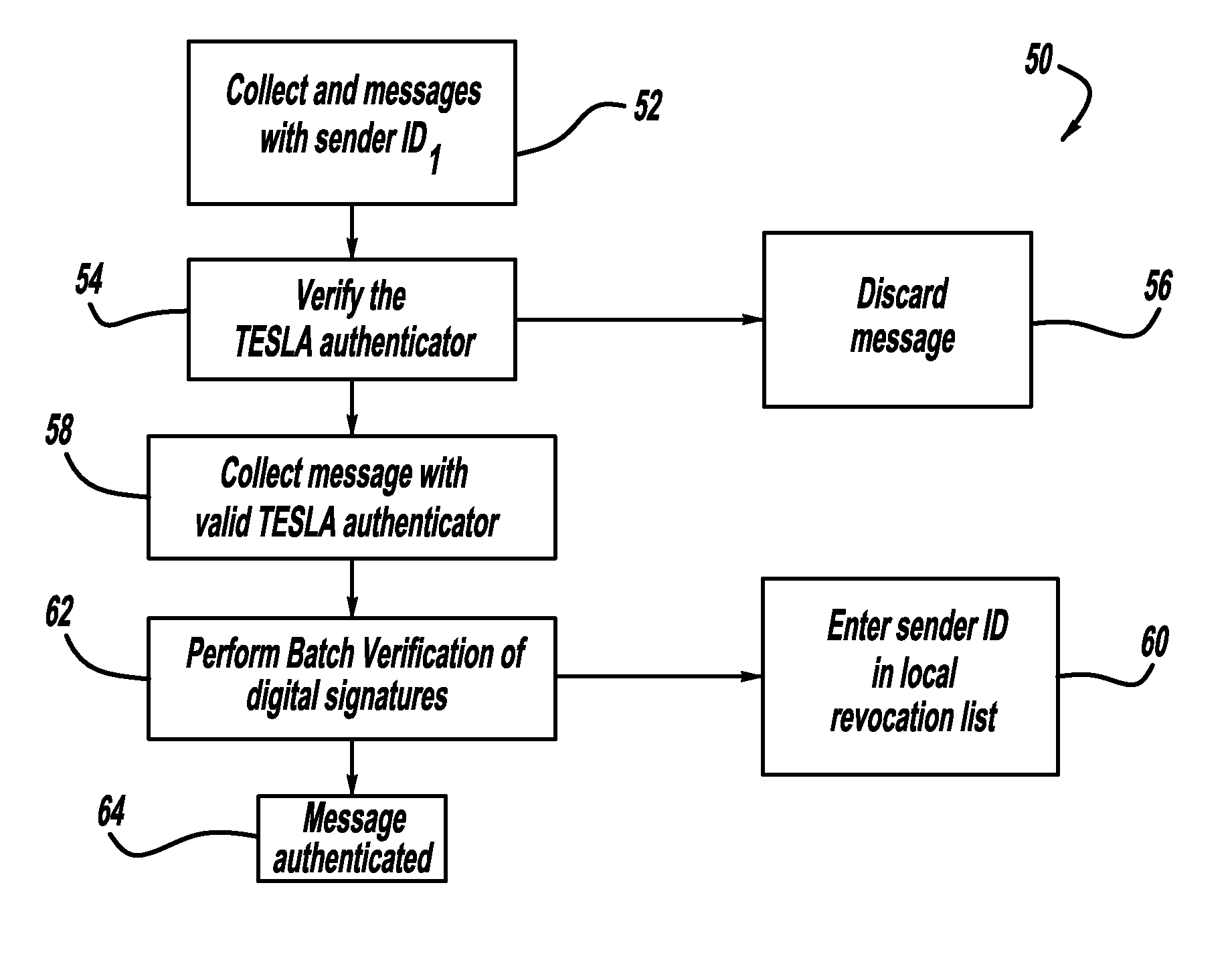
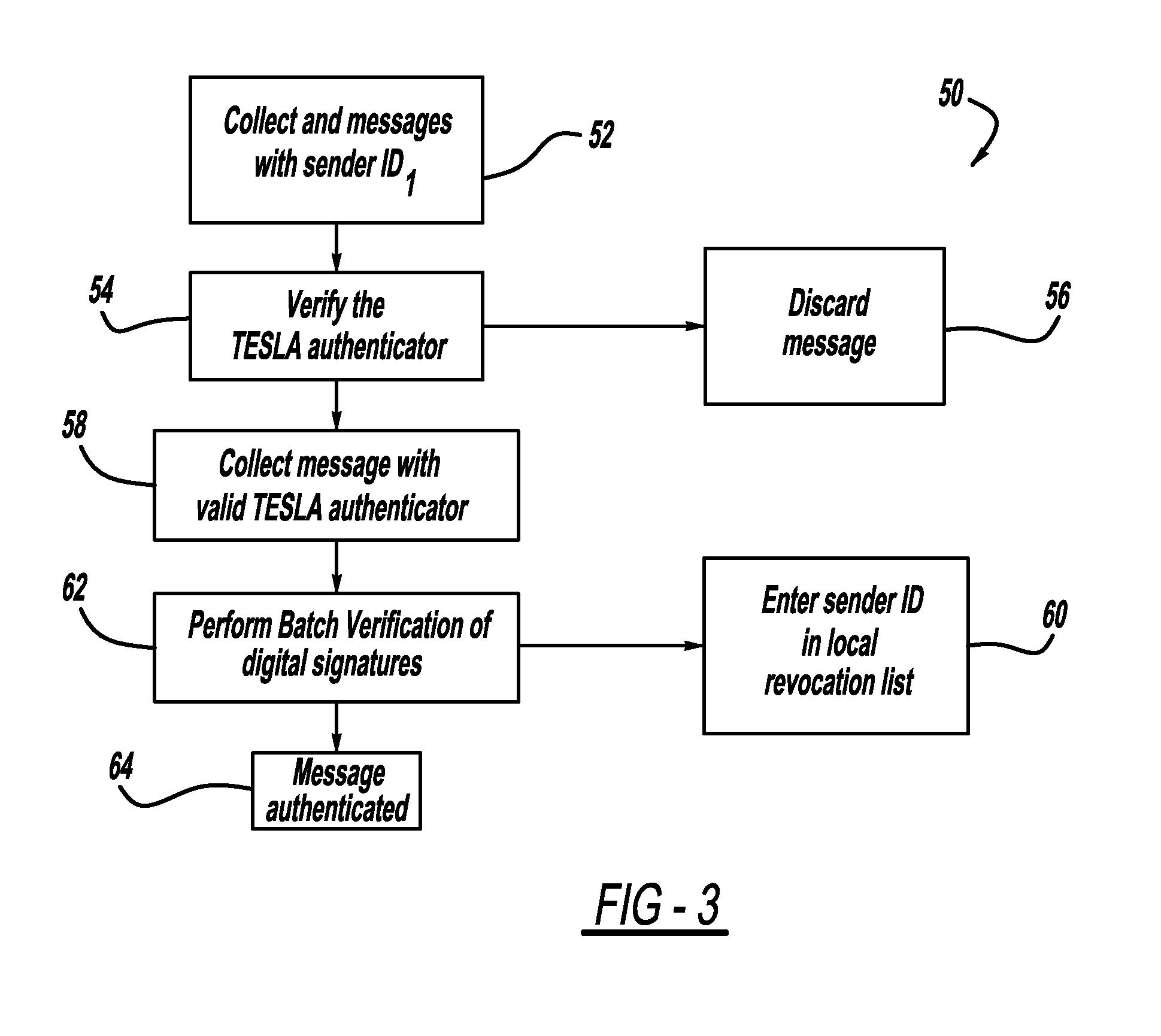
In particular, digital signatures result in high computational overhead, while one-time signatures, such as Merkle-Winternitz signatures, result in high communication overhead, and lightweight protocols, such as TESLA, result in delayed message
authentication.
Further, in one-time signatures, such as the Merkle-Winternitz signature, there is a trade-off between the computational overhead and the communication overhead, both of which increase in proportion with the number of bits being signed.
The
receiver buffers the message without being able to authenticate them, which results in a message verification
delay.
1. Verifies the disclosed key is part of the hash-chain. The disclosed key is then used to verify buffered packers.
2. Determines the interval i in which the packet was transmitted based on the disclosed key in the packet, and an authentic version of the key disclosure schedule.
3. Based on its
current time and a bound on the
clock synchronization error, the
receiver infers the latest possible interval x in which the sender could currently be in.
4. Determines the value of the parameters d in the message. If (x
In addition, TESLA requires
clock synchronization at the nodes, and messages cannot be verified until the corresponding symmetric key is disclosed by the sender.
TESLA does not provide the non-repudiation property.
DSRC channel switching between the
control channel and service channel can also degrade the performance of TESLA.
This verification
delay may be too large for V2X safety applications, such as collision avoidance applications.
The outside attacker can
mount a DoS
attack by sending bogus messages that have a valid format, but an incorrect
authentication tag.


 Login to View More
  Login to View More