Composition Containing Osteopontin for Differentiating Natural Killer Cell as an Active Ingredient and a Method of Differentiation Using Thereof
Inactive Publication Date: 2011-12-15
KOREA RES INST OF BIOSCI & BIOTECH
View PDF0 Cites 1 Cited by
Summary
Abstract
Description
Claims
Application Information
AI Technical Summary
This helps you quickly interpret patents by identifying the three key elements:
Problems solved by technology
Method used
Benefits of technology
Benefits of technology
[0018]Osteopontin (OPN) of the present invention accelerates NK cell differentiation and increases cytotoxic activity thereof. Therefore the said osteopontin can be effectively used as a compo
Problems solved by technology
However, there are no reports saying that osteopontin affects differentiation of natural killer cells.
Method used
the structure of the environmentally friendly knitted fabric provided by the present invention; figure 2 Flow chart of the yarn wrapping machine for environmentally friendly knitted fabrics and storage devices; image 3 Is the parameter map of the yarn covering machine
View more
Image
Smart Image Click on the blue labels to locate them in the text.
Viewing Examples
Smart Image
Click on the blue label to locate the original text in one second.
Reading with bidirectional positioning of images and text.
Smart Image
Examples
Experimental program
Comparison scheme
Effect test
example 1
Separation of Hematopoietic Stem Cells from Bone Marrow Cells
[0079]Bones of lower limbs were obtained from 6-9 week old C57BL / 6 mice (Coretech, Korea), which were grinned using a mortar. The pulverized bone cells were passed through 70 μm cell strainer, and then treated with lysis buffer (Sigma, St. Louse, Mo.) to eliminate erythrocytes. As a result, bone marrow cells were obtained. Already differentiated cells were eliminated from the obtained bone marrow cells and rest of the cells were obtained by negative selection using MACS (magnetic activated cell sorting) (Miltenyi Biotech, Auburn, Calif.). At this time, anti-Mac-1, anti-Gr-1, anti-B220, anti-NK1.1, anti-CD2 and anti-TER-119 (Becton-Dickinson and PharMingen, San Diego, Calif.) antibodies were used. Positive selection was performed to separate CD117+ hematopoietic stem cells (referred as “HSC” hereinafter) from those cells obtained by negative selection by MACS using anti-CD117 antibody.
example 2
Differentiation of NK Cells from HSC
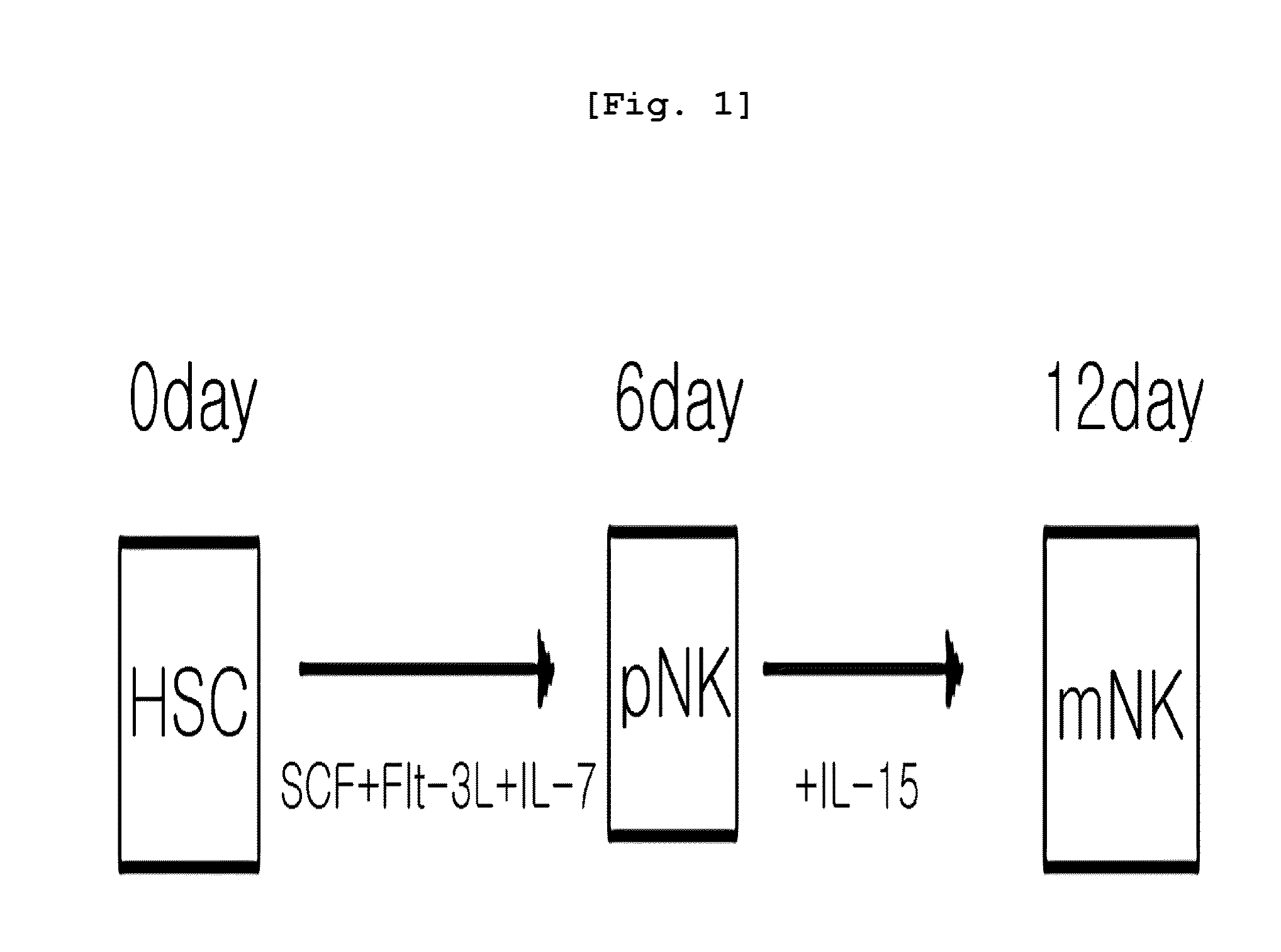
[0080]The CD117+ cells obtained from bone marrow in Example were inoculated in a 24 well plate (1×10⁶ cells / well) (Falcon, USA) containing a medium supplemented with cytokine mouse SCF (30 ng / ml, PeproTech, Rocky Hill, N.J.), mouse Flt3L (50 ng / ml, PeproTech, Rocky Hill, N.J.), mouse IL-7 (5 ng / ml, PeproTech) and antibiotics [indometacin (2 ug / ml, Sigma), gentamycin (20 ug / ml, Sigma)] in a 37° C., 5% CO2 incubator for 7 days. The medium was replaced once three days later. After 7 days of the culture, CD122+ premature NK cells (referred as “pNK cells” hereinafter) were isolated by MACS using FITC labeled CD122 antibody and magnetic bead conjugated anti-FITC antibody.
[0081]For differentiation into mature NK cells, the cells were further cultured in RPMI1640 medium supplemented with cytokine mouse IL-15 (50 ng / ml, PeproTech) which is important factor for NK differentiation and antibiotics [indometacin (2 ug / ml), gentamycin (20 ug / ml)] for 6 more days...
example 3
Preparation of OPN Knock-Out Mouse
[0082]OPN knock-out mice generated by the method described in U.S. Pat. No. 6,414,219 were purchased from Jackson Laboratory, USA.
the structure of the environmentally friendly knitted fabric provided by the present invention; figure 2 Flow chart of the yarn wrapping machine for environmentally friendly knitted fabrics and storage devices; image 3 Is the parameter map of the yarn covering machine
Login to View More
PUM
Property
Measurement
Unit
Cytotoxicity
aaaaa
aaaaa
Login to View More
Abstract
The present invention relates to a composition for differentiating natural killer cells comprising osteopontin (OPN) as an active ingredient and a method for differentiation using the same. More precisely, osteopontin of the present invention accelerates differentiation of natural killer cells from hematopoietic stem cells and increases cytotoxic activity of natural killer cells, so that it can be effectively used as a composition for differentiating natural killer cells. OPN of the present invention regulates differentiation of natural killer cells capable of killing cancer cells, so that it can be effectively used for the treatment of cancer.
Description
TECHNICAL FIELD[0001]The present invention relates to a composition for accelerating differentiation of natural killer cells from stem cells and a method of differentiation using the same, more precisely a composition comprising osteopontin (OPN) as an active ingredient for differentiation of natural killer cells and a method for differentiation of natural killer cells from hematopoietic stem cells using the same.BACKGROUND ART[0002]Natural killer cells (referred as “NK cells” hereinafter) are immune cells differentiated from hematopoietic stem cells in bone marrow. NK cells are able to kill those cells infected by a foreign antigen directly or indirectly by hiring other immune cells by secreting cytokines or chemokines. So, NK cells play a very important role in mediating acquired immune response of natural immune response.[0003]While being differentiated, NK cells express a specific receptor on the cell surface. So, NK cell differentiation can be confirmed by investigating the rec...
Claims
the structure of the environmentally friendly knitted fabric provided by the present invention; figure 2 Flow chart of the yarn wrapping machine for environmentally friendly knitted fabrics and storage devices; image 3 Is the parameter map of the yarn covering machine
Login to View More
Application Information
Patent Timeline
Application Date:The date an application was filed.
Publication Date:The date a patent or application was officially published.
First Publication Date:The earliest publication date of a patent with the same application number.
Issue Date:Publication date of the patent grant document.
PCT Entry Date:The Entry date of PCT National Phase.
Estimated Expiry Date:The statutory expiry date of a patent right according to the Patent Law, and it is the longest term of protection that the patent right can achieve without the termination of the patent right due to other reasons(Term extension factor has been taken into account ).
Invalid Date:Actual expiry date is based on effective date or publication date of legal transaction data of invalid patent.



 Login to View More