[0006]The object of the invention is therefore to provide an apparatus for monitoring a door with a 3D sensor, which apparatus improves the mounting and / or installation convenience in comparison with the prior art with reasonable costs.
[0007]The aim of the invention is to develop a universal monitoring sensor for automatic doors (revolving doors and double doors). In this case, the area to be monitored is intended to be easily and quickly adapted to the corresponding application and mounting position. The use of the TOF (Time-of-Flight) principle makes it possible to determine the distance of an object in the monitoring area as the third dimension. This makes it possible not only to monitor a precisely defined area but to set the sensor to a precisely defined monitoring volume using knowledge of the ambient conditions of the sensor. In this case, the sensor preferably consists of a compact unit which simultaneously comprises a
transmitter and a
receiver. In the first step, the scene to be monitored is illuminated using LEDs, for example. The emitted light is reflected and passes back into the sensor where it is detected using the receiving unit. The receiving part consists of a TOF
chip with a plurality of pixels. Each pixel may receive a measurement beam reflected by an object. Modulated IR light is used for example. In order to determine the distance, a phase shift between the received
signal and the emitted
signal may be evaluated. The corresponding evaluation results in a distance value for each pixel, thus achieving a three-dimensional / volume-related capture image. The
optics are designed in such a manner that the illumination remains focused in individual discrete beams, which results in corresponding spots with a high
light intensity.
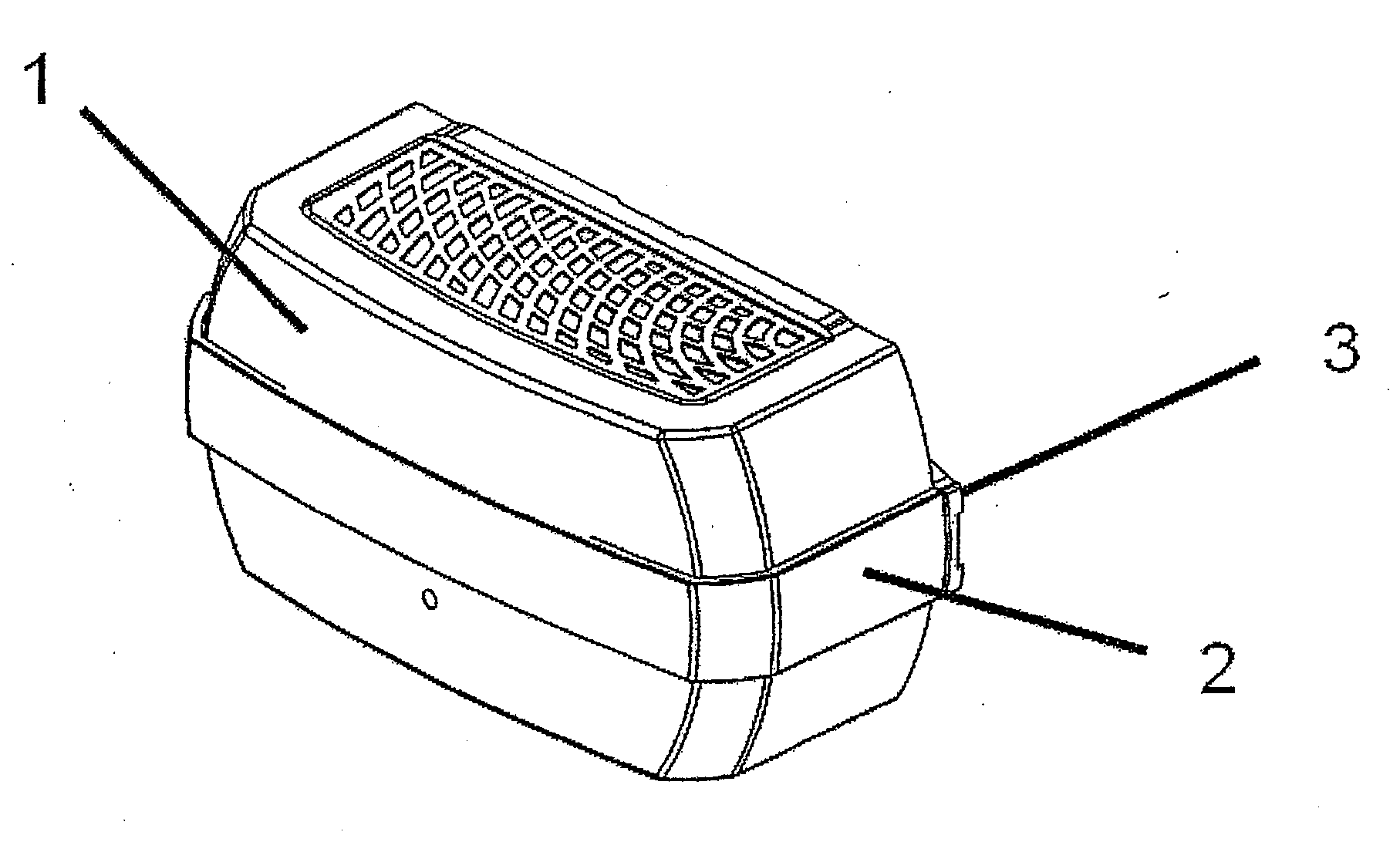
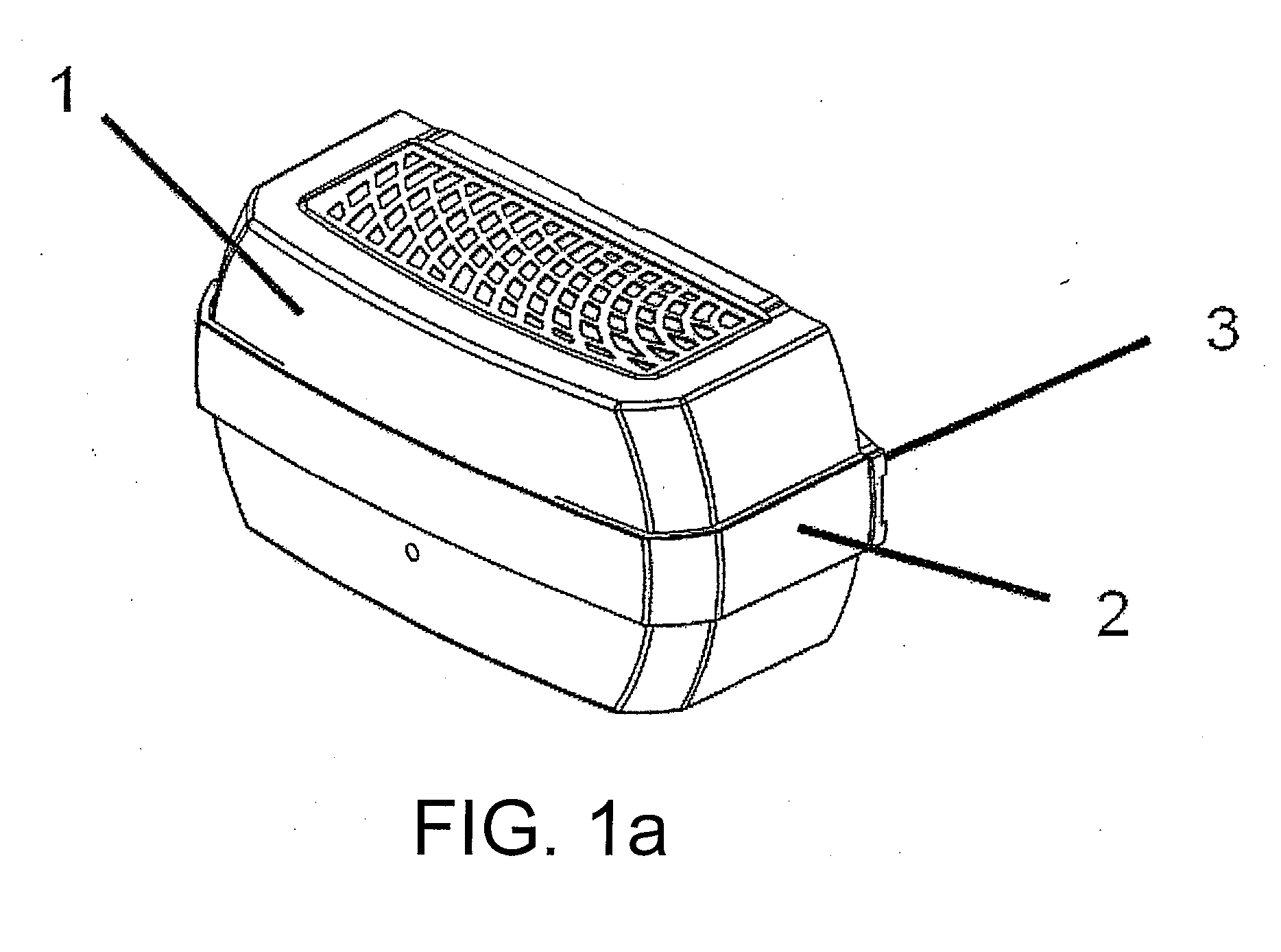
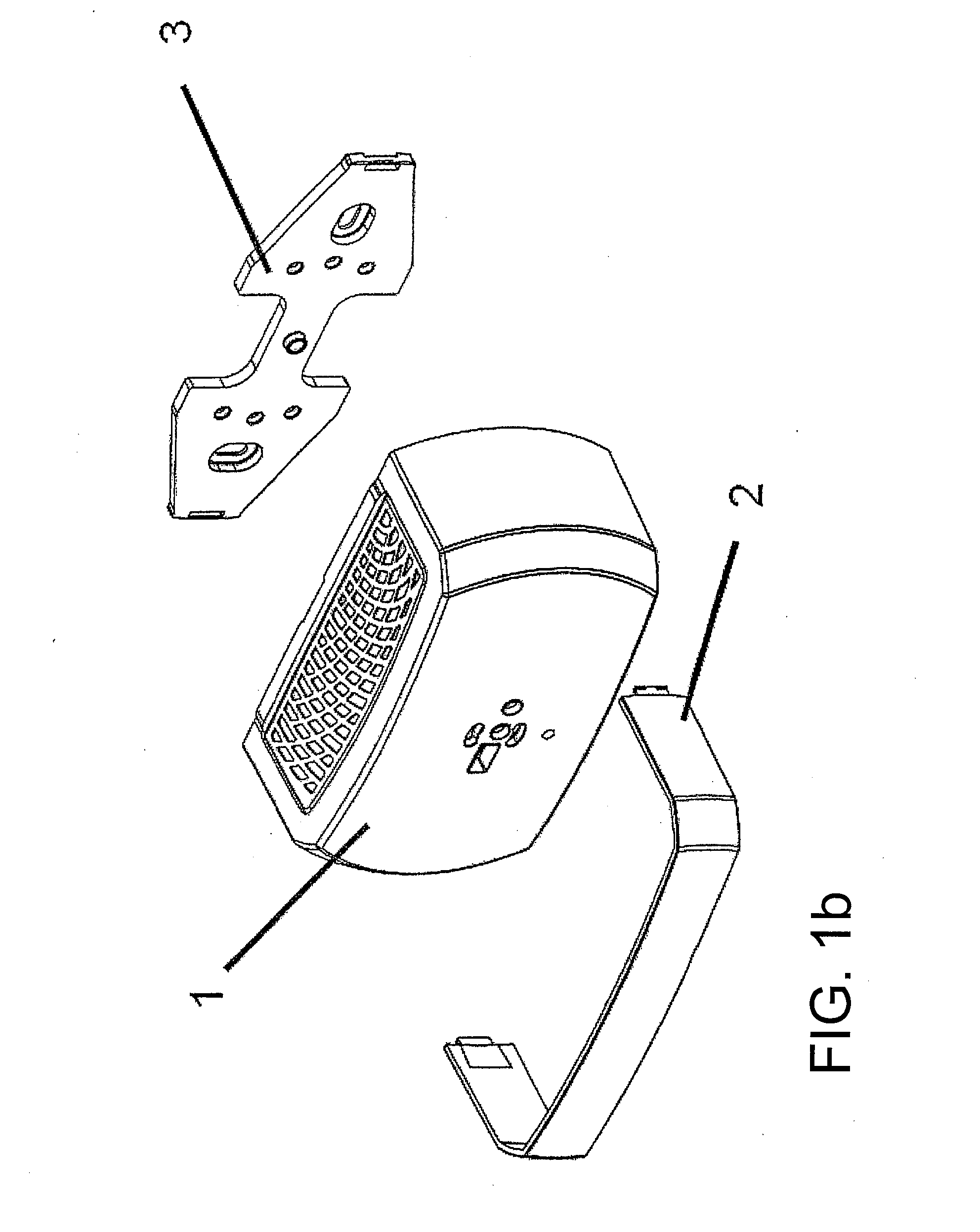
[0009]In an apparatus for monitoring a door with a 3D sensor which is able to detect distances to an object in the monitoring area as the third dimension, the 3D sensor being arranged in a housing, and immovably arranged transmission means for transmitting a measurement beam and
receiver means for receiving the reflected measurement beam being provided in the housing, one aspect of the invention is that provision is made of a
control unit which is designed to obtain information relating to the position of the apparatus, and the control unit evaluates the measurement beam on the basis of an item of position information. As a result, the mounting of a monitoring apparatus can be simplified and can be made more reliable. This is because, with an item of position information, the apparatus can unambiguously assign measurement beams detected after mounting to the environment and can thus also correctly evaluate said beams. In addition, it is possible for the apparatus to align itself as it were after mounting. For example, the control unit is designed to determine a mounting height of the apparatus after mounting by evaluating the measurement beam on the basis of the item of position information. It is thus no longer necessary to input a mounting height in order to calibrate the apparatus.
[0010]In one preferred refinement of the invention, the control unit is also designed to use a height of the mounting location as a parameter for defining the monitoring area. In order to be able to completely define the monitoring area, it is then only still necessary to specify the width of the monitoring area in the case of conventional double doors. Mounting and input errors can thus be minimized.
[0014]The practice of specifying a basic position and at least two further mounting positions, which are in the form of defined positions, makes it considerably easier for an installer to
mount and orient a corresponding 3D sensor, as a result of which positioning errors and
resultant malfunctions are avoided.
[0017]In order to achieve a
high resolution of the 3D sensor, it is also proposed that the 3D sensor in a housing comprises a receiver array and / or a
sensor array. A receiver array makes it possible to evaluate a large number of measurement beams, in particular at the same time, in which case a
transmitter array can be used to scan a comparatively large area, in particular with a plurality of measurement beams.


 Login to View More
  Login to View More