Check patentability & draft patents in minutes with Patsnap Eureka AI!

Method and system of data input for an electronic device equipped with a touch screen

a technology of electronic devices and touch screens, applied in the field of computer data input, can solve the problems of increasing the cost of devices, unable to determine the means of initiating the contact, and generally limited input detection,

Inactive Publication Date: 2013-10-03
ADONIT
View PDF11 Cites 189 Cited by
  • Summary
  • Abstract
  • Description
  • Claims
  • Application Information

AI Technical Summary

Benefits of technology

The patent describes a system and method for selectively filtering input from a stylus on a touchscreen-equipped device. The system receives signals from the stylus and matches them with touch events from the existing touchscreen hardware. A queue of touch events is created and then a set of touch events is selected based on their type and timing. This set of touch events is then associated with a specific touch identifier. The technical effect is that the system can accurately track input from the stylus and offer improved precision and efficiency in interpreting touch events.

Problems solved by technology

However, touch screens register input from simple screen surface contact or capacitive flux sensing only, with variations in input detection generally limited to initial contact and sliding contact.
Furthermore, the means of initiating the contact, such as by fingertip, by stylus, or by other means, cannot be determined; for example, using a touchscreen outdoors during a rainstorm can result in random “touches” from large-enough raindrops or the puddles they form.
Lastly, capacitive touch screens do not actually detect contact, they detect the capacitance of any large-enough conductive objects that are near the screen; bringing a finger close to a touchscreen can generate an event even when the user is hesitating about, for example, clicking on a “buy it now” button.
Hardware solutions raise the cost of devices.
High-resolution touchscreens are available, but are expensive; raising the gain of lower-resolution capacitive sensing devices increases noise and hence false detection of contacts, in addition to draining batteries much more quickly.
As a consequence, users are forced to use awkward holding methods to avoid inadvertent contact with the touchscreen that would otherwise result in unwanted input, or else the users must deal with unwanted input that occurs from touching the touchscreen with their palms and fingers.
The rejection of unwanted input is sometimes referred to as the “palm rejection” problem, where resting the palm of the hand on the touchscreen or gripping the touchscreen device with fingers touching the touchscreen, while using a finger or a stylus to generate a desired input, causes the device also to register inadvertent undesired input from the hand contact.
One solution would be to require the use of a special input tool at all times, but this lacks flexibility and impairs convenience for the user, and may increase manufacturing costs in order to create touchscreen hardware that would detect the difference between the tool's touch and a finger / palm / other non-tool touch.
Moreover, not all such contacts are unwanted; a user may choose to switch between the use of a stylus for precision and a finger for convenience, even while using the same application, for example when switching between drawing a sketch (stylus) and touching menu controls (finger); and yet a user may need to stabilize a hand against the device touchscreen, for example when in a moving vehicle on a bumpy road, in order to use a stylus with sufficient precision to generate desired input, for example when using a stylus to select a position for input into a map application.
Because of these conflicting user needs, the problem of palm rejection is a difficult one.

Method used

the structure of the environmentally friendly knitted fabric provided by the present invention; figure 2 Flow chart of the yarn wrapping machine for environmentally friendly knitted fabrics and storage devices; image 3 Is the parameter map of the yarn covering machine
View more

Image

Smart Image Click on the blue labels to locate them in the text.
Viewing Examples
Smart Image
  • Method and system of data input for an electronic device equipped with a touch screen
  • Method and system of data input for an electronic device equipped with a touch screen
  • Method and system of data input for an electronic device equipped with a touch screen

Examples

Experimental program
Comparison scheme
Effect test

Embodiment Construction

[0026]The following detailed description of embodiments of the invention references the accompanying drawings that form a part hereof, and in which is shown by way of illustration specific embodiments in which the invention may be practiced. The embodiments are described in sufficient detail to enable those skilled in the art to practice the invention, and it is to be understood that other embodiments may be utilized and that logical changes may be made without departing from the spirit and scope of the present invention. The following detailed description is, therefore, not to be taken in a limiting sense, and the scope of the present invention is defined solely by the appended claims.

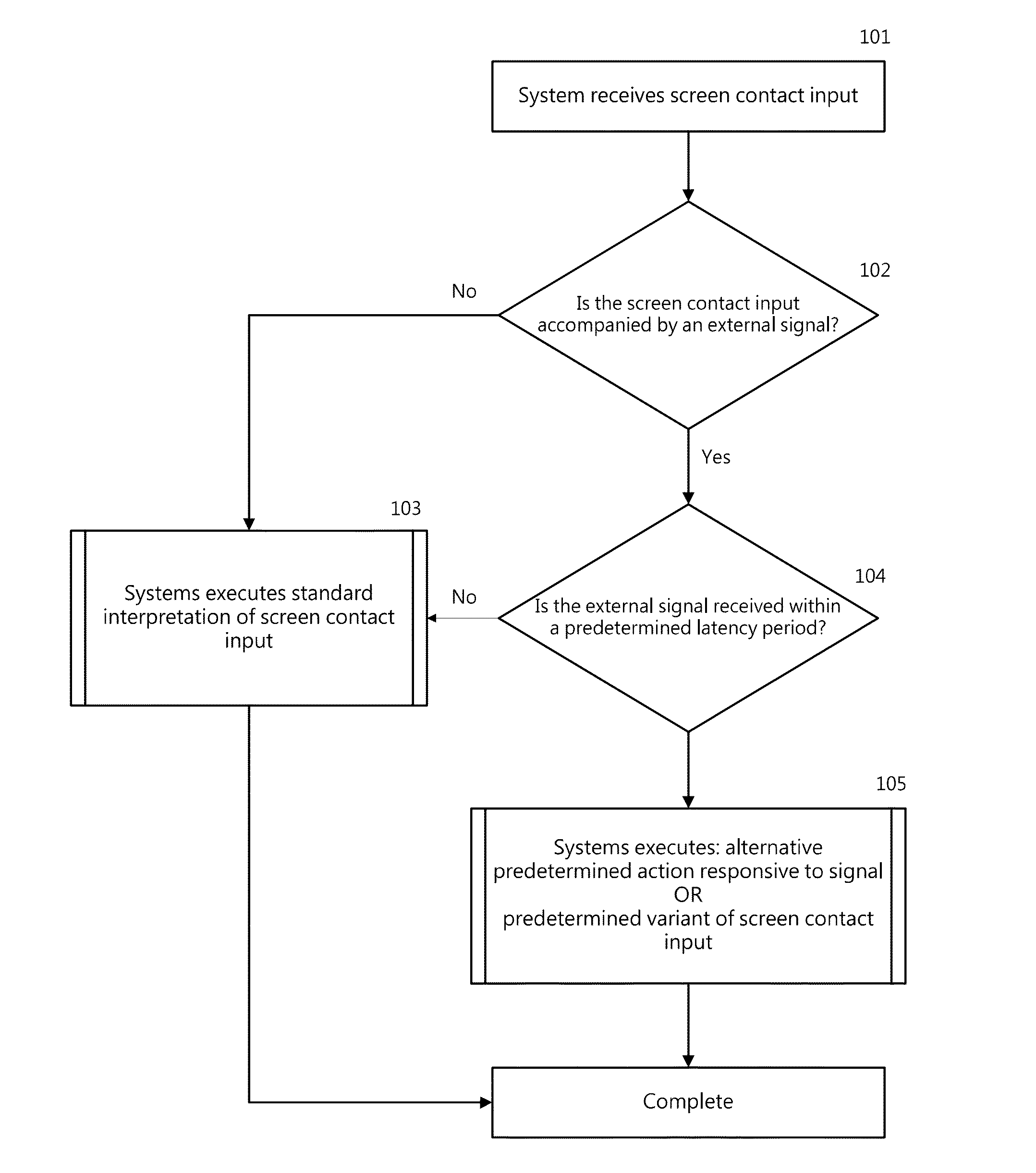
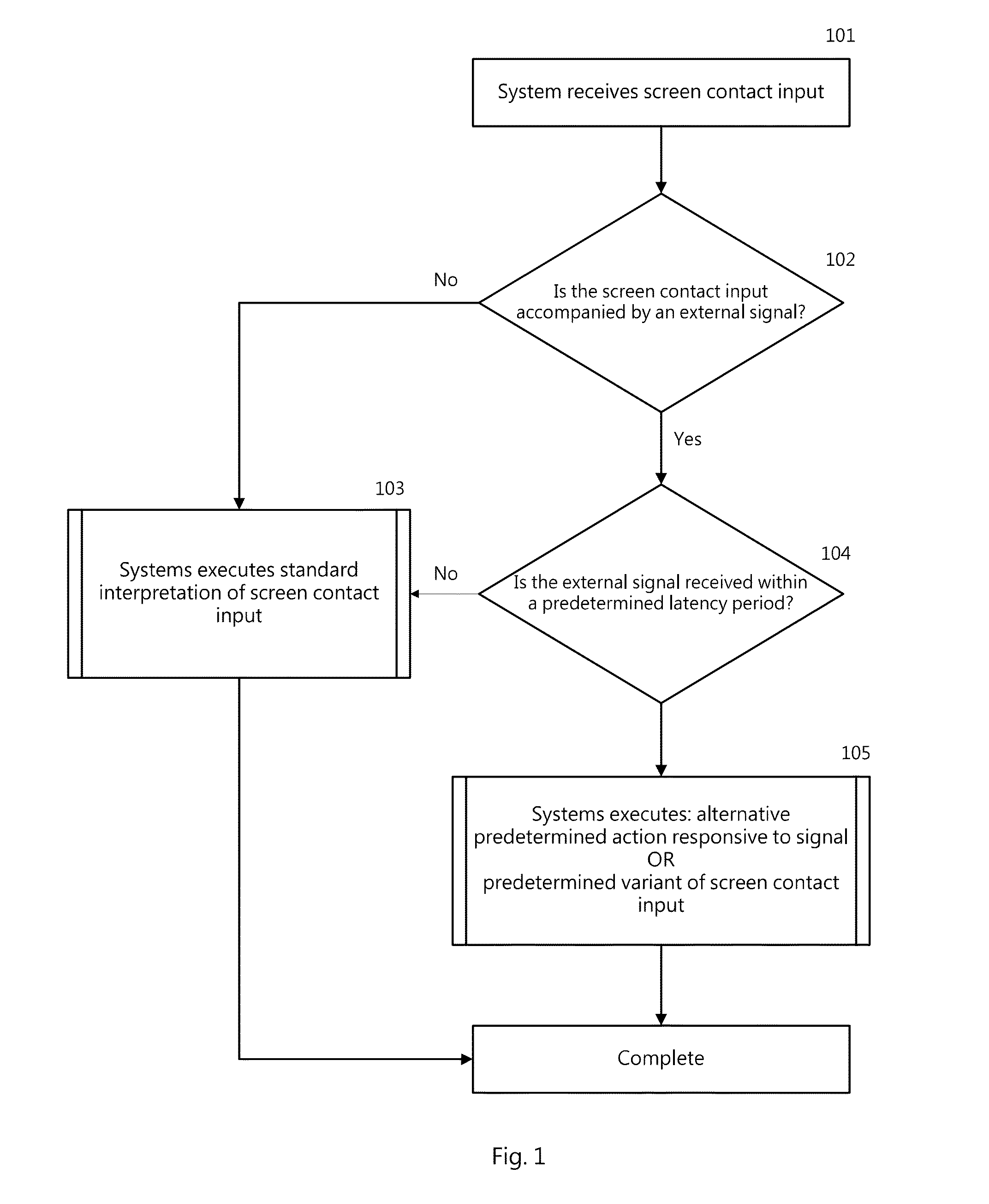
[0027]As shown in FIG. 1, a flowchart illustrating a method of data input for an electronic device equipped with a touch screen is disclosed. In step 101, a screen touch start input is received. In step 102, an application installed on the electronic device equipped with a touch screen determines if t...

the structure of the environmentally friendly knitted fabric provided by the present invention; figure 2 Flow chart of the yarn wrapping machine for environmentally friendly knitted fabrics and storage devices; image 3 Is the parameter map of the yarn covering machine
Login to View More

PUM

No PUM Login to View More

Abstract

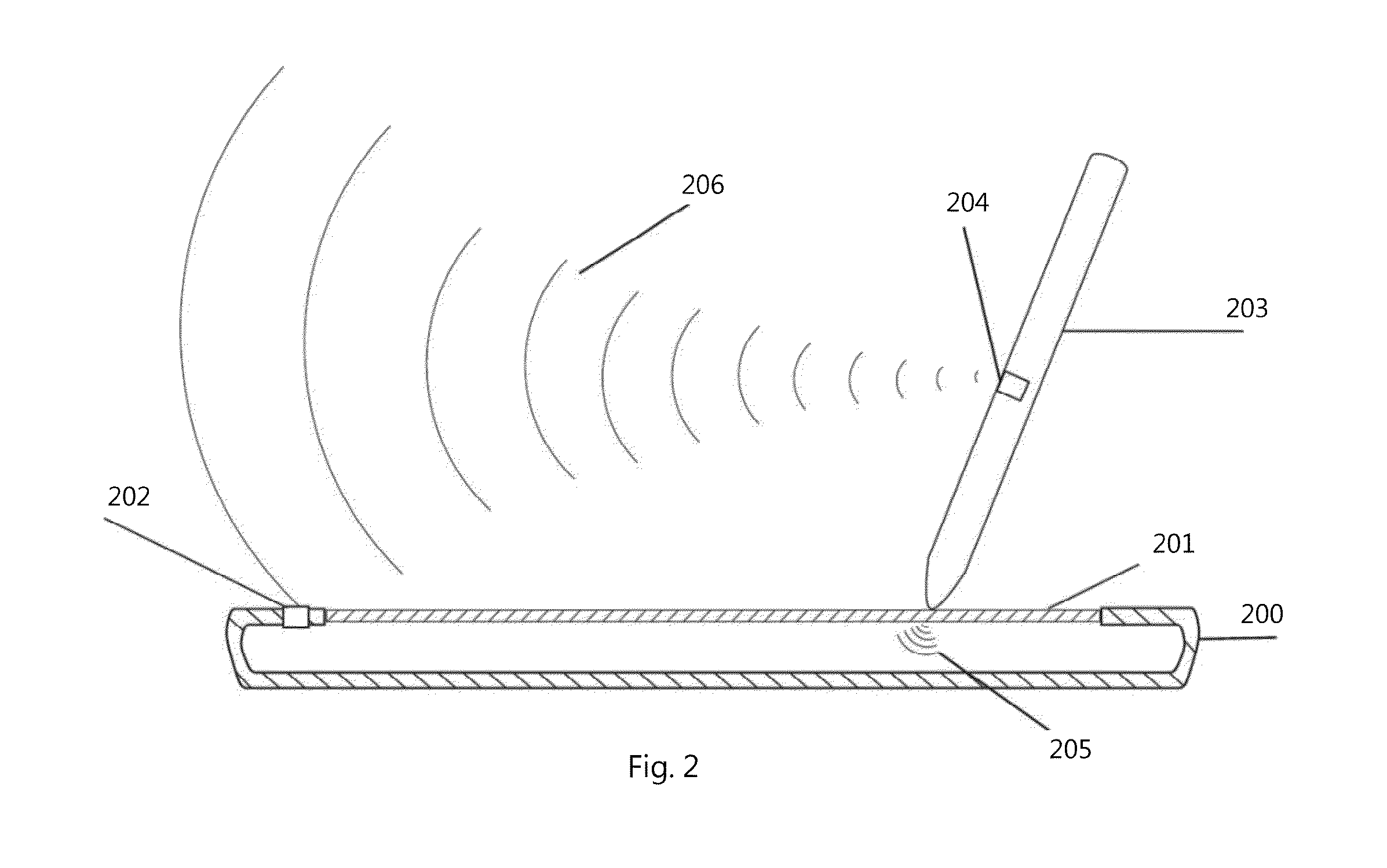
Systems and methods are disclosed for differentiating between stylus touches and non-stylus touches on a touchscreen device. A stylus emits a signal, received by the touchscreen device, and software selects a touch, the touch start event for which occurred near the time of the signal, and the size and location of which best fit filters, as being the touch made by the stylus. The software associates that touch with the stylus until the touch ends, or until the stylus emits a signal indicating that contact has ended. The signal may be mechanically generated audio, such as from the stylus contacting the screen, or electronic (audio, RF, IR), generated by the stylus upon detecting pressure or capacitive flux. The methods and systems allow software to perform palm rejection filtering, to track one stylus or multiple styluses, and to ignore touches triggered by dirt, rain, and other environmental causes.

Description

CROSS-REFERENCES TO RELATED APPLICATIONS[0001]This application claims the benefit of priority to U.S. provisional patent application No. 61 / 615908, filed Mar. 27, 2012, and entitled “METHOD AND SYSTEM OF DATA INPUT FOR A DEVICE EQUIPPED WITH A TOUCH SCREEN”, the disclosure of which is hereby incorporated by reference in its entirety.BACKGROUND OF THE INVENTION[0002]1. Field of the Disclosure[0003]The disclosure relates to computer data input, and more specifically, to a method and system of data input for an electronic device equipped with a touch screen.[0004]2. Description of the Related Art[0005]With recent innovations in functionality and application development, touch screens are experiencing a dramatic surge in popularity for electronic device input.[0006]Compared to conventional input, such as a keyboard and / or a pointing device, touch screens provide a considerable improvement in convenience; no external devices or bulky real-estate-hogging components are required, since the...

Claims

the structure of the environmentally friendly knitted fabric provided by the present invention; figure 2 Flow chart of the yarn wrapping machine for environmentally friendly knitted fabrics and storage devices; image 3 Is the parameter map of the yarn covering machine
Login to View More

Application Information

Patent Timeline
no application Login to View More
IPC IPC(8): G06F3/044G06F3/033G06F3/041
CPCG06F3/0416G06F3/044G06F3/0447G06F3/03545G06F3/03547G06F3/041G06F2203/04104G06F2203/04105G06F2203/04808
Inventor ZELIFF, ZACHARY JOSEPHLI, YUEH-HUALOKERS, NATEPERPICH, KRIS
Owner ADONIT
Features
  • R&D
  • Intellectual Property
  • Life Sciences
  • Materials
  • Tech Scout
Why Patsnap Eureka
  • Unparalleled Data Quality
  • Higher Quality Content
  • 60% Fewer Hallucinations
Social media
Patsnap Eureka Blog
Learn More