
Pneumatic tire for heavy load
- Summary
- Abstract
- Description
- Claims
- Application Information
AI Technical Summary
Benefits of technology
Problems solved by technology
Method used
Image

Examples
example 1
[0070]Next, the results of a performance assessment of sample pneumatic tires according to the present invention are described. The size of each sample tire was 27.00 R49.
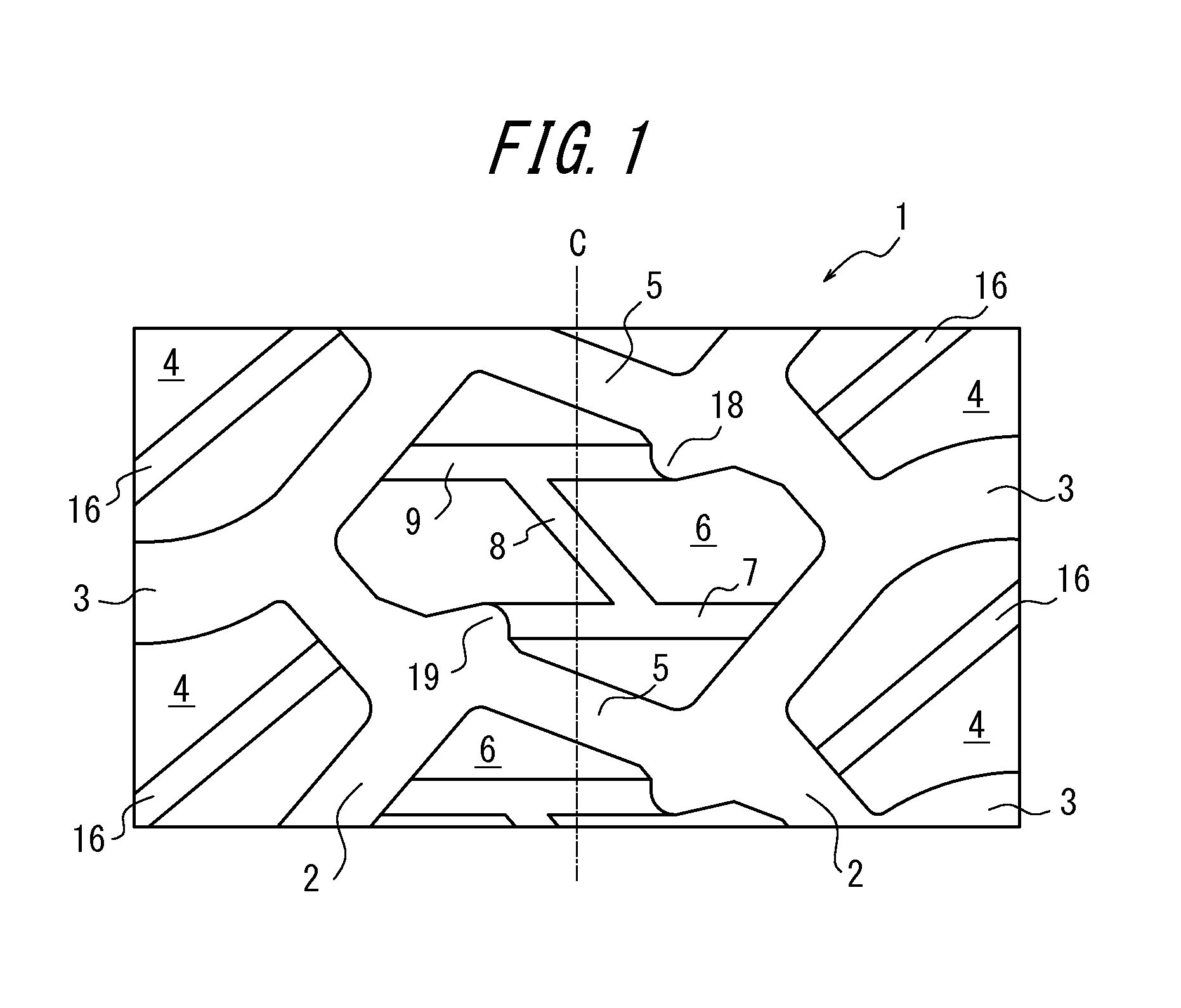
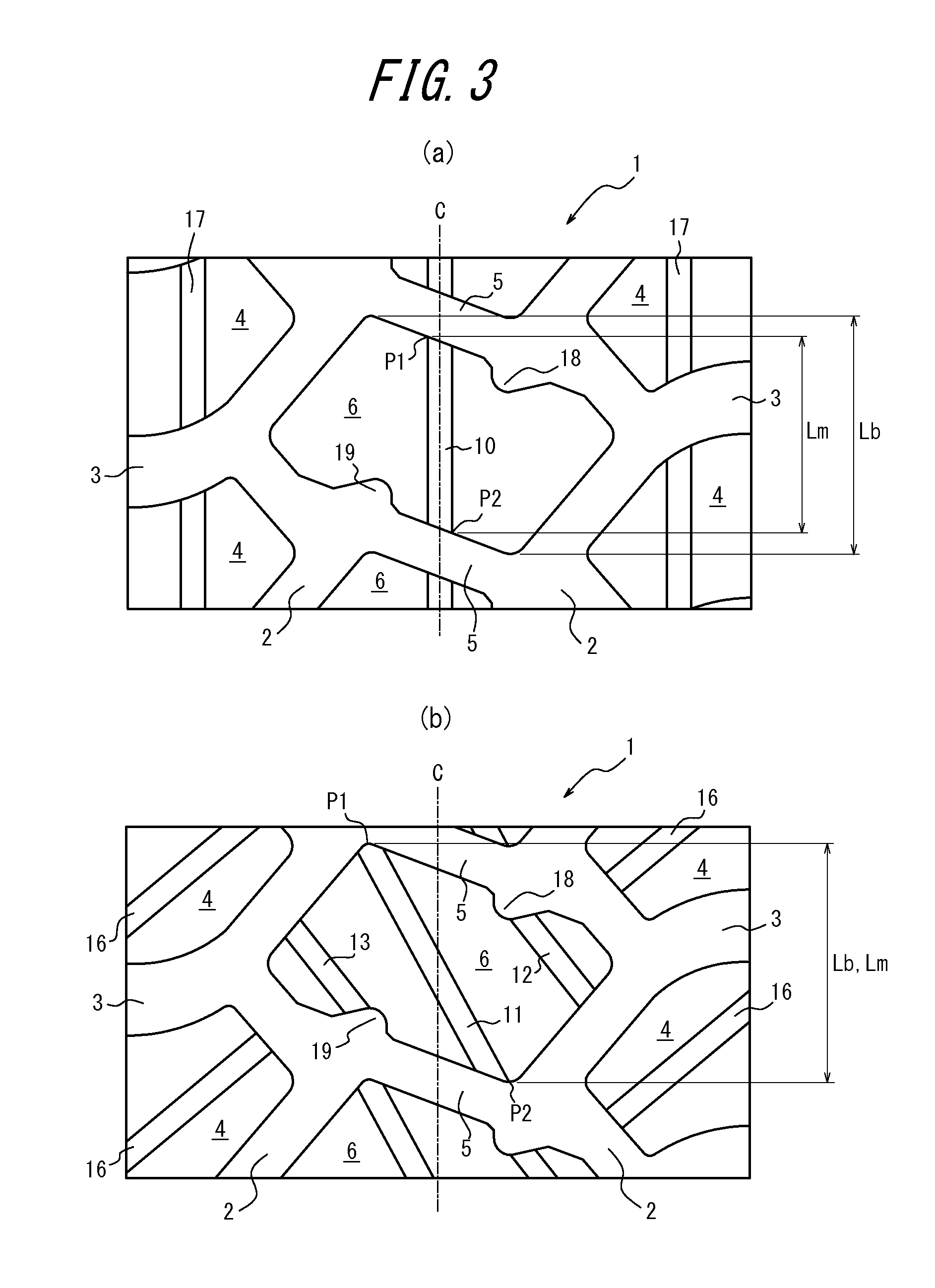
[0071]Example Tires 1-10 had the patterns illustrated in FIG. 3(a), FIG. 7, FIG. 8, FIG. 4(b), FIG. 4(a), FIG. 3(b), FIG. 1, and FIG. 5. The Comparative Tire had the pattern illustrated in FIG. 6.
[0072]Each of these sample tires was mounted on a dump truck and run over a route with identical conditions under settings conforming to TRA. After a predetermined time had elapsed, the distance the vehicle had progressed (travel distance) was measured by GPS, and the slip ratio was calculated by comparison with the distance calculated based on the number of tire revolutions (revolution distance). The slip ratio can be calculated with the following equation.
slip ratio=(revolution distance−travel distance) / travel distance
[0073]Tables 1 and 2 show the results along with the specifications for each sample tire. Note that the ...
PUM
 Login to View More
 Abstract
Description
Claims
Application Information
 Login to View More