Check patentability & draft patents in minutes with Patsnap Eureka AI!

System and method for audio sample rate conversion

Inactive Publication Date: 2014-05-29
QUALCOMM INC
View PDF4 Cites 1 Cited by
  • Summary
  • Abstract
  • Description
  • Claims
  • Application Information

AI Technical Summary

Benefits of technology

The patent describes a method for converting audio signals to different rates. It involves analyzing the audio signal to find a minimum point in the signal and then adjusting the audio samples in the signal to create a new audio signal with a different rate. The technical effect is improved audio signal conversion accuracy.

Problems solved by technology

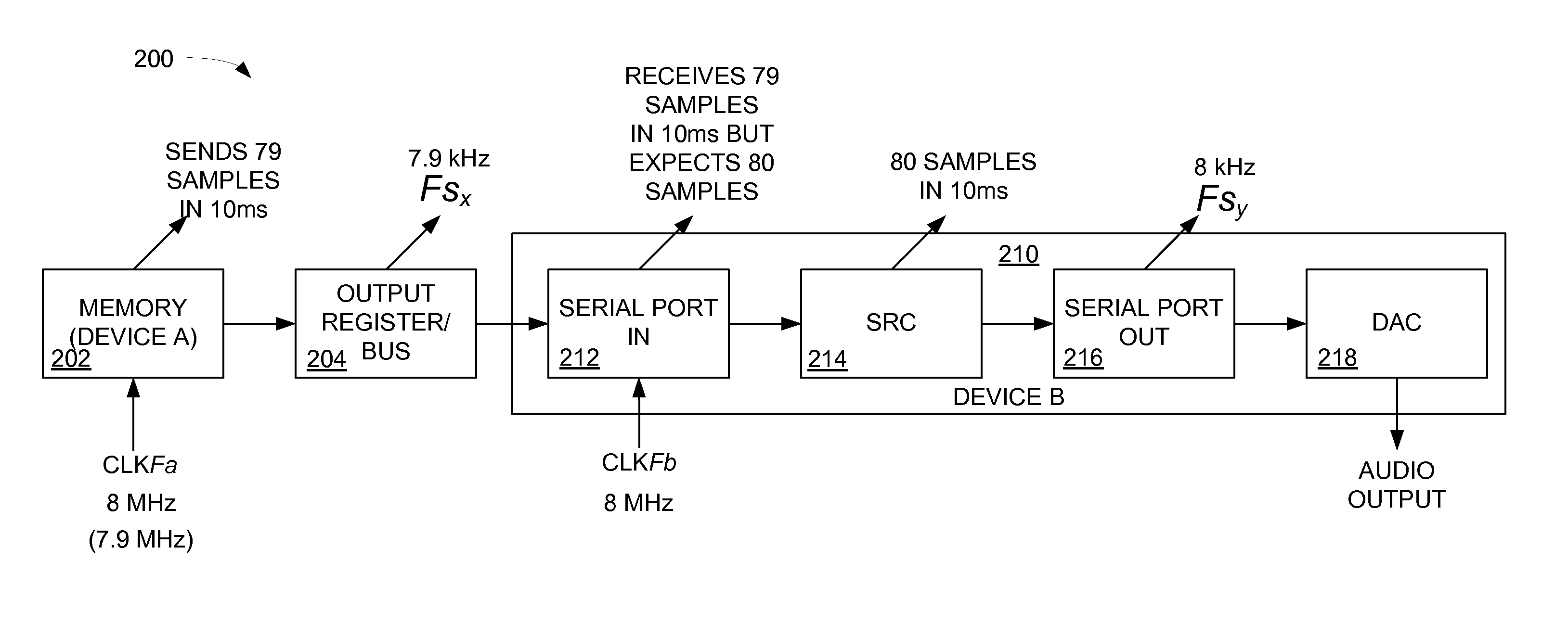
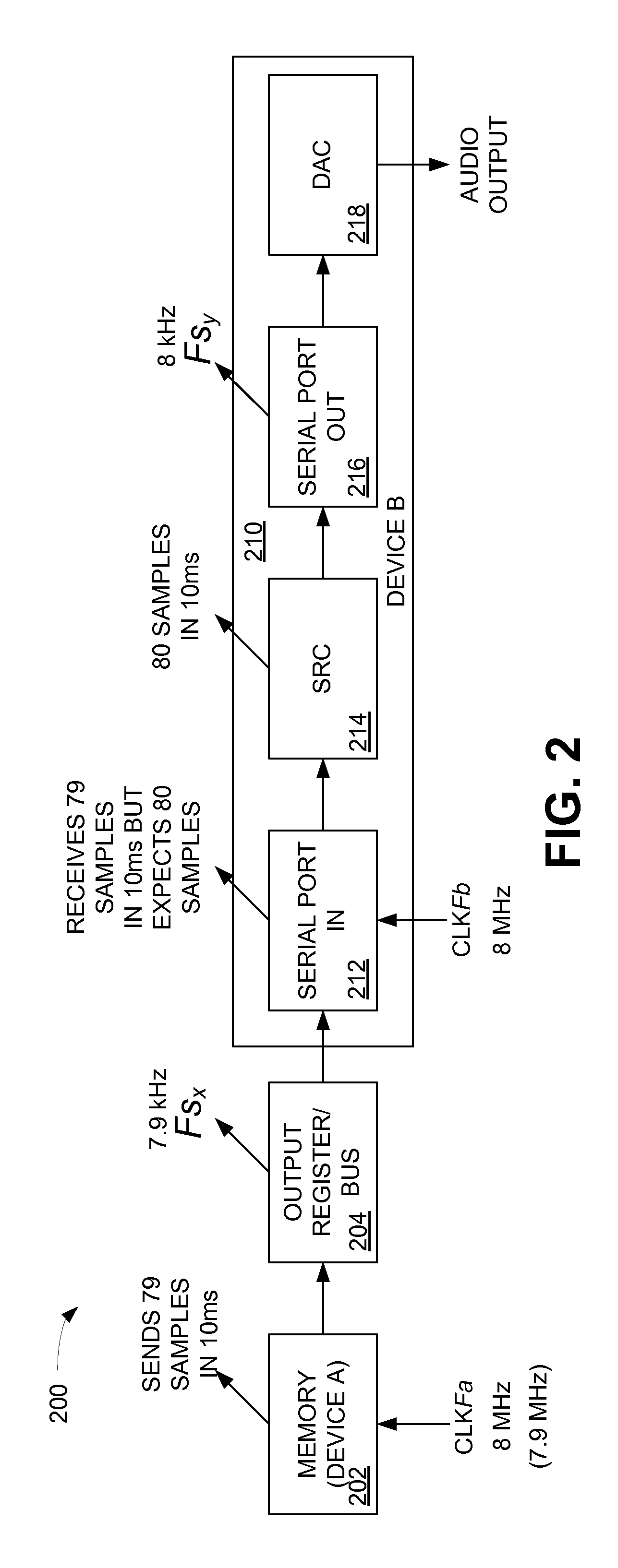
In practice, it is likely that the two devices will have a sampling rate that is based on slightly different oscillator clocks, resulting in a mismatch in the signal processing between the two devices.
Sample rate mismatch can be caused by oscillators or crystals having tolerance in their nominal frequency.
In the above example, the frequency mismatch (Δf) is rather small (a very few samples at a relatively high frequency) and leads to a resampling ratio close to 1, thus leading to very large interpolation and decimation factors being required to perform sample rate conversion.
Time domain interpolation leads to aliasing levels that produce audible distortion and require very long low pass filters (especially for high factor interpolation in the above example) which are computationally expensive.
However, simply dropping / adding samples usually produces audible distortion.
However dropping or adding samples, even in noise only regions of the signal, produces audible distortion especially in high quality music such as piano, etc.

Method used

the structure of the environmentally friendly knitted fabric provided by the present invention; figure 2 Flow chart of the yarn wrapping machine for environmentally friendly knitted fabrics and storage devices; image 3 Is the parameter map of the yarn covering machine
View more

Image

Smart Image Click on the blue labels to locate them in the text.
Viewing Examples
Smart Image
  • System and method for audio sample rate conversion
  • System and method for audio sample rate conversion
  • System and method for audio sample rate conversion

Examples

Experimental program
Comparison scheme
Effect test

Embodiment Construction

[0017]The word “exemplary” is used herein to mean “serving as an example, instance, or illustration.” Any aspect described herein as “exemplary” is not necessarily to be construed as preferred or advantageous over other aspects.

[0018]In this description, the term “application” may also include files having executable content, such as: object code, scripts, byte code, markup language files, and patches. In addition, an “application” referred to herein, may also include files that are not executable in nature, such as documents that may need to be opened or other data files that need to be accessed.

[0019]The term “content” may also include files having executable content, such as: object code, scripts, byte code, markup language files, and patches. In addition, “content” referred to herein, may also include files that are not executable in nature, such as documents that may need to be opened or other data files that need to be accessed.

[0020]As used in this description, the terms “com...

the structure of the environmentally friendly knitted fabric provided by the present invention; figure 2 Flow chart of the yarn wrapping machine for environmentally friendly knitted fabrics and storage devices; image 3 Is the parameter map of the yarn covering machine
Login to View More

PUM

No PUM Login to View More

Abstract

A method for audio sample rate conversion may include receiving an audio signal at a first rate, the audio signal having a fundamental frequency, determining absolute derivatives of the audio signal at the first rate, and generating a weighted sum of the absolute derivatives to arrive at a combined absolute derivative. The combined absolute derivative may be analyzed to locate a local minimum of the combined absolute derivative, a location in the audio signal may be selected based on the local minimum of the combined absolute derivative and at least one audio sample in the audio signal may be altered at the selected location to develop an audio signal at a second rate.

Description

DESCRIPTION OF THE RELATED ART[0001]The transfer of audio signals between electronic devices is becoming more and more prevalent. Examples of such audio signal transfer include, but are not limited to, Bluetooth communication, music played from a wireless device through a wireless headset, and others. The electronic devices typically each have an audio oscillator that generates an audio frequency to control and synchronize the audio transfer. The audio frequency (also referred to as the audio sample rate) is typically one or more orders of magnitude lower than the frequency of the audio oscillator. When transferring an audio signal between two devices, the audio signal sample rate on both devices would ideally be the same resulting in no audio distortion and good sound quality at the playing device. In practice, it is likely that the two devices will have a sampling rate that is based on slightly different oscillator clocks, resulting in a mismatch in the signal processing between t...

Claims

the structure of the environmentally friendly knitted fabric provided by the present invention; figure 2 Flow chart of the yarn wrapping machine for environmentally friendly knitted fabrics and storage devices; image 3 Is the parameter map of the yarn covering machine
Login to View More

Application Information

Patent Timeline
no application Login to View More
IPC IPC(8): G06F17/00
CPCG06F17/00H03H17/0628
Inventor CASTRO, BOAZ
Owner QUALCOMM INC
Features
  • R&D
  • Intellectual Property
  • Life Sciences
  • Materials
  • Tech Scout
Why Patsnap Eureka
  • Unparalleled Data Quality
  • Higher Quality Content
  • 60% Fewer Hallucinations
Social media
Patsnap Eureka Blog
Learn More