Unlock instant, AI-driven research and patent intelligence for your innovation.

Novel imidazole quinoline-based immune system modulators

a technology of immune system and imidazole, applied in the field of immunology, can solve the problems of protective or adverse physiologic outcomes of the host, and achieve the effect of altering tlr-mediated immunostimulatory signaling

Active Publication Date: 2014-08-28
JANUS BIOTHERAPEUTICS
View PDF6 Cites 17 Cited by
  • Summary
  • Abstract
  • Description
  • Claims
  • Application Information

AI Technical Summary

Benefits of technology

The patent describes compounds that can inhibit the immune system, specifically by blocking the TLR-mediated immunostimulatory signaling. These compounds can be used to treat conditions involving unwanted immune activity, such as inflammatory and autoimmune disorders. The compounds can be administered in pharmaceutical compositions and can be prepared as heterocyclic compounds or as mono or di-substituted compounds. The patent also describes the structure of the compounds and provides various methods for their preparation.

Problems solved by technology

Stimulation of the immune system, which includes stimulation of either or both innate immunity and adaptive immunity, is a complex phenomenon that can result in either protective or adverse physiologic outcomes for the host.

Method used

the structure of the environmentally friendly knitted fabric provided by the present invention; figure 2 Flow chart of the yarn wrapping machine for environmentally friendly knitted fabrics and storage devices; image 3 Is the parameter map of the yarn covering machine
View more

Image

Smart Image Click on the blue labels to locate them in the text.
Viewing Examples
Smart Image
  • Novel imidazole quinoline-based immune system modulators
  • Novel imidazole quinoline-based immune system modulators
  • Novel imidazole quinoline-based immune system modulators

Examples

Experimental program
Comparison scheme
Effect test

example 1

Compound 3 was Prepared by Using Procedures Below

[0537]

[0538]A mixture of 2,4-quinolinediol (20 gm, 0.124 moles) in acetic acid (120 mL) was stirred as concentrated nitric acid (32 mL) was added in a single portion. A thick mass resulted. This was heated in an oil bath set at 105° C. After a few minutes the mass liquefied allowing the mixture to be stirred. After a clear brown solution formed, the reaction was allowed to proceed at 105° C. for 10 minutes. The heating bath was removed and water (200 mL) was added with stirring causing a slurry to form. After stirring for 30 minutes, the solid was isolated by filtration and was washed well with water. The solid was then dried under vacuum. The yield of the nitro compound was 23 gm (89.9%) as a yellow solid.

[0539]A mixture of 2,4-dihydroxy-3-nitroquinoline (23 gm, 0.112 moles), and diisopropylethylamine (22.3 gm, 30 mL, 0.172 moles) was stirred in toluene (100 mL) and cooled in an ice bath. To this mixture was added phosphorous oxychlo...

example 2

Compound 54

[0544]

[0545]A mixture of 2,4-dihydroxy, 5,7-difluoroquinoline (24.4 gm, 0.124 moles) in acetic acid (120 mL) is stirred as concentrated nitric acid (32 mL) is added in a single portion. A thick mass results. This is heated in an oil bath set at 105° C. After a few minutes the mass liquefies allowing the mixture to be stirred. After a clear brown solution forms, the reaction is allowed to proceed at 105° C. for 10 minutes. The heating bath is removed and water (200 mL) is added with stirring causing a slurry to form. After stirring for 30 minutes, the solid is isolated by filtration and is washed well with water. The solid is then dried under vacuum. The yield of the nitro compound is about 27 gm as a yellow solid.

[0546]A mixture of 2,4-dihydroxy-5,7-difluoro-3-nitroquinoline (27.1 gm, 0.112 moles), and diisopropylethylamine (22.3 gm, 30 mL, 0.172 moles) is stirred in toluene (100 mL) and cooled in an ice bath. To this mixture is added phosphorous oxychloride (67.4 gm, 41 ...

example 3

Compound 56

[0551]

[0552]A mixture of 2,4-dihydroxy, 6,7-dichloroquinoline (28.5 gm, 0.124 moles) in acetic acid (120 mL) is stirred as concentrated nitric acid (32 mL) is added in a single portion. A thick mass results. This is heated in an oil bath set at 105° C. After a few minutes the mass liquefies allowing the mixture to be stirred. After a clear brown solution forms, the reaction is allowed to proceed at 105° C. for 10 minutes. The heating bath is removed and water (200 mL) is added with stirring causing a slurry to form. After stirring for 30 minutes, the solid is isolated by filtration and is washed well with water. The solid is then dried under vacuum. The yield of the nitro compound is about 30 gm as a yellow solid.

[0553]A mixture of 2,4-dihydroxy-6,7-dichloro-3-nitroquinoline (30.8 gm, 0.112 moles), and diisopropylethylamine (22.3 gm, 30 mL, 0.172 moles) is stirred in toluene (100 mL) and cooled in an ice bath. To this mixture is added phosphorous oxychloride (67.4 gm, 41 ...

the structure of the environmentally friendly knitted fabric provided by the present invention; figure 2 Flow chart of the yarn wrapping machine for environmentally friendly knitted fabrics and storage devices; image 3 Is the parameter map of the yarn covering machine
Login to View More

PUM

No PUM Login to View More

Abstract

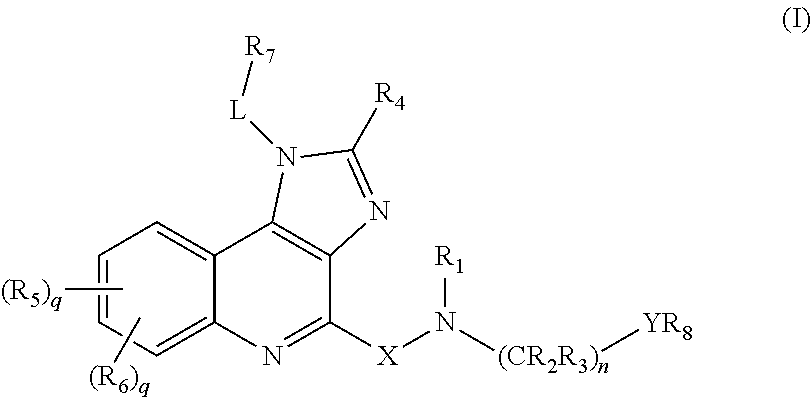
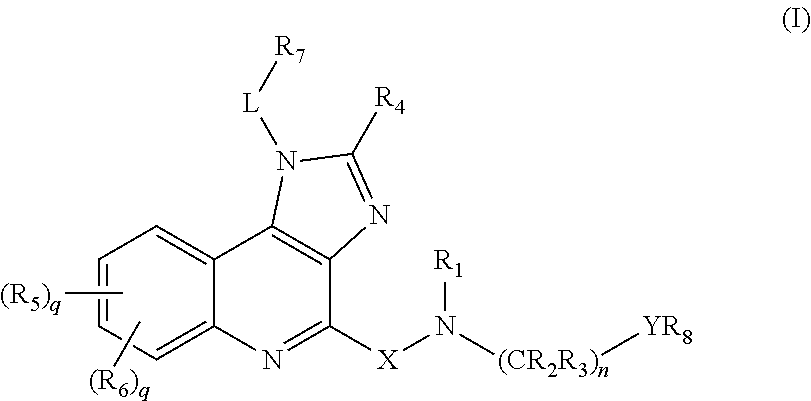
The present invention relates to a compound of Formula I: or an enantiomer, diastereomer, tautomer, or pharmaceutically acceptable salt or solvate thereof, wherein the symbols are as defined in the specification; a pharmaceutical composition comprising the same; and a method for treating or preventing autoimmunity disease using the same.

Description

RELATED APPLICATIONS[0001]This application claims priority to U.S. Provisional Patent Application No. 61 / 543,082, filed on Oct. 4, 2011, which is hereby incorporated by reference in its entirety.FIELD OF THE INVENTION[0002]The invention relates generally to the field of immunology. More particularly, the invention relates to compositions and methods for altering immune function. More specifically, the invention relates to compositions and methods for affecting immune stimulation mediated through Toll-like receptor (TLR) molecules.BACKGROUND OF THE INVENTION[0003]Stimulation of the immune system, which includes stimulation of either or both innate immunity and adaptive immunity, is a complex phenomenon that can result in either protective or adverse physiologic outcomes for the host. In recent years there has been increased interest in the mechanisms underlying innate immunity, which is believed to initiate and support adaptive immunity. This interest has been fueled in part by the r...

Claims

the structure of the environmentally friendly knitted fabric provided by the present invention; figure 2 Flow chart of the yarn wrapping machine for environmentally friendly knitted fabrics and storage devices; image 3 Is the parameter map of the yarn covering machine
Login to View More

Application Information

Patent Timeline
no application Login to View More
IPC IPC(8): C07D471/04
CPCC07D471/04A61P1/04A61P1/16A61P17/00A61P17/06A61P19/02A61P21/00A61P21/04A61P25/00A61P29/00A61P37/06A61P5/00A61P7/04A61P7/06A61P9/00A61P9/10A61P3/10
Inventor LIPFORD, GRAYSON B.ZEPP, CHARLES M.
Owner JANUS BIOTHERAPEUTICS