

Using dynamic bursts to support frequency-agile memory interfaces
a technology of frequency-agile memory and dynamic bursts, applied in the field of clock memory systems, can solve the problems of not being able to take full advantage of these speed and voltage reductions
- Summary
- Abstract
- Description
- Claims
- Application Information
AI Technical Summary
Benefits of technology
Problems solved by technology
Method used
Image



Examples
Embodiment Construction
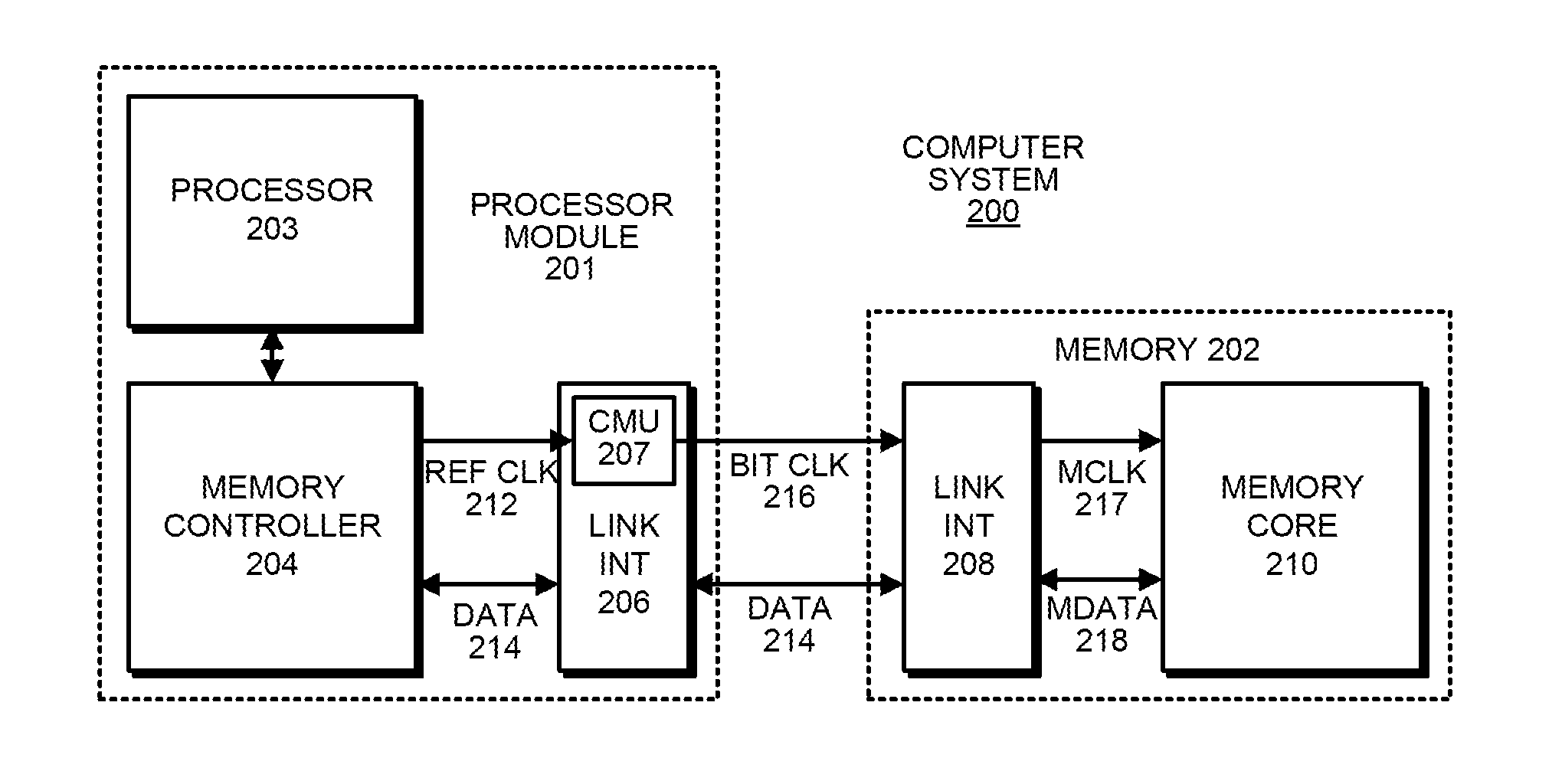
[0017]As mentioned previously, during a power-saving mode it is desirable to reduce power consumption in the link circuitry which connects the processor and the memory. For example, the graph presented in FIG. 1 illustrates power consumption 102 for a link (in mW) and also energy consumed per bit transferred 104 (in mW / Gbps) as a function of the data rate. In this graph, the horizontal axis is associated with data rate (in Gbps) and the vertical axis is associated with power (in mW) and energy consumption per bit (in mW / Gbps). Note that as the data rate increases, power consumption 102 also increases. In contrast, as data rate increases, the energy consumed per bit 104 actually decreases until a sweet spot 106 is reached. This decrease in energy consumed per bit 104 is due to the fact that at lower data rates certain portions of the link circuitry continue to consume constant power whether the link is transmitting data or not, so energy consumption per bit 104 actually increases. (F...
PUM
 Login to View More
 Abstract
Description
Claims
Application Information
 Login to View More