Mild hydrolysis of proteins from rice bran
a technology of rice bran and proteins, which is applied in the field of mild hydrolysis of proteins from rice bran, can solve the problems of bitter taste of products, affecting the extraction of proteins from agro-sources, and reducing the solubility of proteins
- Summary
- Abstract
- Description
- Claims
- Application Information
AI Technical Summary
Benefits of technology
Problems solved by technology
Method used
Image

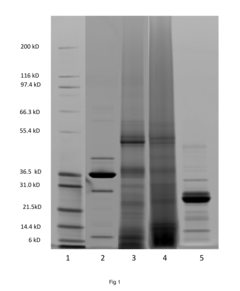


Examples
example 1
[0125]Several proteases and an amylase have been tested to hydrolyse and separate (or extract) proteins from defatted rice bran. Selection of the enzyme was based on the protein yield in supernatant or continuous phase after incubation and subsequent solid-liquid separation. Both a very broad range (non-specific) as several very specific proteases have been selected like Fromase 750TL®, Collupuline 200L®, Maxazyme NNP DS® and especially Brewers Clarex®, while also anamylase Dexlo CL® had been tested. The pH and temperature of the incubations were adjusted to the specific enzyme as following:
Fromase 750TL® pH 5 50° C., Brewers Clarex® pH 4 40° C., Maxazyme NNP DS® pH 7 50° C. and Collupuline 200 L pH 8 55° C. The dosage of enzyme was always set on 0.5 ml / 250 g defatted rice bran (for economic feasibility) and the incubations were performed with 15 wt % of substrate in potable water during 1 hr. To stop the enzymatic action, all samples were heat treated for 5 min at 95° C. and subseq...
example 2
[0127]9.63 gram DRB (defatted rice bran) in 35 gram potable water was incubated with the protease Maxazyme® NNP DS (dosage 86 microliter) at 50° C. during 4 hours, samples were taken during several time intervals. After incubation the samples were heat shocked during 10 minutes at 80° C. to inactivate the enzyme after which a S / L separation was performed.
[0128]In the table below the yield is presented in two manners:[0129]1. yield as obtained after solid / liquid separation and heat shock based on the obtained supernatant.[0130]2. yield as can be calculated based on the amount of added water. This value reflects the maximal theoretical yield (maximal washing out of the pellet, the solid fraction after L / S).
Nitrogen yieldincludingnitrogen in waterEnzymeTimephase of theProtein on drydose(min)Nitrogen Yieldpelletmatter (N * 6.25)863024.2%41.5%34.8%microliter4524.4%43.9%34.6%6026.0%45.5%35.5%9025.6%48.7%36.0%12028.1%51.5%36.0%18030.3%56.0%36.6%24033.5%59.2%35.8%1733027.0%45.1%36.4%microli...
example 3
[0132]In a further experiment, it was investigated if it would be advantageous if the S / L separation was taken place before the heat shock to inactivate the enzyme instead of after this heat treatment. For this, the procedure of Example 2 was followed, with 173 microliter of enzyme dose (Maxazyme NNP DS®).
Sequence heat-TimeProtein on dryshock-S / L(min)Nitrogen yieldmatterHeat shock-S / L24033.7%37.8%separationS / L separation-24041.2%38.7%heat shock
[0133]In this experiment, it is clearly shown that performing first the S / L separation and then the heat shock, improved the yield considerably compared to the heatshock before the S / L separation. The protein on dry content was in this experiment slightly affected.
PUM
| Property | Measurement | Unit |
|---|---|---|
| Temperature | aaaaa | aaaaa |
| Temperature | aaaaa | aaaaa |
| Fraction | aaaaa | aaaaa |
Abstract
Description
Claims
Application Information
 Login to View More