
Cognitive Educational Tool For Effectuating Learning
a learning tool and cognitive technology, applied in the field of educational games, can solve the problems of lack of actual teachers' involvement in making the system effective, too expensive private teacher approach for most students, and inability to achieve the effect of effective system, so as to increase the level of visual stimulation, increase the user's ability to retain information, and increase the level of ability
- Summary
- Abstract
- Description
- Claims
- Application Information
AI Technical Summary
Benefits of technology
Problems solved by technology
Method used
Image



Examples
Embodiment Construction
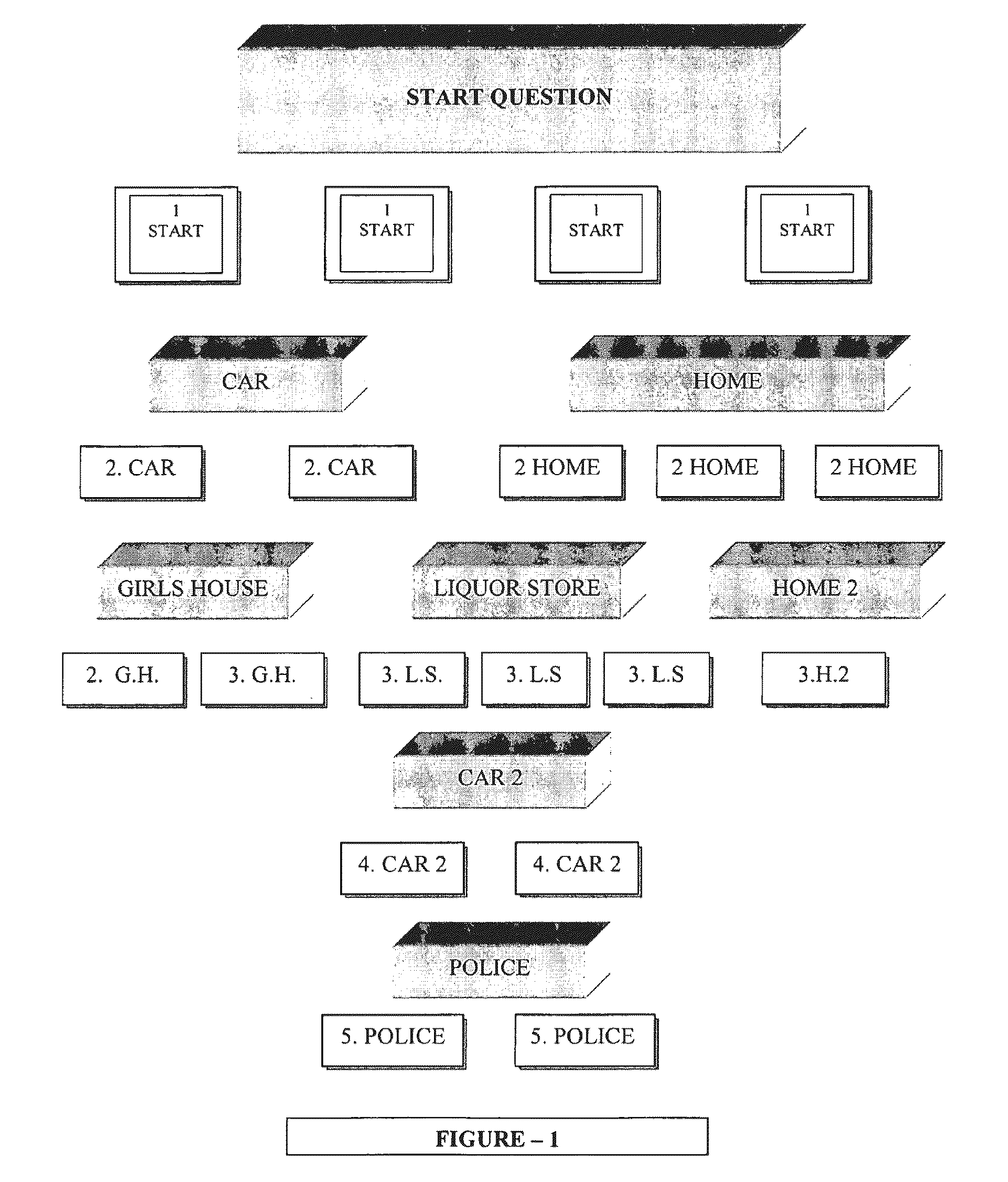
[0035]With reference now to the illustrations, and specifically FIG. 1 to FIG. 3 thereof, a new educational conceptual framework for learning and practicing steps in any given decision making process, thus highlighting possible problem areas will now be described.
[0036]FIG. 1 provides a front elevational view of how the concept is set up. The cards are all placed on the floor in a room that will allow for maximum movement, i.e., a classroom / training room. In this particular example, there are 8 ‘station cards’—labeled ‘A’ through ‘H’. There are also 19 ‘movement cards’—labeled ‘J1’ through ‘J19’.
[0037]In FIG. 1, (A) represents the starting point of the scenario and the particular topic being taught / practiced. On card 1(A) is a given situation, which either the instructor(s) or participants read out aloud. Below the Start ‘station card’ are four ‘movement cards’—labeled ‘J1’ through ‘J4’, (note all the ‘movement cards’ are placed on the floor face down, the reason being participants ...
PUM
 Login to View More
 Abstract
Description
Claims
Application Information
 Login to View More