
Apparatus and Method for Monitoring the Mechanical Properties of Subsea Longitudinal Vertical Components in Offshore Drilling and Production Applications
- Summary
- Abstract
- Description
- Claims
- Application Information
AI Technical Summary
Benefits of technology
Problems solved by technology
Method used
Image

Examples
Embodiment Construction
[0033]While the invention as described is illustrated using the sensor system 14 on the tension legs of a typical TLP 10, it should be understood that the system is readily adaptable to any SLVC incorporated in offshore drilling and production. The system is particularly useful, and similarly installed on risers, tension legs and other SLVC used during both the drilling and the production phase of the platform.
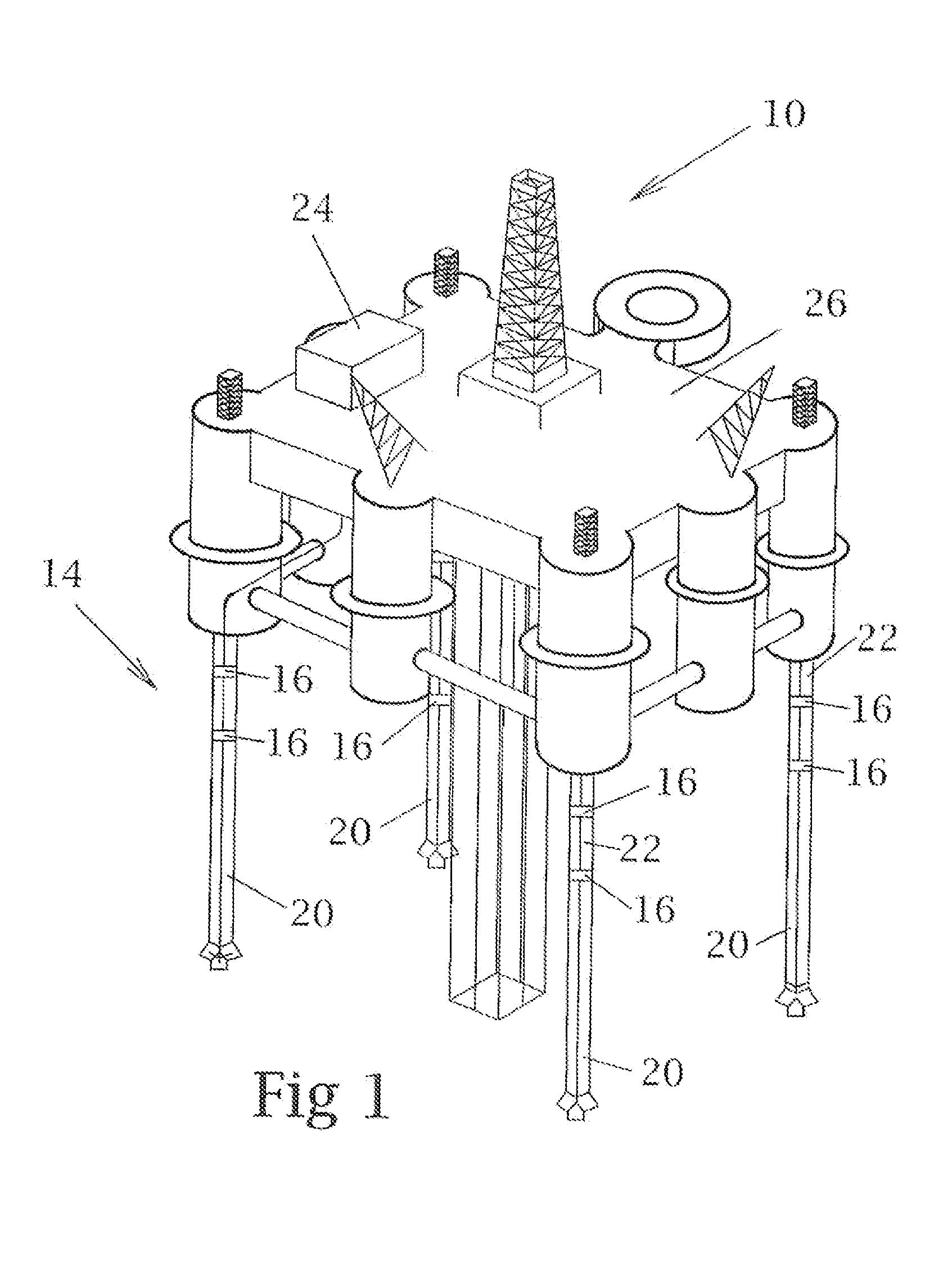
[0034]A TLP 10 with the sensor system 14 is shown in FIG. 1. In the preferred embodiment, the sensor system includes two groups of sensor assemblies 16 mounted on each tension leg 20. In the example, a first sensor ring 18 is mounted approximately thirty feet (eight to ten meters) from the mean sea surface and a second sensor ring 20 is mounted approximately sixty feet (sixteen to twenty meters from the surface. In some applications, it may be desirable to provide sensors strategically placed at intervals extending from the seafloor to a location near the surface platform. An ...
PUM
 Login to View More
 Abstract
Description
Claims
Application Information
 Login to View More