Method and System for Treating Non-Alcoholic Fatty Liver Disease

US20170106026A1Active Publication Date: 2017-04-20SEED HEALTH INC
0 Cites 33 Cited by

Patent Information

Authority / Receiving Office
US · United States
Current Assignee / Owner
Publication Date
2017-04-20

Smart Images

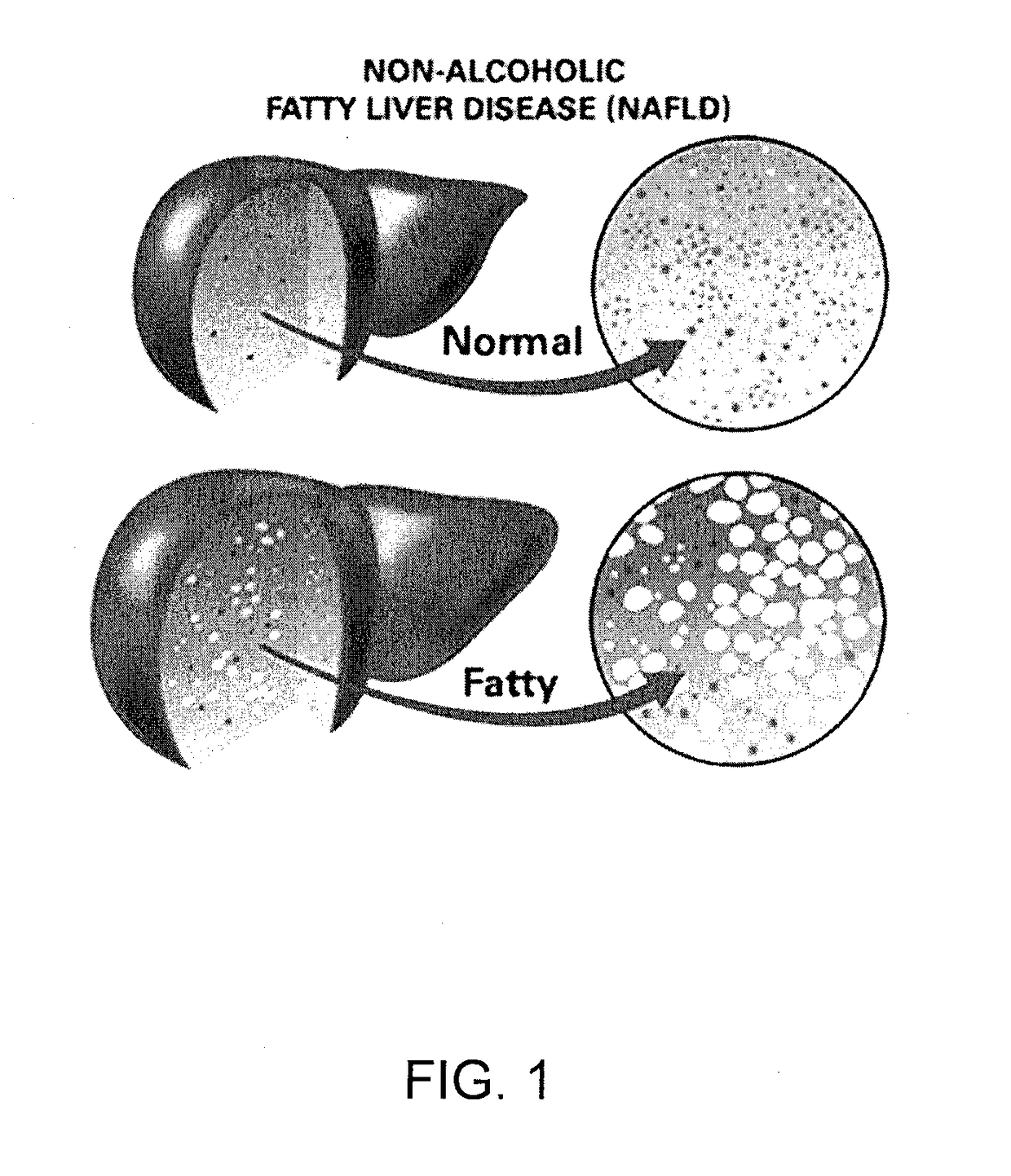
  • Figure 1
    Figure 1
Patent Text Reader

Abstract

A method and system for treating non-alcoholic fatty liver disease (NAFLD) involves the modulation of the gut microbial of a person suffering from NAFLD, and in particular the provision of a probiotic therapy configured to reduce liver aminotransferases, total-cholesterol, TNF-α and to improve insulin resistance in NAFLD patients.
Need to check novelty before this filing date? Find Prior Art

Description

RELATED APPLICATIONS

[0001] This application is a non-provisional of U.S. Provisional Patent Application Ser. No. 62 / 275,341, filed on Jan. 6, 2016.

[0002] This application is a continuation-in-part application of U.S. patent application Ser. No. 14 / 752,192 filed Jun. 26, 2015, which is a continuation-in-part application of U.S. patent application Ser. No. 14 / 225,503 filed Mar. 26, 2014, (now issued U.S. Pat. No. 9,445,936, issued Sep. 20, 2016), which is a continuation of U.S. patent application Ser. No. 13 / 367,052, filed Feb. 6, 2012 (now issued U.S. Pat. No. 8,701,671, issuing on Apr. 22, 2014), which claims priority of U.S. Provisional Patent Application Ser. No. 61 / 439,652, filed on Feb. 4, 2011 and U.S. Provisional Patent Application Ser. No. 61 / 556,023, filed on Nov. 4, 2011.

[0003] This application also is a continuation-in-part application of U.S. patent application Ser. No. 15 / 270,034, filed Sep. 20, 2016, which is a continuation-in-part application of U.S. patent application Se...

Examples

Embodiment Construction

[0042]Probiotic therapies can reduce liver aminotransferases, total-cholesterol, TNF-α and improve insulin resistance in NAFLD patients. Modulation of the gut microbiota represents a new treatment for NAFLD. In certain embodiments, the methods and systems as described herein are directed to inhibiting glucosphingolipid synthesis in an individual by provision of particular microbes effective to achieve such inhibition. In other embodiments, an engineered autonomously distributed circuit that contains a programmable nuclease able to target a virulence factor or an antibiotic resistance gene of the bacterial species is employed, whether they be Gram-negative bacterial cells, Gram-positive bacterial cells, or a combination thereof. Microbial cells may include members of the phyla Actinobacteria, Bacteroidetes, Proteobacteria, Firmicutes, or a combination thereof. In particular embodiments, gut bacteria are modified to address the synthesis of triacylglycerol. There is a direct correlati...