Organic light emitting diode packaging method and packaging structure and device having the same
a light-emitting diode and organic technology, applied in the field of electronic components, can solve the problems of no light-emitting diode, no light-emitting diode, and certain limitations in use of the oled devi
- Summary
- Abstract
- Description
- Claims
- Application Information
AI Technical Summary
Benefits of technology
Problems solved by technology
Method used
Image



Examples
example 1
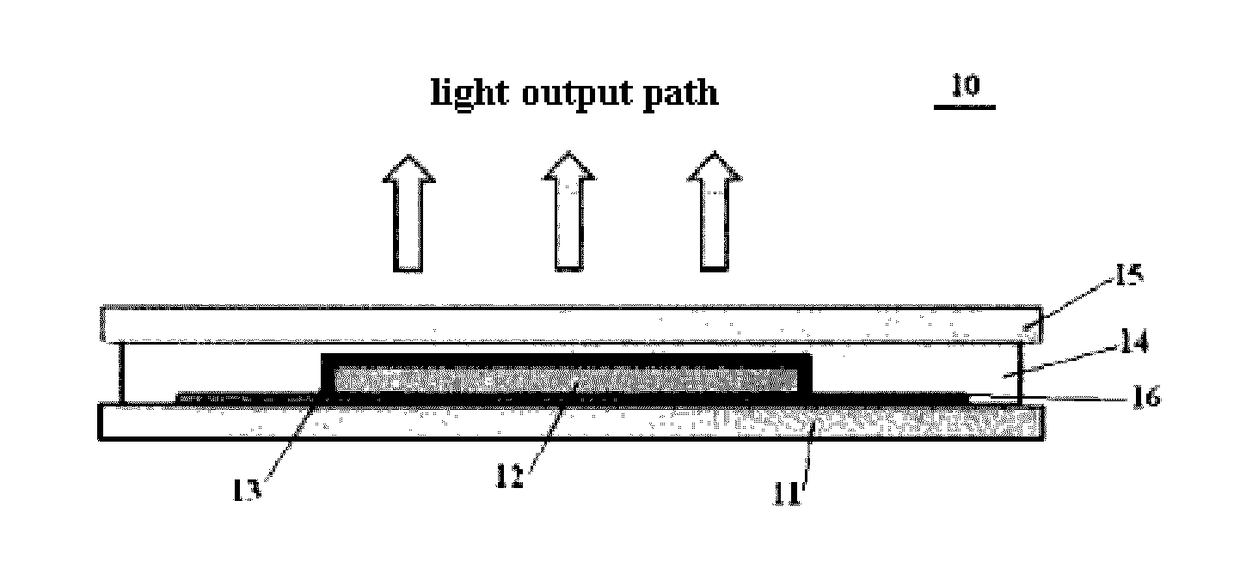
[0035]Invar alloy having a thickness of 50 μm is provided as a first substrate, and, a SiNx film having a thickness of 0.5 μm, as a planarization layer, is formed by means of CVD on the first substrate. An OLED is manufactured on the planarization layer. A SiNx film having a thickness of 1 μm, as a passivation layer, is formed by means of CVD and the passivation layer covers the OLED. Encapsulation adhesive is coated onto surface of the first substrate and covers the first substrate entirely. A plastic film, as a second substrate, is provided at least on a portion of the encapsulation adhesive covering the passivation layer. An area of a major surface of the second substrate is less than an area of a major surface of the first substrate. An edge of the first substrate is folded to enwrap the second substrate while a light emitting region is exposed, meanwhile one edge of the first substrate is kept unfolded so that a circuit portion can be extended to outside. Finally, the encapsula...
example 2
[0036]Kovar alloy having a thickness of 100 μm is provided as a first substrate, and, a plastic film having a thickness of 0.5 μm, as a planarization layer, is adhered evenly by means of being heated on the first substrate. An OLED structure is manufactured on the planarization layer. An Al2O3 film having a thickness of 0.5 μmm, as a passivation layer, is formed by means of atomic layer deposition (ALD) and the passivation layer covers the OLED. Encapsulation adhesive is coated onto surface of the first substrate and covers the first substrate entirely. A plastic film, as a second substrate, is provided at least on a portion of the encapsulation adhesive covering the passivation layer. An area of a major surface of the second substrate is less than an area of a major surface of the first substrate. An edge of the first substrate is folded to enwrap the second substrate while a light emitting region is exposed, meanwhile one edge of the first substrate is kept unfolded so that a circ...
PUM
 Login to View More
 Abstract
Description
Claims
Application Information
 Login to View More