
Monitor and Control of Tumbling Mill Using Measurements of Vibration, Electrical Power Input and Mechanical Power
- Summary
- Abstract
- Description
- Claims
- Application Information
AI Technical Summary
Benefits of technology
Problems solved by technology
Method used
Image

Examples
Embodiment Construction
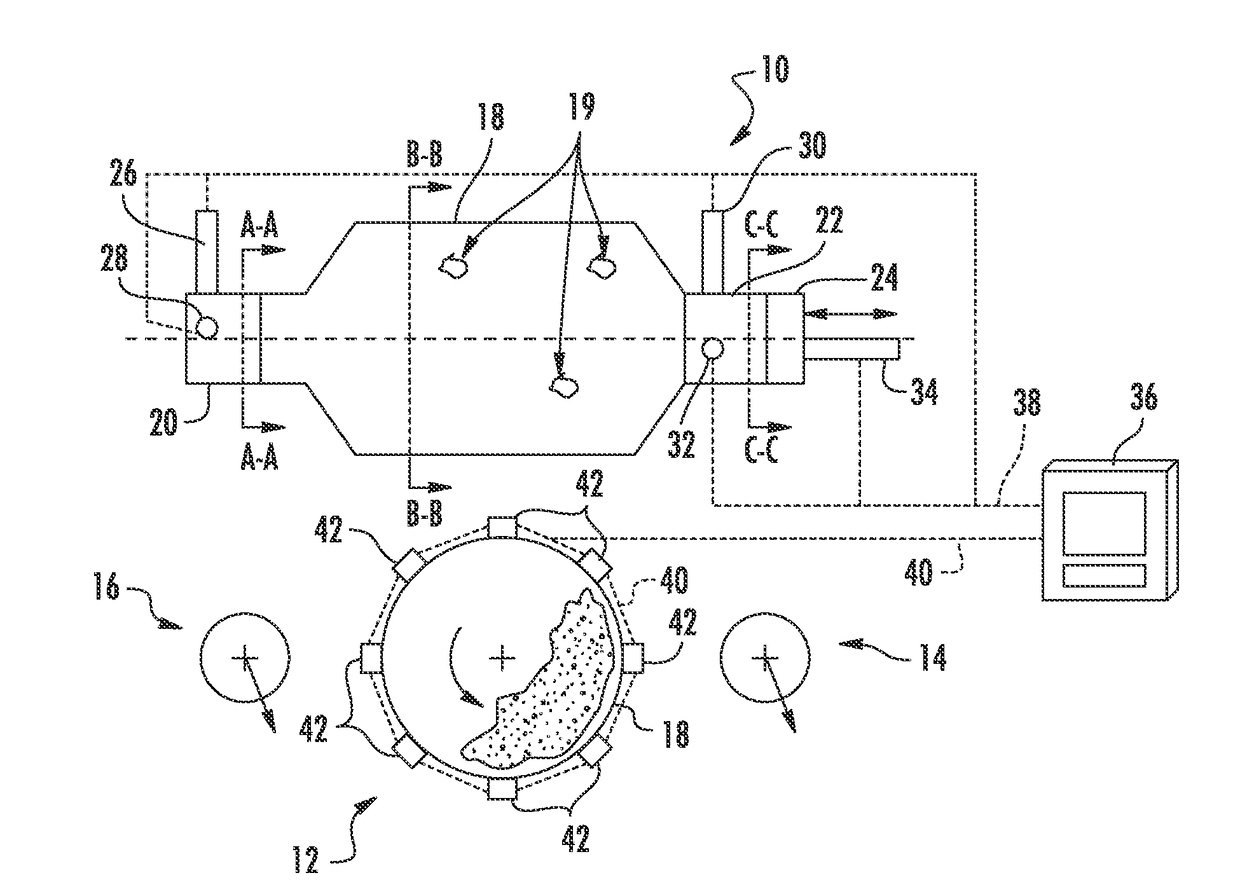
[0018]Referring to FIG. 1, a somewhat diagrammatic and schematic side view of a tumbling mill 10 is shown. Three sectional views are also shown in FIG. 1, section A-A, B-B and C-C. Section view A-A is also is also identified by the reference 16. Likewise, section B-B as identified by the reference 12 and section C-C is identified by the reference 14. The tumbling mill 10 includes a shell 18 that contains a charge of material to be tumbled and ground. For example, a rock mineral may be supplied to the shell 18 as a charge. The rock 19 and the charge will tumble against itself and the side of the shell 18 grinding itself into finer material. In a SAG mill, a supplemental material may be added to the charge to aid in the grinding process, such as steel balls.
[0019]The shell 10 is supported on two main bearings 20 and 22 and in addition a thrust bearing 24 is provided to resist thrust forces that may be generated by the shell 18 as it rotates. Vibration sensors 26 and 28 are provided on...
PUM
 Login to View More
 Abstract
Description
Claims
Application Information
 Login to View More