
Abnormality detection method, abnormality detection apparatus, and abnormality detection system
- Summary
- Abstract
- Description
- Claims
- Application Information
AI Technical Summary
Benefits of technology
Problems solved by technology
Method used
Image

Examples
first embodiment
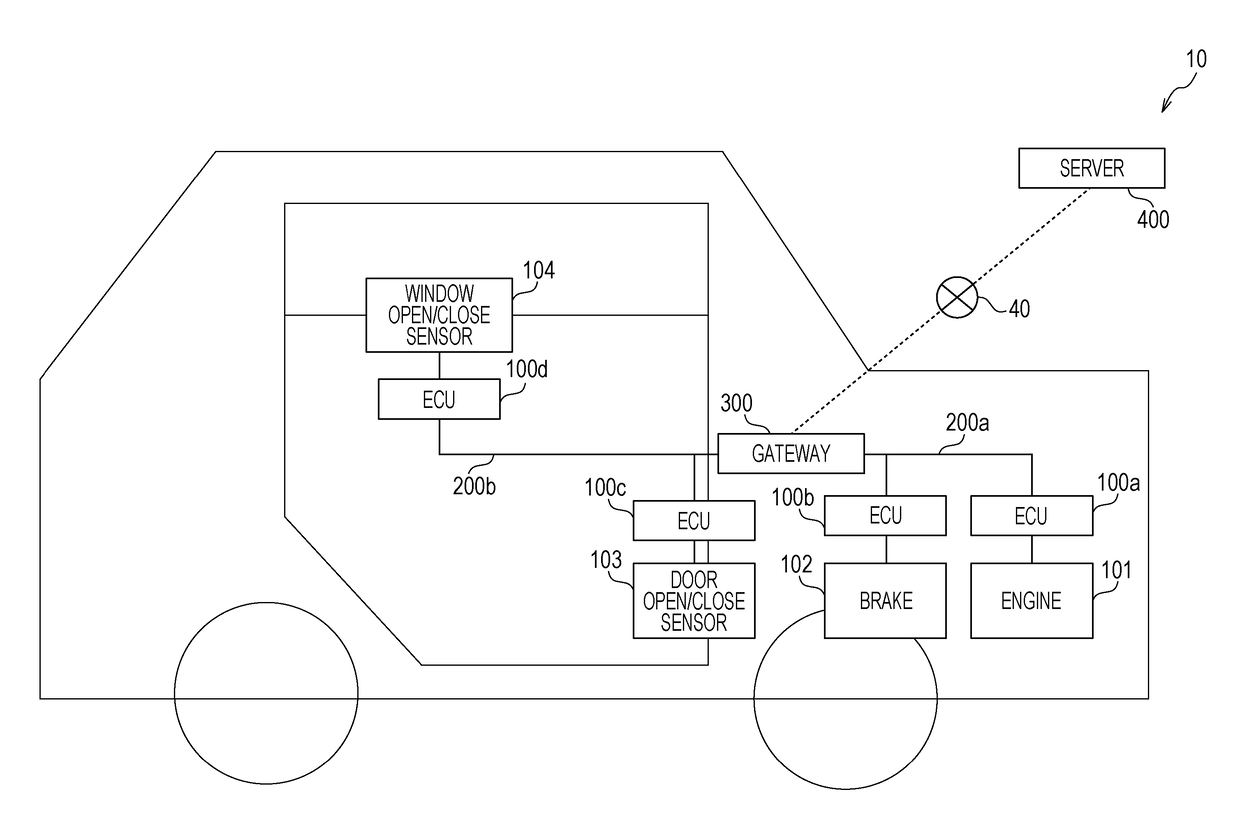
[0058]An embodiment of the present disclosure is described below with reference to drawings for a case in which in an abnormality detection system, abnormality detection apparatus for detecting an abnormality in an on-board network in a vehicle is configured to determine, in cooperation with a server outside the vehicle, a detection window size (a unit time) used in detecting the abnormality. In this abnormality detection system, the abnormality detection apparatus sends, to a server, vehicle identification information on the vehicle in which the abnormality detection apparatus is installed, and determines the detection window size used in detecting an abnormality based on a response returned from the server.
1.1 Total Configuration of Abnormality Detection System 10
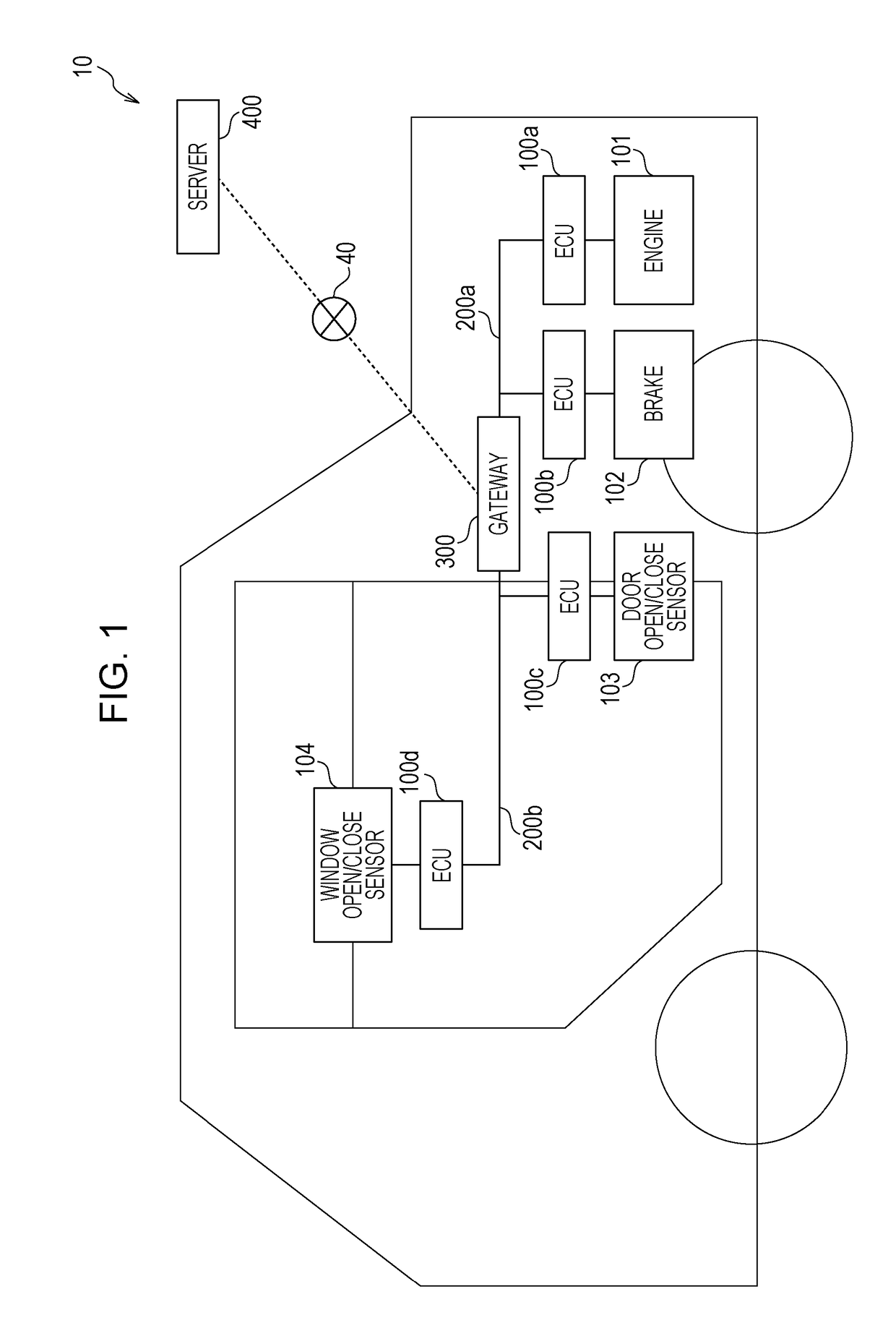
[0059]FIG. 1 is a diagram illustrating a total configuration of an abnormality detection system 10 according to a first embodiment.
[0060]The abnormality detection system 10 includes a vehicle including an on-board network...
second embodiment
[0149]A description is given below as an embodiment, which is a modification to the on-board network system of the vehicle in the abnormality detection system according to the first embodiment described above.
[0150]In the first embodiment, the detection window size is determined by the gateway 300 of the vehicle via the communication with the server 400 located outside the vehicle, and feature information based on the number of frames received in a time period corresponding to the detection window size counted individually for each ID is transmitted to the server 400 to allow it to update, via learning, the criterion model serving as the basis of the particular model used in detecting an abnormality in the on-board network. In contrast, in an example according to the second embodiment described below, a detection window size used in detecting an abnormality is determined independently by an abnormality detection apparatus of an on-board network system of a vehicle (that is, independ...
PUM
 Login to View More
 Abstract
Description
Claims
Application Information
 Login to View More