

Optical guide comprising a bend with a pseudo-index gradient
- Summary
- Abstract
- Description
- Claims
- Application Information
AI Technical Summary
Benefits of technology
Problems solved by technology
Method used
Image

Examples
Embodiment Construction
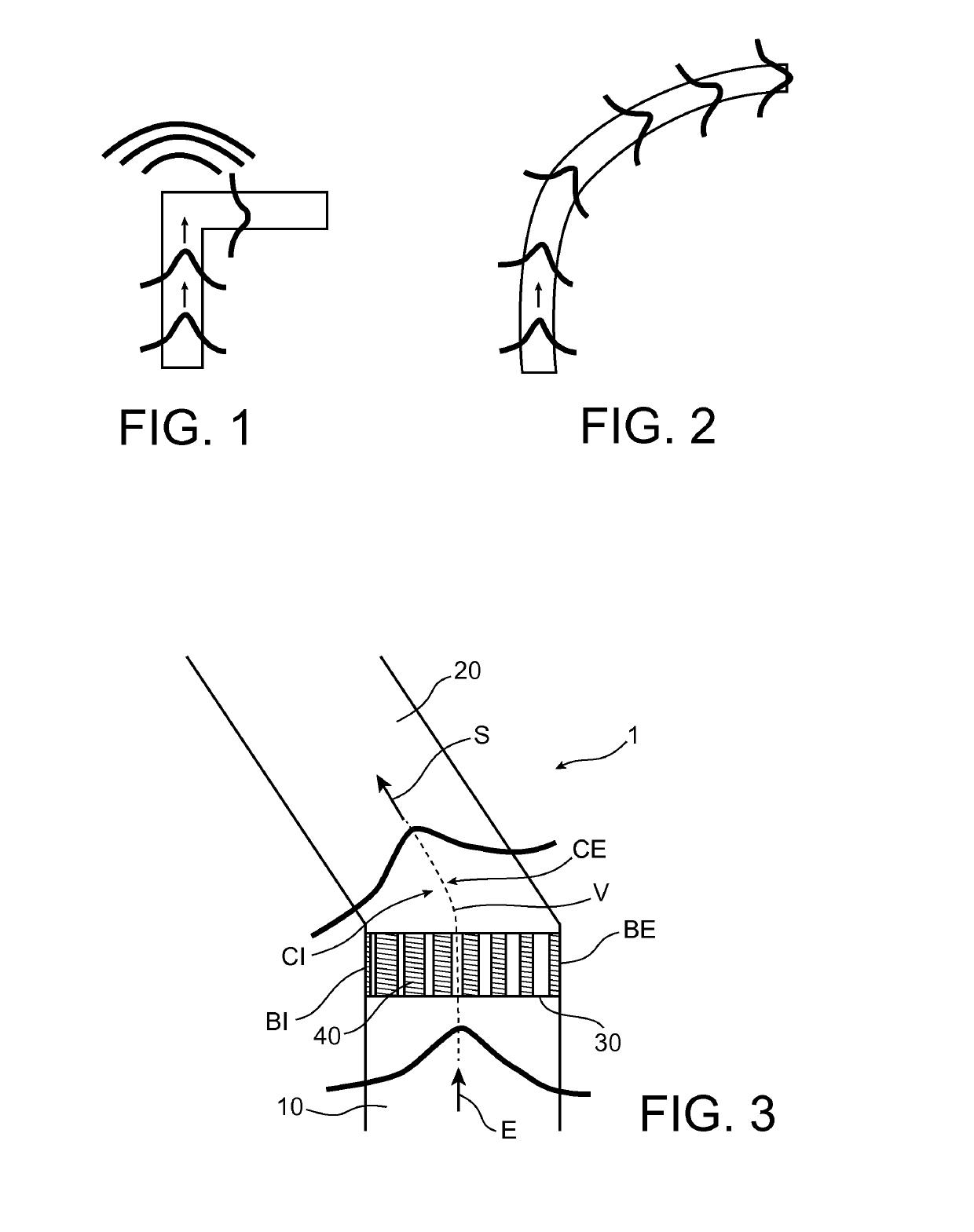
[0025]FIG. 1 shows a diagram of an optical guide integrating a break between two rectilinear optical paths, in the form of an abrupt bend of 90°. With such a right-angle break, the light is confronted with strong radiation losses, whether the guide is narrow or wide. In order to prevent such a break, it is thus possible to resort to a curve having a large radius as is shown in FIG. 2. The transfer of the electromagnetic field out of the guide is thus minimised, but to the detriment of the compactness.
[0026]FIG. 3 shows a diagram of an optical guide 1 according to the invention in which the light is deviated while preserving a uniform wave front.
[0027]According to the invention, the optical guide 1 can be a planar waveguide (“Planar waveguide” or “Slab waveguide” in the Anglo-Saxon terminology), a channel waveguide (“Ridge waveguide” in the Anglo-Saxon terminology), or a rib waveguide (“Rib waveguide” in the Anglo-Saxon terminology).
[0028]The optical guide 1 comprises a core made fro...
PUM
 Login to View More
 Abstract
Description
Claims
Application Information
 Login to View More