Check patentability & draft patents in minutes with Patsnap Eureka AI!

Method and system for an emergency location information service (e-lis) for water-based network devices

Active Publication Date: 2020-04-23
EVERBRIDGE
View PDF0 Cites 17 Cited by
  • Summary
  • Abstract
  • Description
  • Claims
  • Application Information

AI Technical Summary

Benefits of technology

The invention provides a method and system for determining and verifying the location of water-based network devices on or in a body of water. This is helpful in cases of emergency situations, as the devices can automatically send out emergency messages without operator input and the E-LIS server network device can provide a current physical geographic location for the devices. Overall, this improves the efficiency and accuracy of locating water-based network devices in emergency situations.

Problems solved by technology

For example, in the event of a vehicular accident, public safety personnel may need to operate within an unfamiliar wooded area on short notice, in conditions of poor visibility due to smoke, flame or darkness, or on or in a body of water.
A mobile device an individual may be carrying may not be able to communicate because of poor signal strength to the mobile device in the rural area or on or in a body of water.
Prior art methods of accomplishing such location do not simultaneously meet the requirements of rapid location determination, automation, and accuracy.
Navigation employing conventional maps and visual observation or dead reckoning are not readily automated and thus require time and attention by a human observer.
There are many problems associated with determining a location of a network device and a caller who needs to place an E911 call or a person who sends a text to E911 in an emergency situation.
One problem is the network device and caller may be located in a remote area, rural area in in the event of a natural disaster or terrorist attack when a local infrastructure may be compromised or an adequate communication signal not available to send an emergency message.
Another problem is that many E911 calls a misrouted to the wrong PSAP.
This can delay the dispatch of emergencies services to the caller.
Another problem is that existing mobile technology makes it difficult to accurately locate mobile devices.
Another problem is that triangulation based on time of arrival at multiple mobile-communications base stations (TDOA) has inadequate coverage and is insufficiently accurate unless supplemented by signals provided by local radios placed outside the facility by public safety personnel.
Another problem is that conventional radio-frequency-based location methods do a poor job of providing topological location within a building: that is, location relative to floors, walls, doors, partitions, stairways, and other features whose spatial extent is small but whose significance to a person's ability to move is great.
Another problem is that many wearable mobile devices are not “location-aware.” Location-aware devices are cognizant of their current geographic location.
However, mobile telephones may only determine their current geographic location by communicating with a particular mobile phone interface or telephony switch that provides coverage to a geographic location such as a telephonycell” but not an exact current geographic location within the cell.
Another problem is that mobile devices are being allowed to send Short Message Services (SMS) text-to-911 messages to contact emergency services when an emergency occurs.
Another problem is network devices connected to the IoT need often to be located when an emergency occurs.
There is currently no accurate way to locate such IoT devices in an emergency situation.
Another problem is that network devices connected to the IoT often can provide useful information as an emergency situation is developing.
There is currently no way to collect such information from IoT devices.
Another problem is that network devices and other IoT devices such as cell phones, electronic tablets, etc. are not usable when a person is on or in a body or water, such as a lake, river, ocean, etc. and face an emergency situation.
Another problem is that water-based network devices cannot automatically contact appropriate emergency responders when an emergency event occurs in, or on, a body water (e.g., river, sea, ocean, etc.) at a distance from a nearest shoreline for the body of water.
Another problem is that water-based network devices typically require a wireless interface to connect to high-orbit satellites to contact appropriate emergency responders when an emergency event occurs in or on a body water.
However, most water-based network devices do not include a wireless interface to connect to high-orbit satellites.

Method used

the structure of the environmentally friendly knitted fabric provided by the present invention; figure 2 Flow chart of the yarn wrapping machine for environmentally friendly knitted fabrics and storage devices; image 3 Is the parameter map of the yarn covering machine
View more

Image

Smart Image Click on the blue labels to locate them in the text.
Viewing Examples
Smart Image
  • Method and system for an emergency location information service (e-lis) for water-based network devices
  • Method and system for an emergency location information service (e-lis) for water-based network devices
  • Method and system for an emergency location information service (e-lis) for water-based network devices

Examples

Experimental program
Comparison scheme
Effect test

Embodiment Construction

Exemplary Electronic Emergency Information Message Processing System

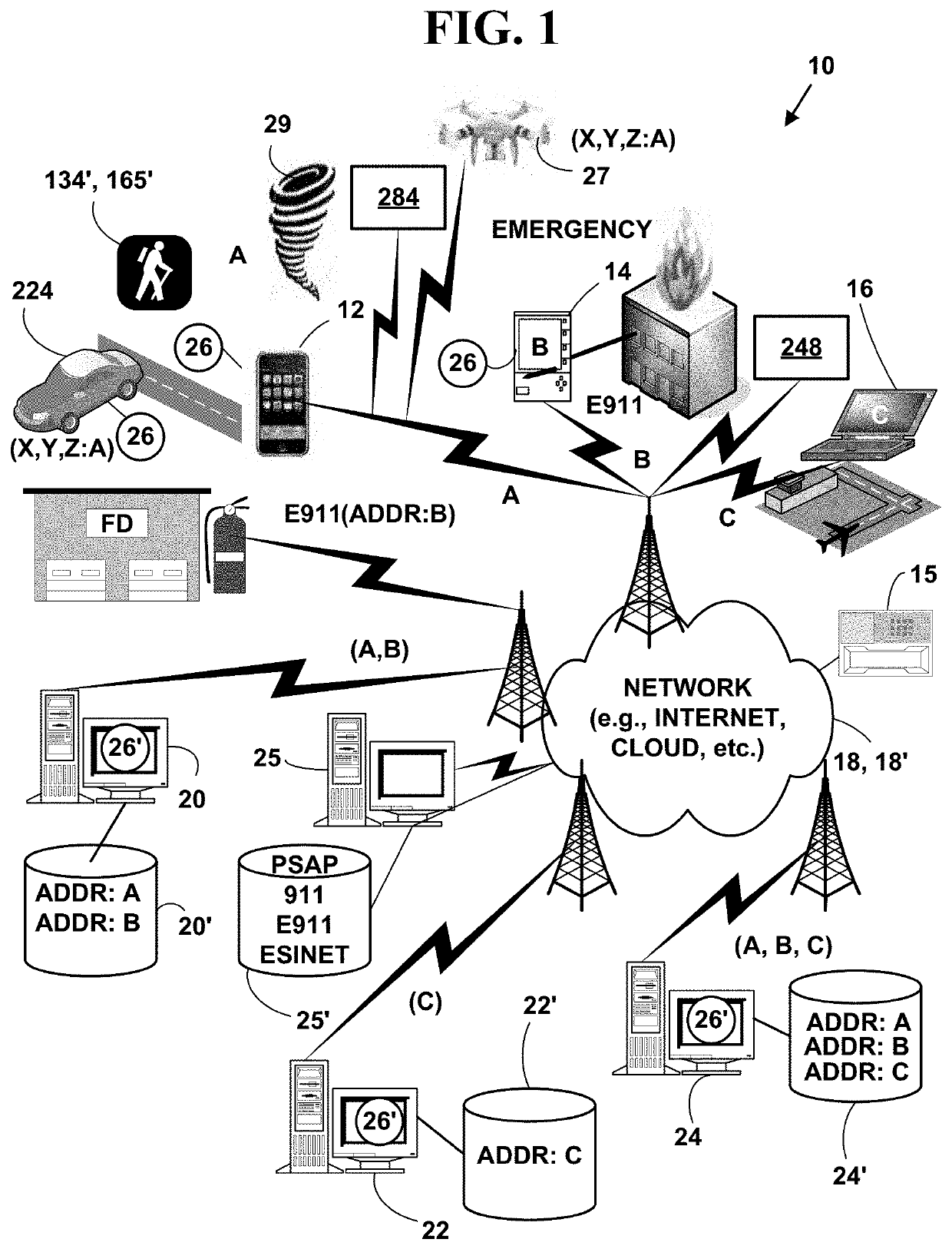
[0062]FIG. 1 is a block diagram illustrating an exemplary communications system 10. The exemplary communications system 10 includes, but is not limited to, one or more target network devices 12, 14, 16, and / or one or more IoT network devices 248 (only three of which are illustrated) each with one or more processors. The target network devices 12, 14, 16, 27, 158, 150, 162, 167, 227 and / or one or more IoT network devices 248, and / or one or more water-based network devices 284, include, but are not limited to, wearable devices (e.g., glasses, watches, wrist bands, smart clothing, jewelry, etc.), UAVs, driverless vehicles, mobile phones, non-mobile phones, smart phones, tablet computers, portable gaming platforms (GAMEBOY and DSI by Nintendo, PSP by Sony, etc.), non-portable gaming platforms (e.g., XBOX by Microsoft, Wii by Nintendo, PLAY STATION, by Sony, etc.) non-mobile computers, wireless devices, wired devices, ga...

the structure of the environmentally friendly knitted fabric provided by the present invention; figure 2 Flow chart of the yarn wrapping machine for environmentally friendly knitted fabrics and storage devices; image 3 Is the parameter map of the yarn covering machine
Login to View More

PUM

No PUM Login to View More

Abstract

An emergency location information service (E-LIS) for water-based network devices. The E-LIS includes a server application and server network devices that accepts emergency messages from water-based network devices. The water based network devices comprise one or more sensors or one or more actuators, a wireless connection interface including a wireless low power wide-area ultra-narrowband network interface and a wireless low earth orbit satellite network connection interface and is an automated network device capable of sensing is own environment and automatically sending out the one or more emergency messages or one or more emergency text messages without operator input to an E-LIS server network device when an emergency event occurs on a body of water. The E-LIS server network device provides a current physical geographic location for such water-based network devices and / or users of the water-based network devices in an emergency situation on the body of water such as a river, lake, sea, ocean, etc.

Description

CROSS REFERENCES TO RELATED APPLICATIONS[0001]This U.S. utility patent application is a Continuation-In-Part (CIP) of U.S. utility patent application Ser. No. 15 / 491,608, filed on Apr. 19, 2017, that issued as U.S. Pat. No. 10,511,950, on Dec. 17, 2019, which is a CIP of U.S. utility patent application Ser. No. 14 / 806,068 filed on Jul. 22, 2015, that issued into U.S. Pat. No. 9,935,534, on Apr. 25, 2017, which is a CIP of U.S. utility patent application Ser. No. 14 / 579,760, filed on Dec. 22, 2014, that issued as U.S. Pat. No. 9,094,816, on Jul. 28, 2015, which is a CIP of U.S. patent application Ser. No. 14 / 303,842, filed on Jun. 13, 2014, that issued as U.S. Pat. No. 8,918,075, on Dec. 23, 2014, which is a CIP of U.S. utility patent application Ser. No. 13 / 831,426, filed Mar. 14, 2013, which issued as U.S. Pat. No. 8,755,767, on Jun. 17, 2014, which is a CIP of U.S. utility patent application Ser. No. 13 / 098,981, filed May 2, 2011, which issued and U.S. Pat. No. 8,442,482 on May 14...

Claims

the structure of the environmentally friendly knitted fabric provided by the present invention; figure 2 Flow chart of the yarn wrapping machine for environmentally friendly knitted fabrics and storage devices; image 3 Is the parameter map of the yarn covering machine
Login to View More

Application Information

Patent Timeline
no application Login to View More
IPC IPC(8): H04W4/90H04W4/029H04W4/30H04W4/38H04M1/725G08B25/00G08B25/10G08B21/18B63C9/00B63B45/00H04M1/72421H04M1/72424
CPCH04M2250/52G08B25/002G08B21/182B63C9/00H04M1/72541B63B45/00H04W4/90H04M1/72538H04M2250/12H04W4/30H04W88/06H04W4/029H04W4/38G08B25/10H04W4/12H04W4/44Y02D30/70G08B21/0269G08B25/016H04M1/72424H04M1/72421
Inventor MAIER, NICHOLAS M.EISNER, GERALD R.
Owner EVERBRIDGE
Features
  • R&D
  • Intellectual Property
  • Life Sciences
  • Materials
  • Tech Scout
Why Patsnap Eureka
  • Unparalleled Data Quality
  • Higher Quality Content
  • 60% Fewer Hallucinations
Social media
Patsnap Eureka Blog
Learn More