

Polymeric composition, aqueous acrylic resin having high solvent resistance, and method for manufacturing the same
a technology of acrylic resin and polymer composition, which is applied in the field of polymer composition, an acrylic resin having high solvent resistance, and a manufacturing method of the same, which can solve the problems of affecting the quality of synthetic leather, and causing harm to the environment and human health, and water-based treating agents still have the disadvantage of exhibiting poor solvent resistan
- Summary
- Abstract
- Description
- Claims
- Application Information
AI Technical Summary
Benefits of technology
Problems solved by technology
Method used
Image

Examples
embodiment 1
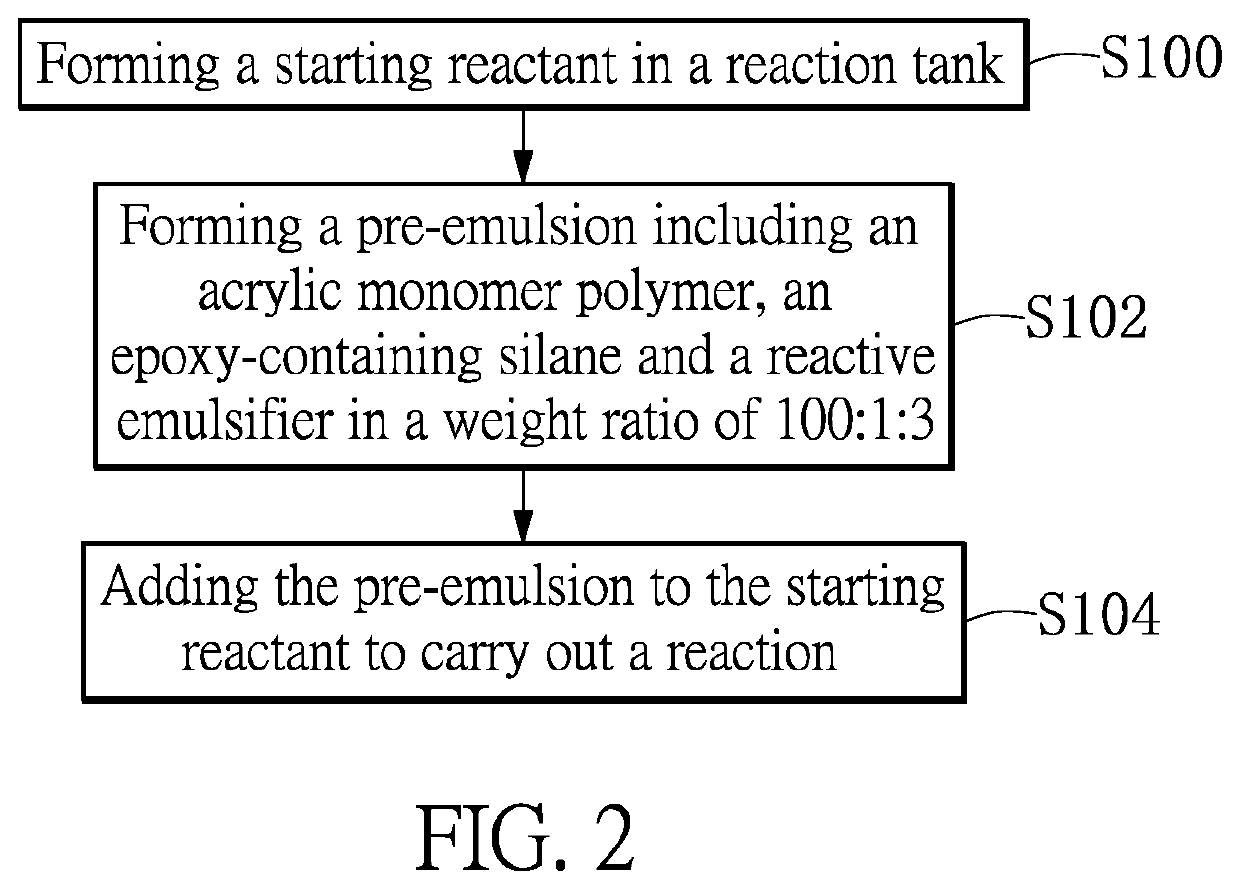
[0049]The starting reactant is added to the reaction tank to be mixed uniformly. After the temperature in the reaction tank is raised to 75° C., a first hydrophilic initiator is added and stirred continuously for 10 minutes. 37 parts by weight of the deionized water, 3 parts by weight of the reactive emulsifier SR-10, 3 parts by weight of the epoxy-containing silane and 3 parts by weight of the acrylic monomer polymer are mixed uniformly by a mixer, so as to form a pre-emulsion. The temperature is maintained at 75° C., and the pre-emulsion is added to the reaction tank in a dropwise manner After 30 minutes of reaction, the aqueous solution formed by a second hydrophilic initiator is added dropwise to the reaction tank (time: controlled to be within 4 hours), and the temperature is raised to 80° C. to react for 2 hours. After the reaction, the temperature in the reaction tank is cooled to below 40° C. Then, ammonia is added to adjust the pH value of the resulting product to pH 7-8. F...
embodiment 2
[0051]The reaction process of Embodiment 2 is the same as that of Embodiment 1. What is different is that in Embodiment 2, the polymeric composition contains 1 part by weight of 3-glycidoxypropyl) methyldiethoxysilane (KBE402). The compositions of the polymeric composition are shown in Table 1. After the reaction, the calculated solid content of a product obtained by the preparing process is 43% by weight. The product is formed into a film, whose physical properties are tested and shown in Table 2.
embodiment 3
[0052]The reaction process of Embodiment 3 is the same as that of Embodiment 1. What is different is that in Embodiment 3, the polymeric composition contains 0.5 parts by weight of 3-glycidoxypropyl) trimethoxysilane and 0.5 parts by weight of (3-glycidoxypropyl) methyldiethoxysilane. The compositions of the polymeric composition are shown in Table 1. After the reaction, the calculated solid content of a product obtained by the preparing process is 43% by weight. The product is formed into a film, whose physical properties are tested and shown in Table 2.
PUM
| Property | Measurement | Unit |
|---|---|---|
| Temperature | aaaaa | aaaaa |
| Temperature | aaaaa | aaaaa |
| Weight ratio | aaaaa | aaaaa |
Abstract
Description
Claims
Application Information
 Login to View More