
Compensation of dispersion
a dispersion and dispersion technology, applied in the field of dispersion compensation, can solve the problems of predetermined value, no system is yet commercially available, and the risk of faulty decision in the receiver exceeds a tolerable valu
- Summary
- Abstract
- Description
- Claims
- Application Information
AI Technical Summary
Benefits of technology
Problems solved by technology
Method used
Image

Examples
Embodiment Construction
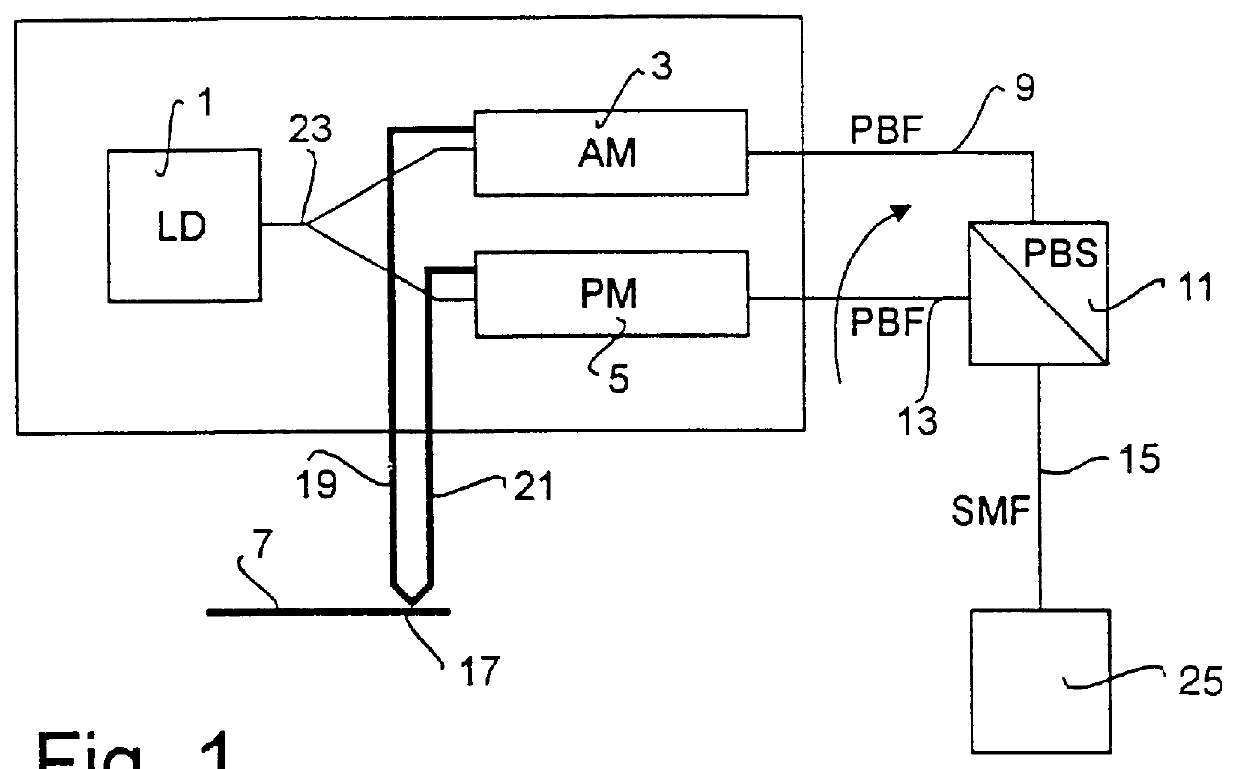
In FIG. 1 a transmitter which is intended to be used for transmitting signals is shown. The transmitter in this embodiment comprises a laser 1, which emits a light beam having a fixed frequency and amplitude. This beam is split into two parallel beams in a beam splitter 23. From the beam splitter 23 the two beams are guided to an amplitude modulator 3 and a phase modulator 5, respectively.
The two modulators 3 and 5 are modulated in parallel with an electrical signal, which is present on a line 7, carrying the information signal, and which is to be transmitted. This signal on the line 7 is split at 17 and transmitted to the amplitude modulator 3 and the phase modulator 5, on the lines 19 and 21, respectively. The output signal from the amplitude modulator 3 passes via a polarization preserving optical fibre 9 to one side of a polarization beam splitter 11, which here acts as a beam collector. The polarized output signal from the phase modulator 5 is transmitted to the polarization be...
PUM
 Login to View More
 Abstract
Description
Claims
Application Information
 Login to View More