While the Buhrke
system was put into practice and used for a period of years during the early 1980's, it was prone to problems and ultimately unsuccessful.
In particular, the void features formed in the sheet of material in the beginning of the operations in the press created an elastic condition when the sheet was indexed through the press, leading to registration problems between the sheet of material and downstream work stations that formed the closure and other features in the end.
More specifically, the void features led to relative movement between various portions of the sheet when the indexing mechanism moved the sheet through the press, resulting in a mis-alignment between the tools of the work stations and the portion of the sheet containing an end in various states of completion.
Furthermore, the
machine had a relatively low
metal realization since the design requires material to carry the ends through the press.
The resulting down-time to change the position of the dies,
slow speed of operation,
poor quality of ends due to the misalignment, and overall maintenance and metal utilization problems experienced by machines made in accordance with the '422 Buhrke patent eventually resulted in the abandonment and eventual replacement of such machines.
The Herrmann '199 patent was commercialized for a short time, but such machines were.soon abandoned and replaced.
The
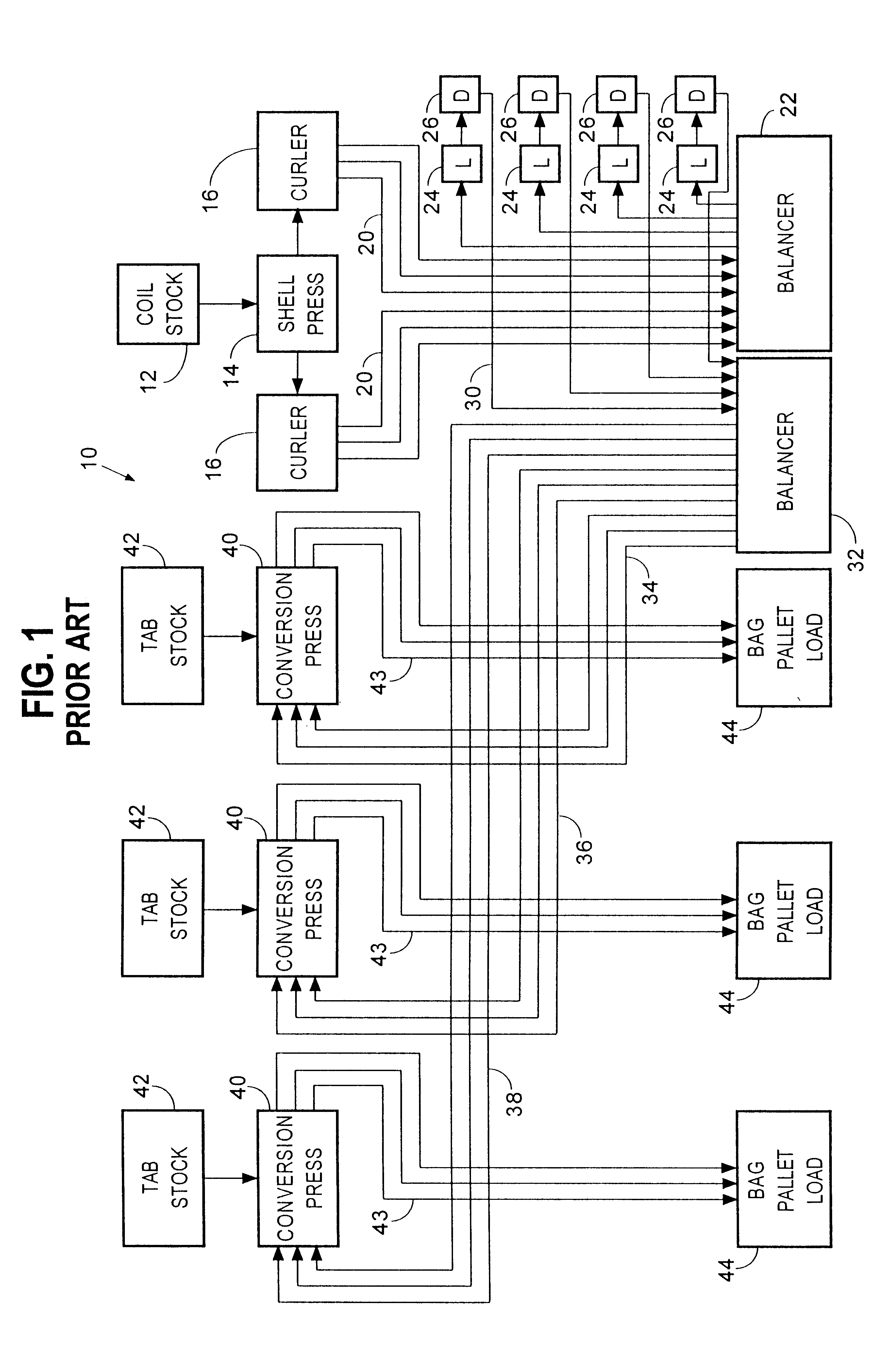
system of FIG. 1, described below, was a much more complex and capital-intensive
system than those systems used previously.
First, an enormous
capital investment is required to install a system such as shown in FIG. 1.
In particular, a large amount of expensive track work is required.
The system requires two balancers and a total of four presses, all of which are very costly machines.
Further, the
layout of the equipment requires a large amount of space and therefore a large building site, which increases the cost.
Construction of such a building and providing heating and cooling also increases costs.
Furthermore, the sheer number of presses and the balancers results in a system that consumes a lot of electrical power during operation, and a large number or operators and
mechanics, increasing the costs further.
While the system of FIG. 1 could be modified somewhat by reducing the number of conversion presses or eliminating the dryers, the basic architecture of the prior art system based on shell presses, conversion presses, balancers and extensive track-work is a very capital, space, energy and labor intensive system.
This results in maintenance of proper alignment of the sheet with respect to the tools as the end is formed by the work stations.
If a particular problem is found with an end at an inspection
station at the end of the line, the problem can be traced to the particular tool or even portion of a tool in the press.



 Login to View More
  Login to View More