Unlock instant, AI-driven research and patent intelligence for your innovation.

Low impedance electrochemical cell

a low-impedance electrochemical and cell technology, applied in the field of electrochemical cells, can solve the problems of less efficient ionic transport through the separator, higher device impedance, and the potential difference between the two electrodes will reach a level

Inactive Publication Date: 2003-09-02
EATON INTELLIGENT POWER LTD
View PDF6 Cites 10 Cited by
  • Summary
  • Abstract
  • Description
  • Claims
  • Application Information

AI Technical Summary

Benefits of technology

This approach results in lower impedance and higher volumetric capacitance, enabling faster charge delivery and increased power storage in double layer capacitor cells.

Problems solved by technology

Ultimately, however, the potential difference between the two electrodes will reach a level where the electrolyte solvent is electrolyzed (introducing a large source of leakage current).
The less efficient the ionic transport through the separator, the higher the impedance of the device.
The greater the distance between the electrodes, the less efficient the ionic transport and the greater the impedance of the cell.
Further, such electrodes may have only a fraction of their available surface area effectively wetted because their pore size distribution extends into a regime where the pore size is on the order of the double layer (i.e., the pores are too small to be effectively wetted).
Still further, surface roughness inherent to electrodes composed of particulates increases the likelihood of shorting of electrodes as dielectric thickness is decreased.

Method used

the structure of the environmentally friendly knitted fabric provided by the present invention; figure 2 Flow chart of the yarn wrapping machine for environmentally friendly knitted fabrics and storage devices; image 3 Is the parameter map of the yarn covering machine
View more

Image

Smart Image Click on the blue labels to locate them in the text.
Viewing Examples
Smart Image
  • Low impedance electrochemical cell
  • Low impedance electrochemical cell
  • Low impedance electrochemical cell

Examples

Experimental program
Comparison scheme
Effect test

Embodiment Construction

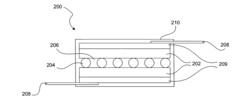
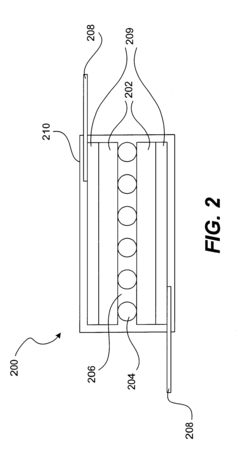
It must be emphasized that the following procedure is a proof of concept for the present invention. This is just one example of an implementation of the present invention and is not intended to limit the scope of the invention. Other techniques and materials can be used in accordance with the general parameters outlined above. Five micron glass fibers were sprinkled onto one of two aerogel carbon disks about 25 mm in diameter. A few drops of organic electrolyte were dispensed on the disk. The second disk was placed over the first disk with fibers and electrolyte sandwiched. The entire assembly was sealed with tape. Gold leaf foil was used to make contact with the carbon disks. The capacitance and impedance were measured to confirm that a functional cell resulted.

Conclusion

The present invention may be applied to produce a low impedance, high performance dielectric between electrochemical device electrodes, in particular in double layer capacitor cells, as well as in other electrical,...

the structure of the environmentally friendly knitted fabric provided by the present invention; figure 2 Flow chart of the yarn wrapping machine for environmentally friendly knitted fabrics and storage devices; image 3 Is the parameter map of the yarn covering machine
Login to View More

PUM

No PUM Login to View More

Abstract

Provided are electrochemical (e.g., double layer capacitor) cell designs and methods of their manufacture, which reduce cell impedance and increase volumetric capacitance while maintaining inter-electrode dielectric integrity and cell performance. The designs eliminate the contiguous separator material used as the dielectric between the electrodes in conventional double layer capacitor cells. The separator is replaced by a noncontiguous array of dielectric particles, such as glass beads or fibers, sized and distributed to provide substantially uniform separation between the electrodes. The remaining space between the electrodes unoccupied by the dielectric particles is filled with electrolyte. In this way, a much greater proportion of the dielectric space between the electrodes is available for ionic transport. Glass beads and fibers are available with diameters less than that available for currently-used separator materials. Thus, the distance between the electrodes may be reduced without compromising dielectric integrity. The result is a lower impedance, higher volumetric capacitance double layer capacitor cell.

Description

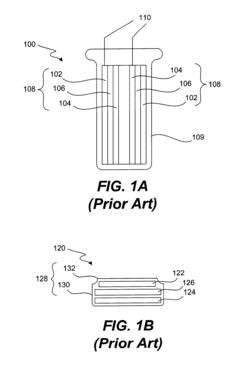
1. Field of the InventionThe present invention relates to electrochemical cells and methods for their manufacture. More particularly, the invention relates to separator-less double layer capacitor cells having improved performance characteristics including decreased impedance.2. Description of Related ArtUnlike a battery, a capacitor does not produce electrons by chemical reaction. However, capacitors, have a distinct advantage over batteries in certain applications in that that they can be recharged incrementally and quickly. Thus, capacitors are advantageously used in hybrid systems in conjunction with batteries to support brief high current demands through pulse discharges. Also, they may be used for power storage and as stand-alone power back-ups, for example, to provide a stable power source for computer memory in the event of a primary power source failure.There are two principal types of capacitors: Parallel plate, and double layer. A parallel plate capacitor is composed of t...

Claims

the structure of the environmentally friendly knitted fabric provided by the present invention; figure 2 Flow chart of the yarn wrapping machine for environmentally friendly knitted fabrics and storage devices; image 3 Is the parameter map of the yarn covering machine
Login to View More

Application Information

Patent Timeline
no application Login to View More
Patent Type & Authority Patents(United States)
IPC IPC(8): H01G9/00H01G9/155
CPCH01G9/155Y02E60/13H01G11/52H01G11/32H01G11/82
Inventor KAMATH, HUNDI P.
Owner EATON INTELLIGENT POWER LTD