The first issue concerns what series connector is used, especially for probes or for direct connections to signals to be measured by the
test equipment, and that are not merely an ancillary part of a
test set-up.
Finally, since it relies solely on internally supplied spring tension to draw its parts together, it can, when under externally applied tension, allow the
mating parts to separate sufficiently to degrade the quality of the connection (greater discontinuity, more loss), sometimes to point where the connection is interrupted altogether (especially if the parts are worn from extended use).
Many of the problems of BNC connectors can be traced to aspects in the design of the male half, which is to say, the part that has the male center conductor pin and that is given the quarter turn twist while gripping a knurled shell we shall call a bayonet latch.
Unfortunately, pulling on the cable, or otherwise inducing external tension urging the two connector halves apart, can overcome the internal spring tension keeping the connectors halves together.
If a sufficient tension is applied the connector halves will draw apart slightly, disturbing the uniform inner
diameter of the mated outer shells and possibly introducing an increased ohmic component in the connection.
A similar bad thing happens in connection with the Teflon sleeves.
That fails when the connector halves pull apart, producing another discontinuity owing to a location of altered
dielectric constant.
This happens adjacent where the center pins have their “
diameter fault,” increasing the resulting discontinuity.
Furthermore, the presence of the Teflon is a bit of a problem in the first place, since it is difficult to
machine the stuff to the tolerances needed to reliably perform the magic of the vanishing edges.
Not only is Teflon difficult to
machine to tight tolerances, but it won't hold them over time, even if it could be done, since Teflon cold flows so easily.
We are now faced with a situation where the connector of choice is a principal limitation in the overall performance of the scope / probe combination.
It is true that there are other RF connectors that would solve the problem of the rotten RF connection, but they are unsuitable for one or more reasons.
Some are simply too expensive, and, it will be noted, the expensive ones tend to be threaded and / or easily damaged; APC 3.5 connectors come to mind in this regard.
Precision type N connectors would carry the signals all right, but they, too, are threaded, and besides being moderately expensive, they take a lot of panel space.
It was (and still is!) a pretty good connector, and perhaps when in good condition is even comparable to a “precision” type N. But it is as big or bigger than N, is more expensive, and sadly, seems to be on the verge of “going away.” Well, then, so be it.
(We note that it cooperates, with some degradation in performance, with conventional BNC.
The second issue concerns the electrical attachment of scope probes in particular.
Unfortunately, despite its ease of use in attaching and detaching it from the scopes
front panel, it is still a conventional
BNC connector as far as the quality of the
transmission line segment formed by the connector is concerned.
It still has a slitted outer conductor on the male side, and the lack of a separate deliberate mechanism to draw the halves together means that tension produced from supporting the weight of the pod can cause separation of the center conductors and of the outer conductors.
These considerations significantly limit the performance of the scope when higher frequencies are considered.
Because the
thumb lever extends through a slot in the pod housing, there is a 90° limitation on the total amount of latch rotation that can be supplied.
With this minimal degree of steepness (essentially to guarantee a sufficient amount of “throw” or
axial displacement to move the connector halves together) there is not always enough
mechanical advantage to sustain the needed compressive force produced by the “locking” action, particularly when there is a significant sideways force applied to the pod (produced by, say, a tug on the cable).
Furthermore, it is somewhat inelegant in that path through which the compressive force is anchored and applied is more convoluted than direct (the path involves the pod housing, the
front panel and the mounting of the connectors themselves).
More elements in the path make the tolerance situation worse, and lessen the amount of rigidity that can expected.



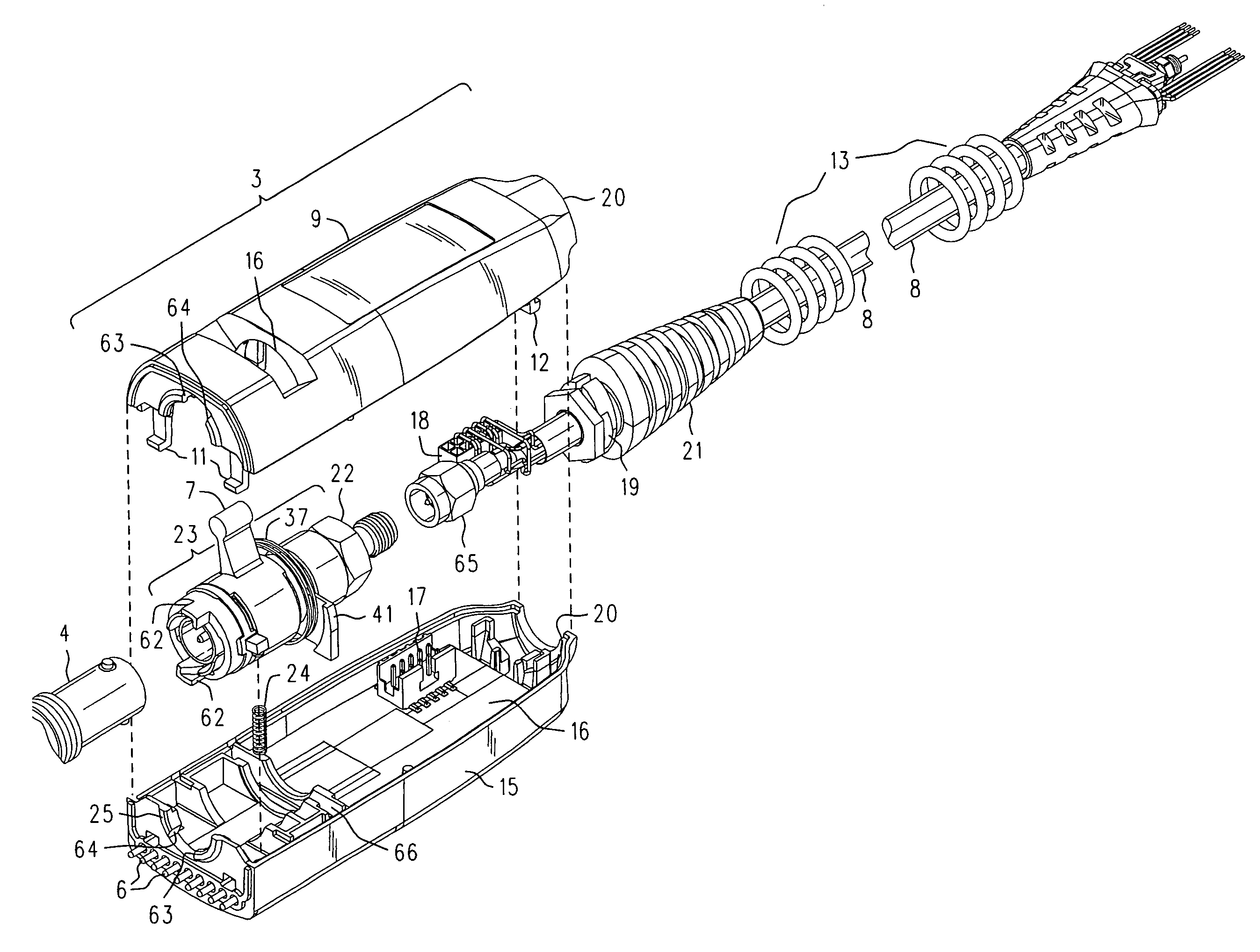
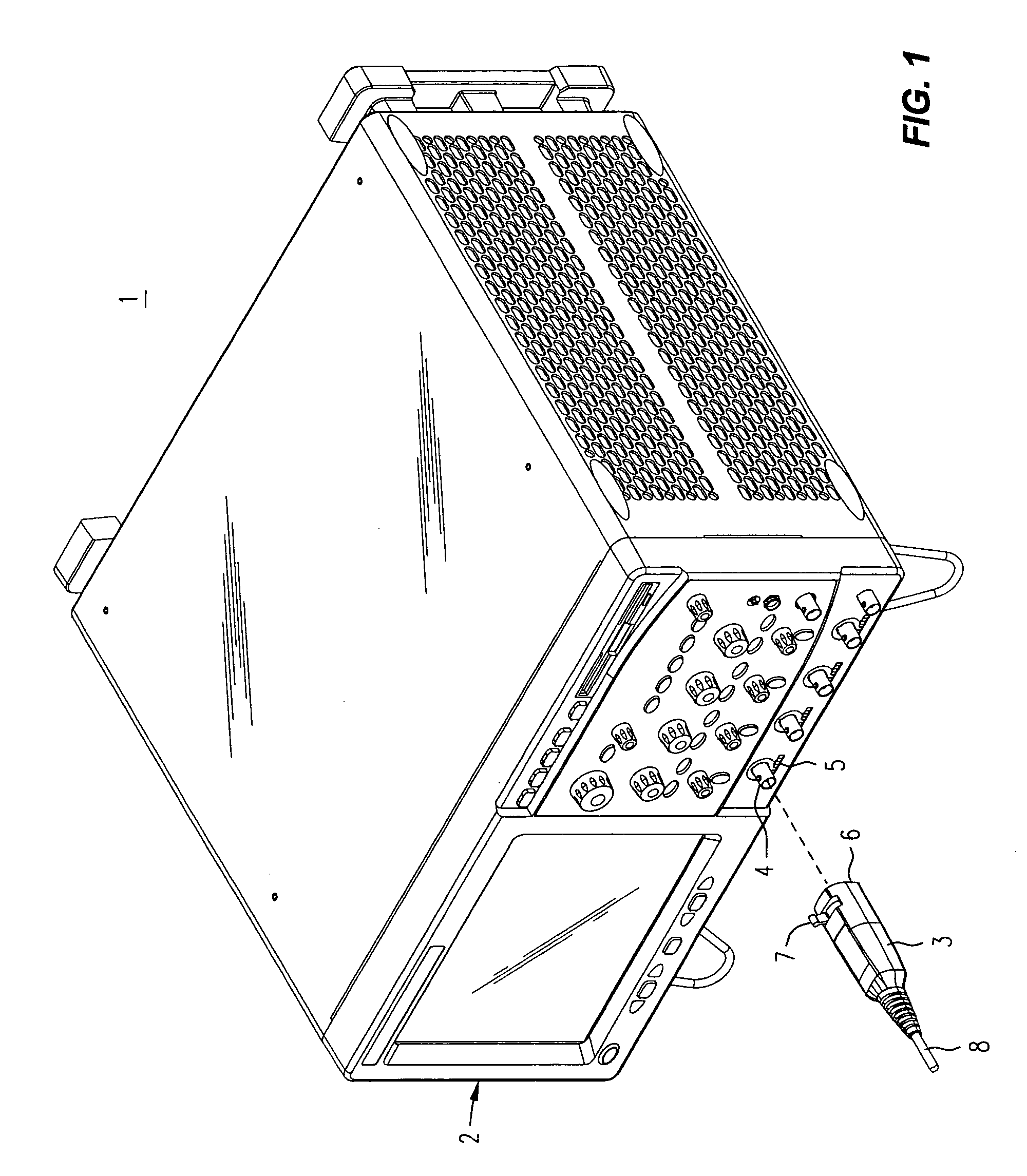
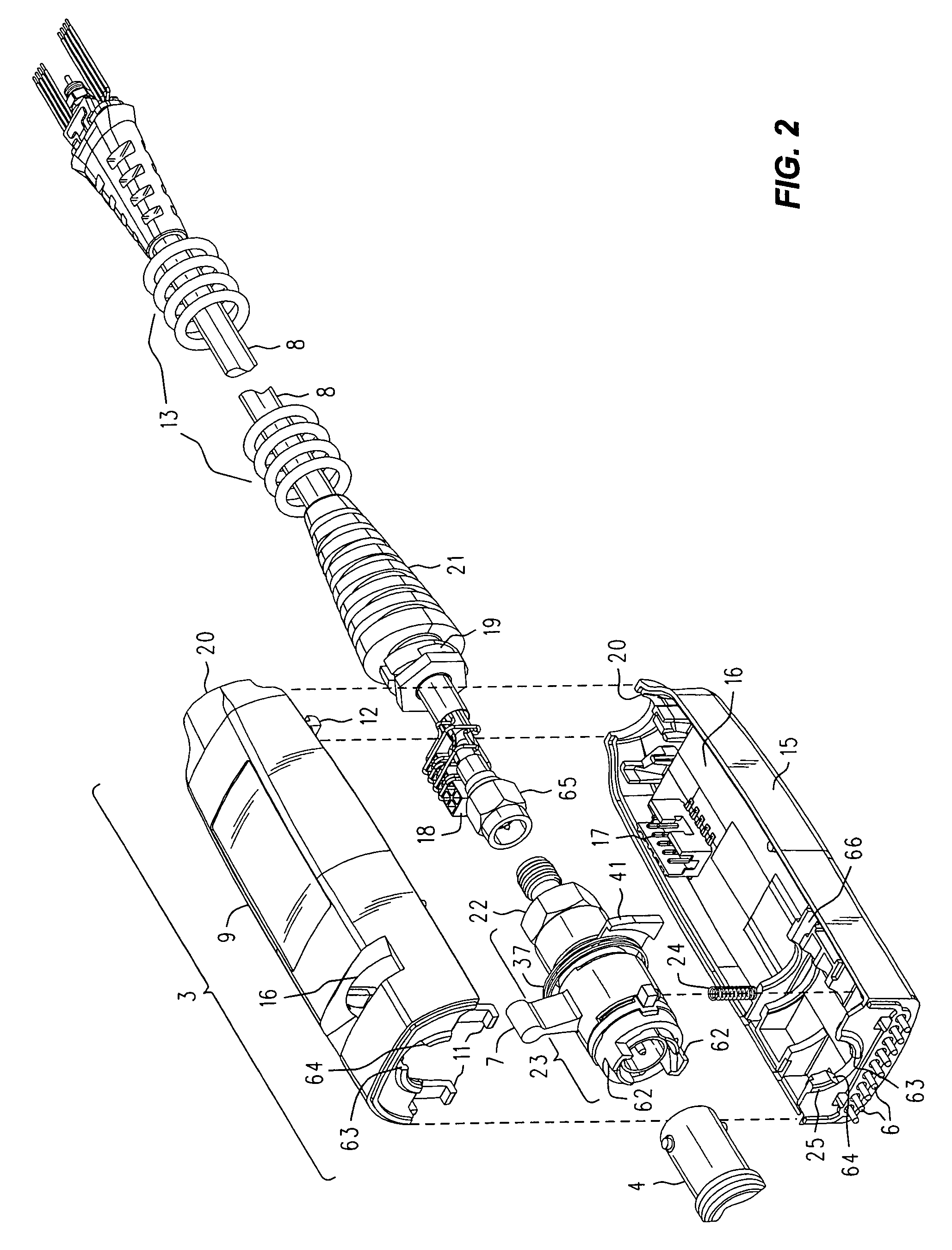
 Login to View More
  Login to View More