
Laser counter-measure using fourier transform imaging spectrometers
a technology of imaging spectrometer and countermeasure, applied in the field of countermeasures, using a fourier transform imaging spectrometer, can solve the problems of saturation artifacts, image artifacts of different levels, and achieve the effect of reducing the level of interfering signals
- Summary
- Abstract
- Description
- Claims
- Application Information
AI Technical Summary
Benefits of technology
Problems solved by technology
Method used
Image

Examples
Embodiment Construction
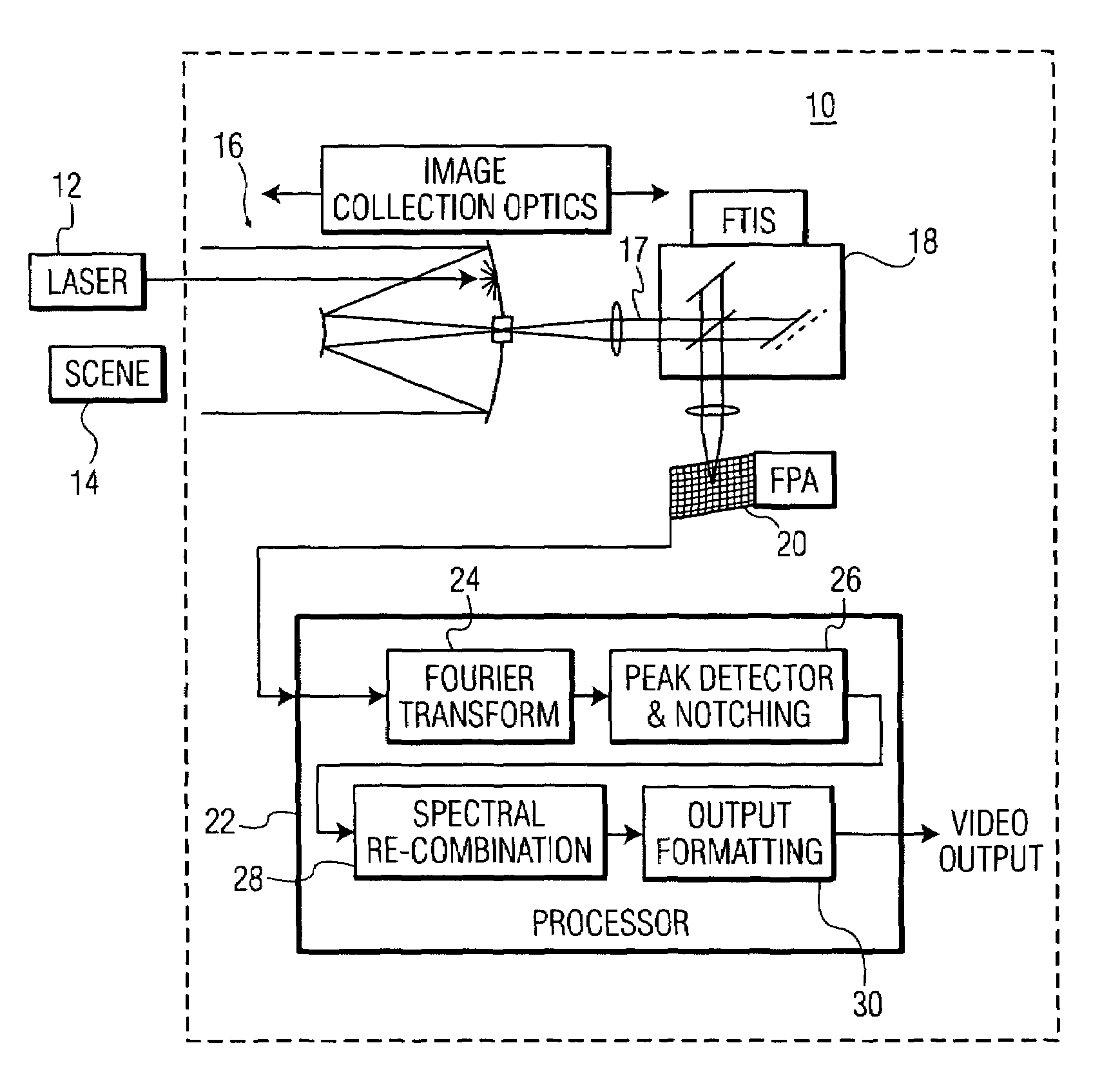
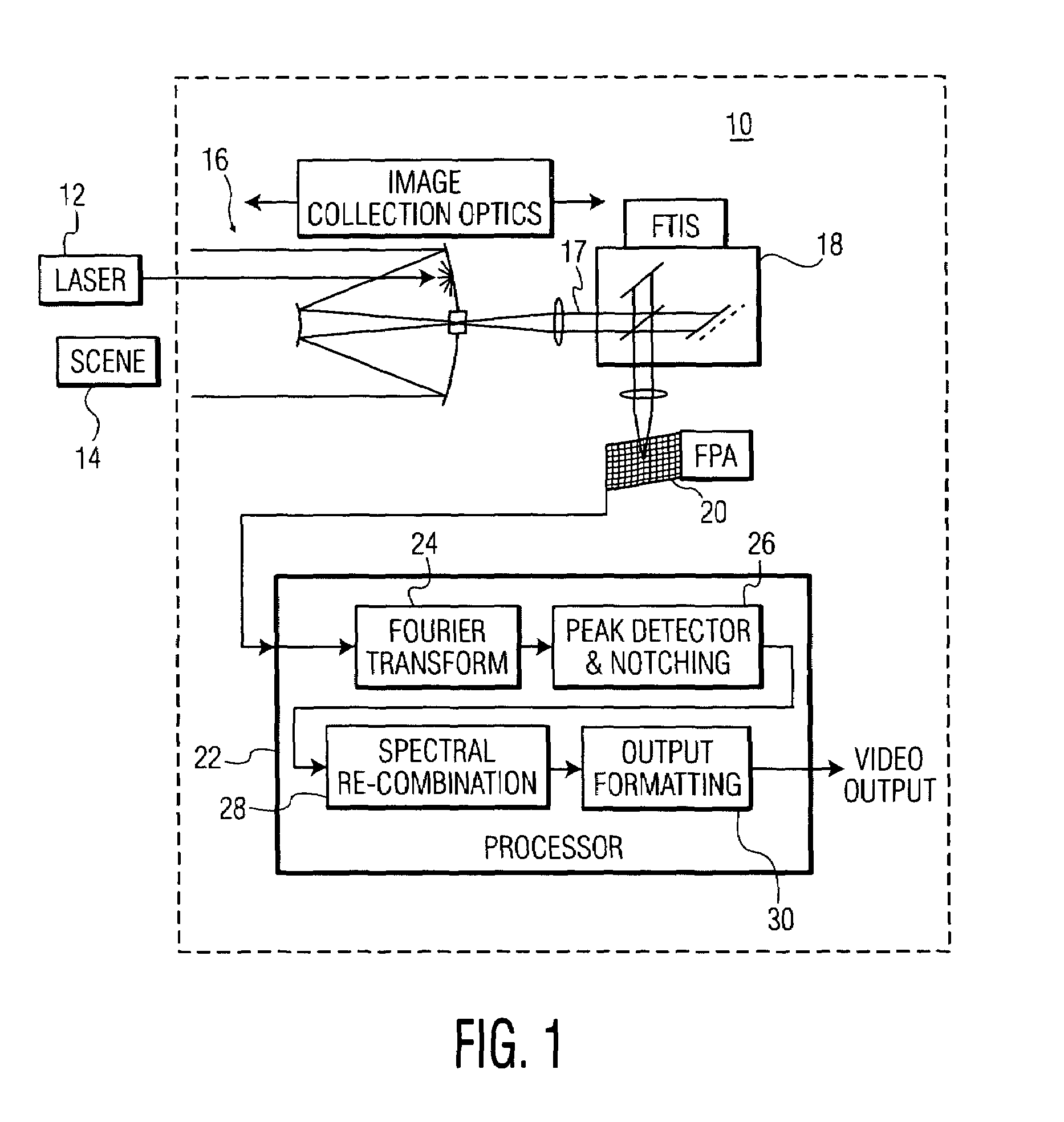
[0028]Referring to FIG. 1, there is shown an imaging system for reducing or eliminating interference from unwanted laser illumination into the imaging system, the system generally designated as 10. Imaging system 10 includes image collection optics 16, Fourier transform imaging spectrometer (FTIS) 18, focal plane array (FPA) 20 and processor 22.
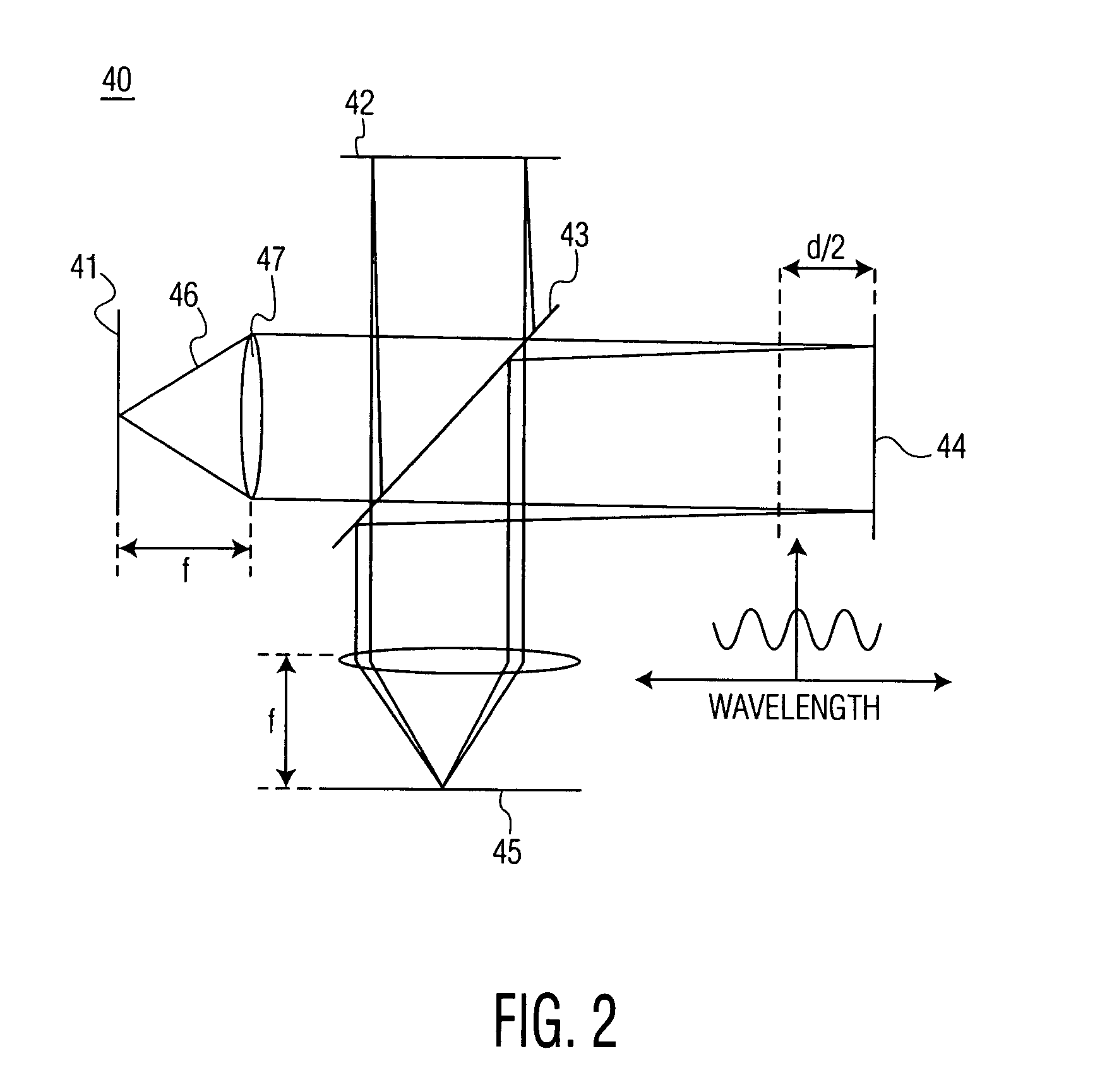
[0029]Light from a target of interest, for example light from scene 14, is directed toward the image collection optics, which may include a telescopic lens and a collimator lens. Collimated beam 17, formed by the collimator lens, is then directed into FTIS 18. As will be explained, FTIS 18 converts the incoming scene energy into interferograms, at each point of the imaging field. These interferograms, which are representations of the output spectrum of the image, at each point of the imaging field, are directed to a two-dimensional array detector, for example FPA 20.
[0030]Since the interferograms represent a Fourier transform of the spectral ...
PUM
 Login to View More
 Abstract
Description
Claims
Application Information
 Login to View More