Data signal processing method and data processor implementing independent and asynchronous system and data clocks
a data signal and clock technology, applied in the direction of synchronising signal speed/phase control, generating/distributing signals, instruments, etc., can solve the problems of data passing/passing, data transfer speed cannot be changed freely by users and makers, and data transmission is not so easy to achieve, so as to speed up the operation
- Summary
- Abstract
- Description
- Claims
- Application Information
AI Technical Summary
Benefits of technology
Problems solved by technology
Method used
Image


Examples
embodiment 1
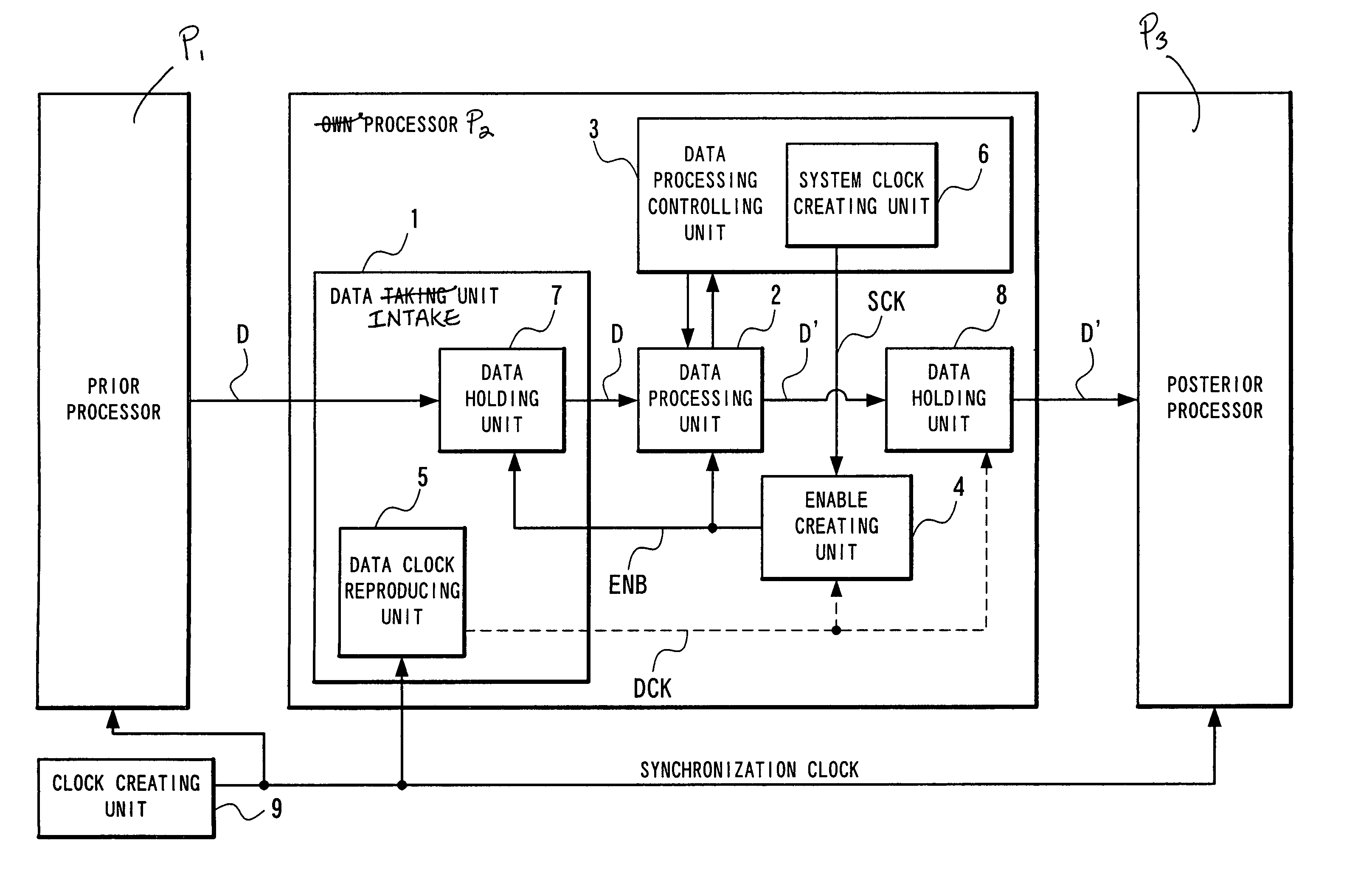
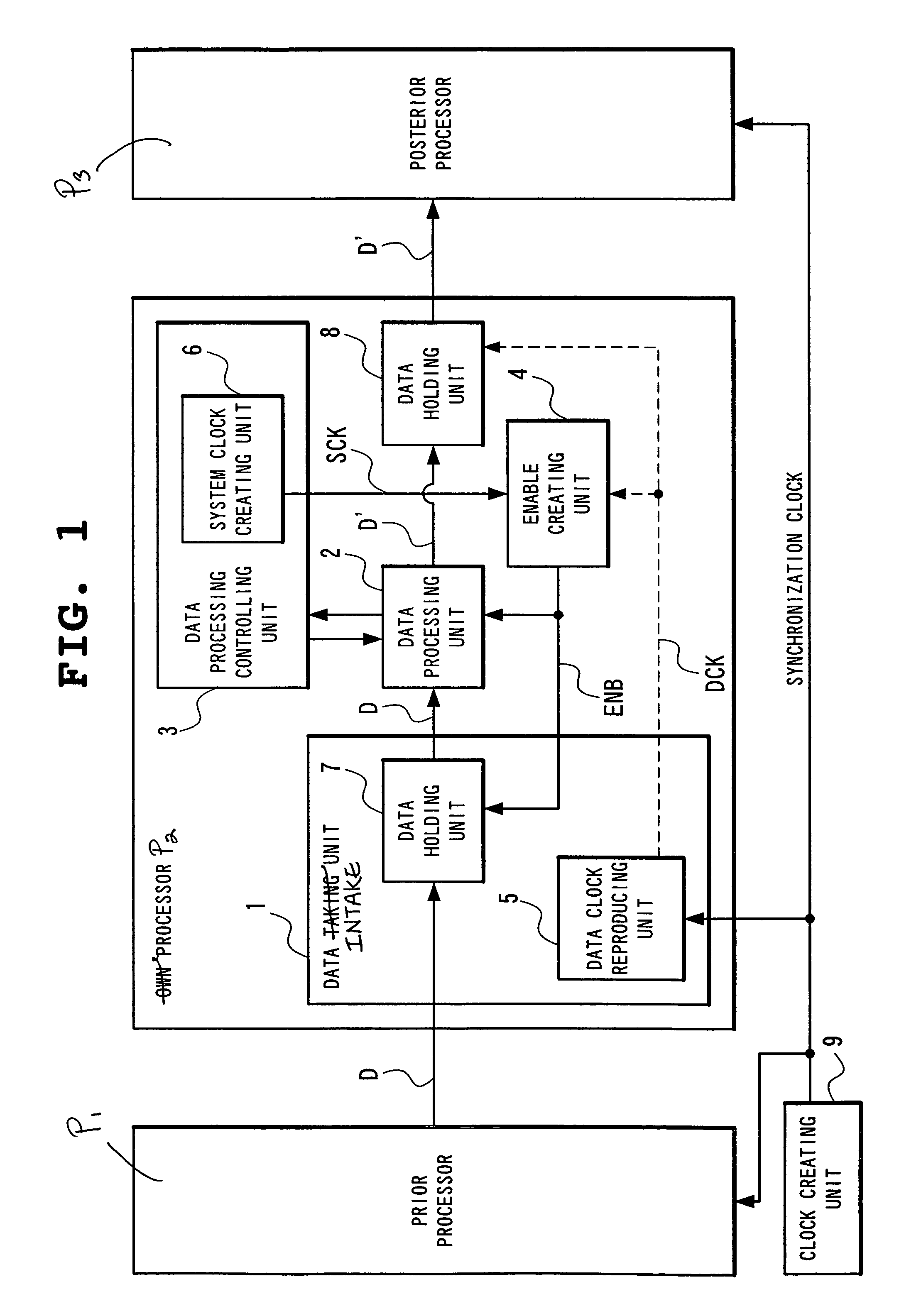
[0057]The method and the data processor comprises a data taking or input unit 1, a data processing unit 2, a data processing controlling unit 3, and an enable creating unit 4. The data input unit 1 further includes a data clock reproducing unit 5 and a first data holding unit 7. The data processing controlling unit 3 includes a system clock creating unit 6. Further, as an interface to the posterior processor P3, it includes a second holding unit 8. In the embodiment 1, there exists a clock creating unit 9 that is an external clock source, so to distribute a synchronization clock to the respective processors.
[0058]The data input unit 1 performs the processing of reproducing and supplying a data clock DCK after phase synchronization with an input clock or data, in the data clock reproducing unit 5 and the processing of taking the data D sent from the prior processor P1 into the first data holding unit 7 according to a data processing enable signal ENB. In the embodiment 1, a synchroni...
embodiment 3
[0078]In the structure of the above embodiments, the structure without the data processing controlling unit 3 (namely, the data processing of the data D is performed by only the data processing unit 2) may be considered (embodiment 3 in FIG. 4). This is in the case, for example, where the input data D is always effective data and the predetermined constant processing is performed in the data processing unit 2. In this case, as the output destination of the processed data D, there exists an interface to the posterior processor P3.
embodiment 4
[0079]Further, the structure without the second data holding unit 8 for supply to the posterior processor P3 may be considered (embodiment 4 in FIG. 5). This is in the case, for example, where there exists the data processing controlling unit 3, the necessary information has been taken out from the input data D and exhausted in processor P2, and therefore the data is not transmitted to the posterior processor P3. Alternatively, this is in the case where even if there exists a posterior processor P3, the data D is transmitted there at the data cycle indifferent to the data clock DCK input in processor P2.
[0080]According to the above structure and operation, it is possible to speed up the data processing by changing the clock rate of the system clock SCK of processor P2, without changing the interface specification for the respective connected processors. This is because the data clock DCK and the system clock SCK are designed to operate independently and asynchronously. As an applica...
PUM
 Login to View More
 Abstract
Description
Claims
Application Information
 Login to View More
 - R&D
- Intellectual Property
- Life Sciences
- Materials
- Tech Scout
- Unparalleled Data Quality
- Higher Quality Content
- 60% Fewer Hallucinations
Browse by: Latest US Patents, China's latest patents, Technical Efficacy Thesaurus, Application Domain, Technology Topic, Popular Technical Reports.
© 2025 PatSnap. All rights reserved.Legal|Privacy policy|Modern Slavery Act Transparency Statement|Sitemap|About US| Contact US: help@patsnap.com