Supercharge Your Innovation With Domain-Expert AI Agents!

Integrated circuit memory devices having clock signal arbitration circuits therein and methods of performing clock signal arbitration

a technology of integrated circuit memory and clock signal, which is applied in the direction of memory adressing/allocation/relocation, digital storage, data conversion, etc., can solve the problems of data stored therein, data cannot be modified but only read, and increase the complexity and layout area requirements of these higher bandwidth memory devices

Active Publication Date: 2006-08-15
INTEGRATED DEVICE TECH INC +1
View PDF8 Cites 12 Cited by
  • Summary
  • Abstract
  • Description
  • Claims
  • Application Information

AI Technical Summary

Benefits of technology

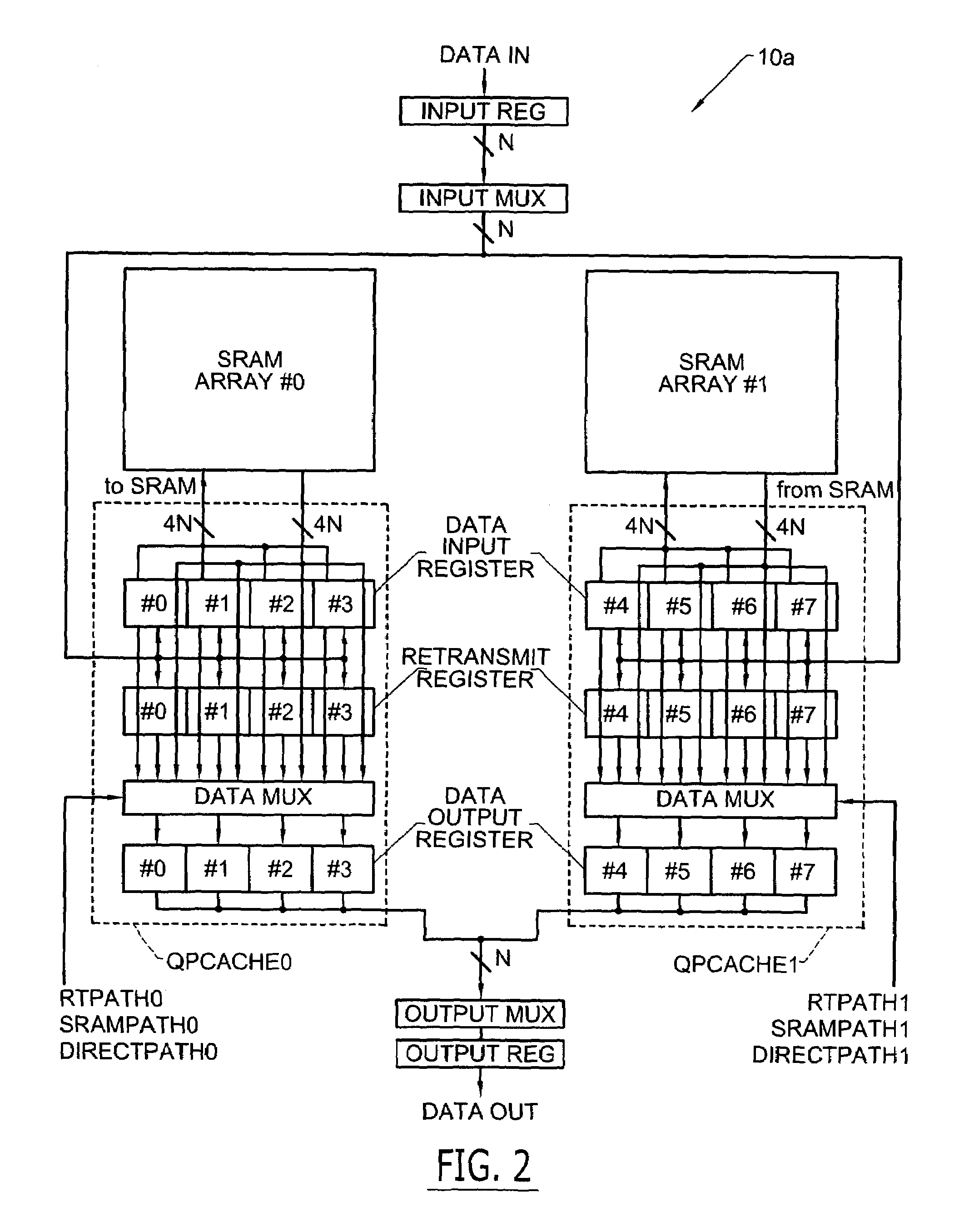
The solution provides high-speed buffer memory devices with expanded functionality, increased data capacity, and faster performance by utilizing a quad-port cache memory device in conjunction with a supplemental memory array, while minimizing the complexity of reading and writing operations.

Problems solved by technology

Because RWM devices use active circuitry to store data, they belong to a class of memory devices known as “volatile” memory devices because data stored therein will be lost upon termination of the power supply.
Since this latter type of data storage may be hardwired, the data cannot be modified, but can only be read.
However, the addition of ports to individual memory cells typically increases the complexity and layout area requirements for these higher bandwidth memory devices.
Unfortunately, a major disadvantage of typical dual-port SRAM-based FIFOs is the relatively large unit cell size for each dual-port SRAM cell therein.
Moreover, the relatively large unit cells of a dual-port SRAM FIFO may limit the degree to which the number of write operations can exceed the number of read operations, that is, limit the capacity of the FIFO.
However, the use of only single port memory cells typically precludes simultaneous read and write access to data in the same memory cell, which means that single-port buffer memory devices typically have slower fall-through time than comparable dual-port memory devices.
Moreover, single-port buffer memory devices may use complicated arbitration hardware to control sequencing and queuing of reading and writing operations.
However, like the above-described single-port buffer memory devices, simultaneous read and write access to data is not feasible.

Method used

the structure of the environmentally friendly knitted fabric provided by the present invention; figure 2 Flow chart of the yarn wrapping machine for environmentally friendly knitted fabrics and storage devices; image 3 Is the parameter map of the yarn covering machine
View more

Image

Smart Image Click on the blue labels to locate them in the text.
Viewing Examples
Smart Image
  • Integrated circuit memory devices having clock signal arbitration circuits therein and methods of performing clock signal arbitration
  • Integrated circuit memory devices having clock signal arbitration circuits therein and methods of performing clock signal arbitration
  • Integrated circuit memory devices having clock signal arbitration circuits therein and methods of performing clock signal arbitration

Examples

Experimental program
Comparison scheme
Effect test

Embodiment Construction

[0051]The present invention now will be described more fully herein with reference to the accompanying drawings, in which preferred embodiments of the invention are shown. This invention may, however, be embodied in many different forms and should not be construed as being limited to the embodiments set forth herein; rather, these embodiments are provided so that this disclosure will be thorough and complete, and will fully convey the scope of the invention to those skilled in the art. Like reference numerals refer to like elements throughout and signal lines and signals thereon may be referred to by the same reference characters. Signals may also be synchronized and / or undergo minor boolean operations (e.g., inversion) without being considered different signals. The suffix B (or prefix symbol “ / ”) to a signal name may also denote a complementary data or information signal or an active low control signal, for example.

[0052]Referring now to FIG. 1, a preferred buffer memory device 10...

the structure of the environmentally friendly knitted fabric provided by the present invention; figure 2 Flow chart of the yarn wrapping machine for environmentally friendly knitted fabrics and storage devices; image 3 Is the parameter map of the yarn covering machine
Login to View More

PUM

No PUM Login to View More

Abstract

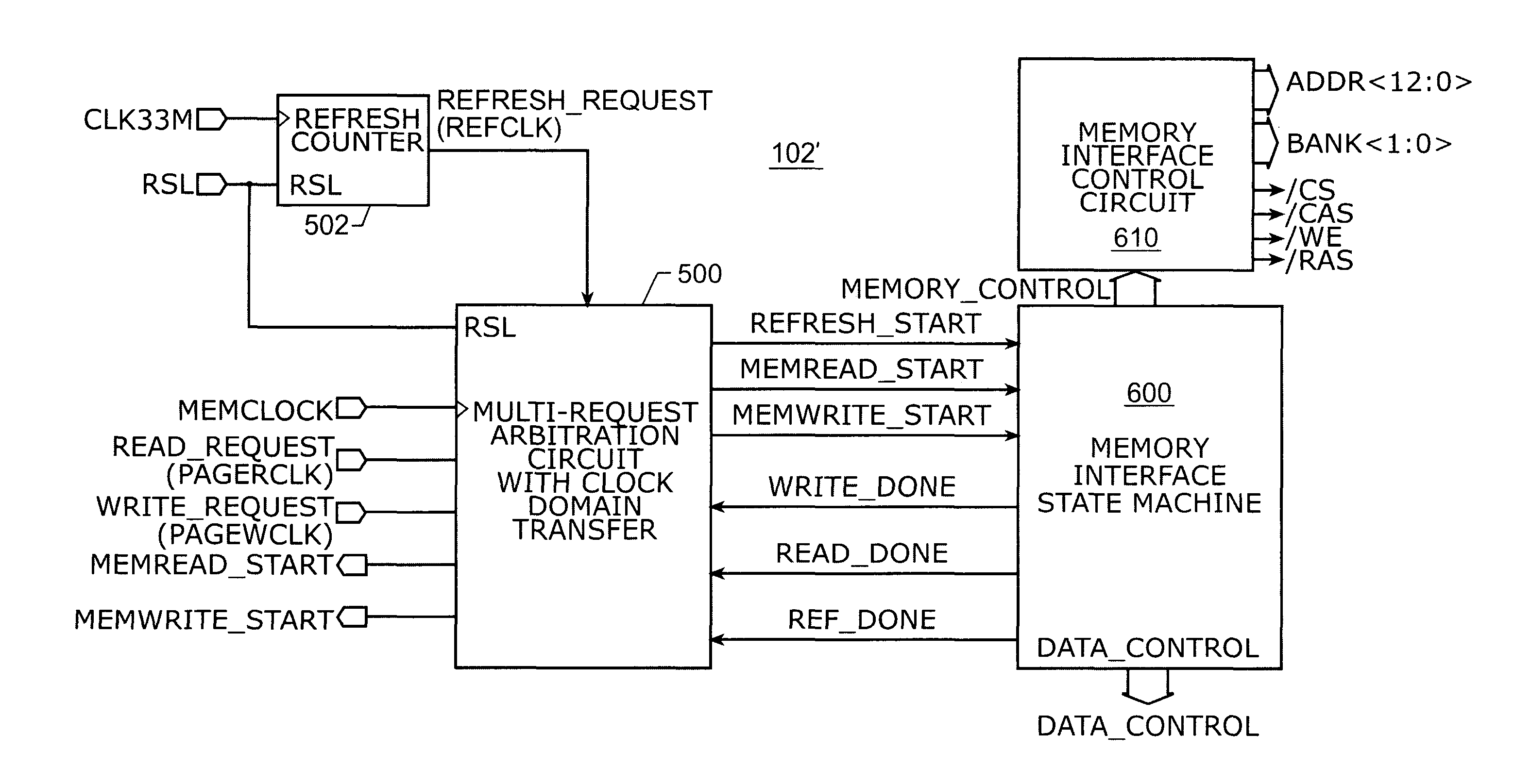
A clock signal arbitration method includes arbitrating between first and second request signals generated in respective first and second clock domains that are asynchronously timed relative to each other, to obtain first arbitration results. These first arbitration results identify a relative queue priority between the first and second request signals. Additional steps are performed to transfer the first arbitration results into a third clock domain that is asynchronously timed relative to the first and second clock domains. The transfer operation may include arbitrating the first arbitration results in a third clock domain to obtain second arbitration results that confirm or correct the first arbitration results.

Description

FIELD OF THE INVENTION[0001]The present invention relates to integrated circuit memory devices and methods of operating same, and more particularly to buffer memory devices and methods of operating buffer memory devices.BACKGROUND OF THE INVENTION[0002]Semiconductor memory devices can typically be classified on the basis of memory functionality, data access patterns and the nature of the data storage mechanism. For example, distinctions are typically made between read-only memory (ROM) devices and read-write memory (RWM) devices. The RWM devices typically have the advantage of offering both read and write functionality with comparable data access times. Typically, in RWM devices, data is stored either in flip-flops for “static” memory devices or as preset levels of charge on a capacitor in “dynamic” memory devices. As will be understood by those skilled in the art, static memory devices retain their data as long as a supply of power is maintained, however, dynamic memory devices req...

Claims

the structure of the environmentally friendly knitted fabric provided by the present invention; figure 2 Flow chart of the yarn wrapping machine for environmentally friendly knitted fabrics and storage devices; image 3 Is the parameter map of the yarn covering machine
Login to View More

Application Information

Patent Timeline
no application Login to View More
Patent Type & Authority Patents(United States)
IPC IPC(8): G06F13/14G06F12/08G11C7/10G06F12/00
CPCG11C7/1012G11C7/1051G11C7/106G11C7/1078G11C7/1087G11C7/1075G11C2207/2245
Inventor AU, MARIODUH, JIANN-JENG
Owner INTEGRATED DEVICE TECH INC
Features
  • R&D
  • Intellectual Property
  • Life Sciences
  • Materials
  • Tech Scout
Why Patsnap Eureka
  • Unparalleled Data Quality
  • Higher Quality Content
  • 60% Fewer Hallucinations
Social media
Patsnap Eureka Blog
Learn More