Although the prepaid account holders can be identified, it is also possible that the prepaid accounts are anonymous, i.e. the operator does not necessarily know the identity of the owner of the account.
However, if the call is made to a terminal connected to another network, e.g. to a terminal connected to a PSTN, the operator of the originating network may become liable for clearing charges later on for the use of the resources of said other network regardless the nature of the charging (post paid or prepaid charging).
Clearing of call charges incurred in the other networks usually takes few days to accomplish.
However, the controller of the originating or first network (such as the MSC) does not necessarily get this charging information from the destination or the second network in all current charging applications.
This may cause problems especially when the originating terminal pays for the connection by means of a prepayment service, since the system should be able to deduct the charges during the connection from the balance associated with the originating terminal.
Although the mobile switching center (MSC) of a PLMN system may obtain the charging component that is associated with the charges in the PLMN system, the mobile switching center does not necessarily receive all information required for the charging from the PSTN e.g. via ISUP (ISDN User part) signalling.
However, this is not possible with the subscribers to the prepaid services, as their charging should occur immediately during the connection.
Although it may be possible to provide the controller of a network, such as the MSC of a PLMN, with information regarding the use of resources in all networks, the controller cannot calculate these different components separately.
The controller may not be made aware of all of the charging components and / or the controller may not be able to calculate all of the needed components and / or to calculate the components separately.
Therefore, although the originating network may be able to produce some kind of estimate of the charges for the prepaid subscribers, the charging of the pre-paid subscribers may still be inaccurate.
A problematic situation may also occur when more than one independently operating charging model is used for a call from a common termination point.
Different call
charge control features used in the different charging and tariff schemes may be in conflict with each other and / or may not interact in a proper manner.
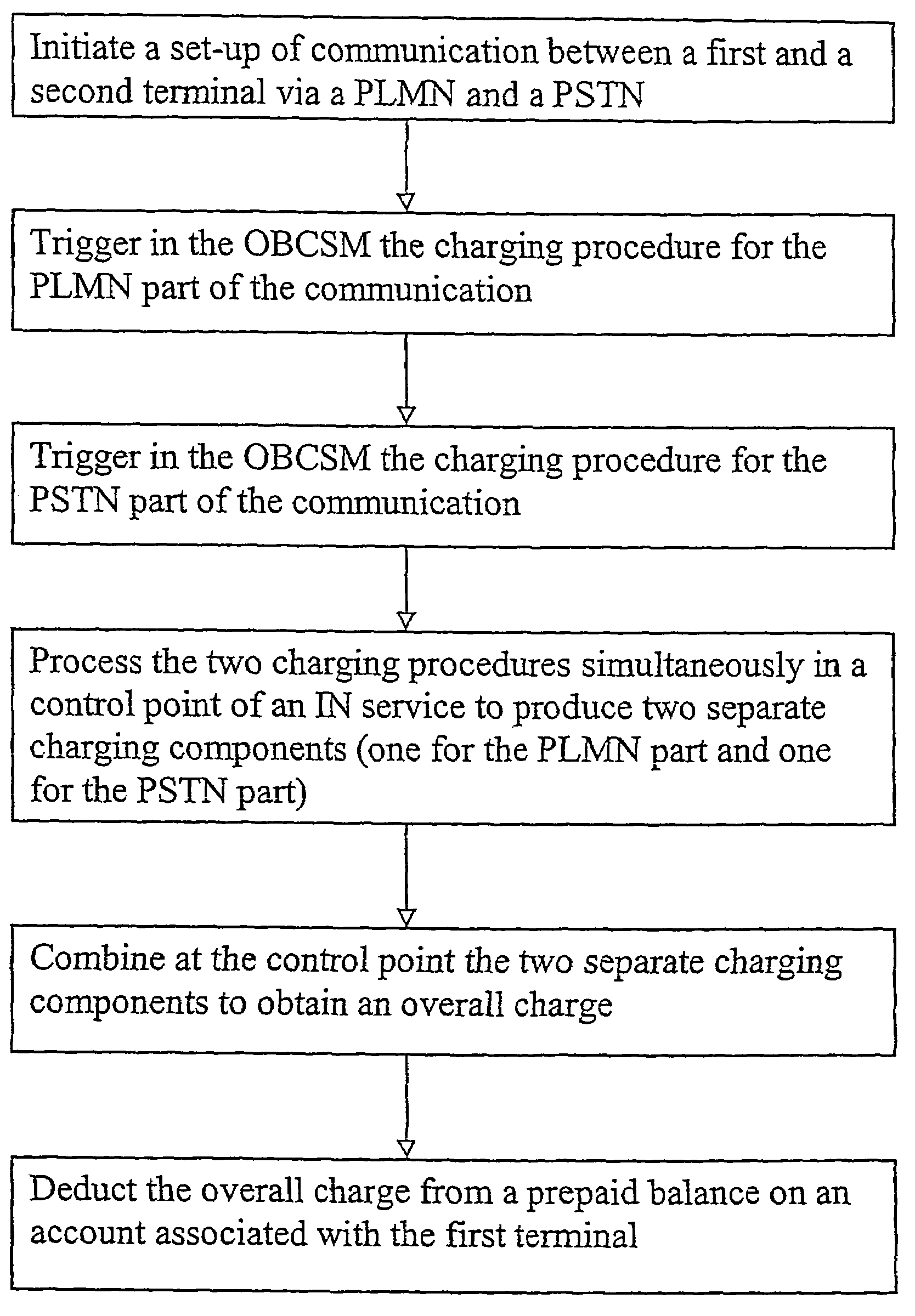
However, the inventors have found that the controller of the originating network cannot calculate independently the two or more charging components at the same time in a same originating
state model.





 Login to View More
  Login to View More