Check patentability & draft patents in minutes with Patsnap Eureka AI!

Shape memory alloy actuator system using segmented binary control

Inactive Publication Date: 2007-03-13
ASADA HARRY HARURIKO
View PDF9 Cites 79 Cited by
  • Summary
  • Abstract
  • Description
  • Claims
  • Application Information

AI Technical Summary

Benefits of technology

[0018]It is therefore an object of the present invention to improve displacement control of the SMA actuators and other active material based actuators.
[0019]It is further object of the present invention to improve the robustness of the control when there is a load disturbance.
[0020]It is further object of the present invention to simplify the control of the SMA actuators and other active material based actuators.

Problems solved by technology

Although these actuator materials have lots of possibilities, numerous difficulties persist in using them reliably and suitably as robot actuators.
Despite the tremendous actuation stress and energy density, SMA has highly complex nonlinear dynamics that limit applicability and utility to rather simple tasks.
Controlling the displacement of SMA is not easy.
Despite these valuable research efforts, control of SMA is still difficult.
Fundamental control performance, e.g. speed of response and disturbance rejection, is still limited even when complex models and sophisticated controls are used.
The fundamental difficulties of SMA control include:The phase transition diagram shows a prominent hysteresis with transitional regions that are both steep and nonlinear.The phase transition temperatures shift as the stress and environmental conditions change.The process is distributed and thereby phase transition is not uniform along the SMA wire.
But the models are not reliable and require knowledge of accurate parameter values.
Because the prior art devices rely on the nonlinear relationship between the temperature and the length of the SMA wire, the accuracy of the control will be degraded when there is a load change during operation.
Also when controlling the displacement using resistance or displacement of the actuator, the temperature of the wire can increase to very high temperature, which will degrade the actuator and make the actuator unusable.
This is why most of the SMA actuator applications are limited to switching, rather than creating a continuous displacement.

Method used

the structure of the environmentally friendly knitted fabric provided by the present invention; figure 2 Flow chart of the yarn wrapping machine for environmentally friendly knitted fabrics and storage devices; image 3 Is the parameter map of the yarn covering machine
View more

Image

Smart Image Click on the blue labels to locate them in the text.
Viewing Examples
Smart Image
  • Shape memory alloy actuator system using segmented binary control
  • Shape memory alloy actuator system using segmented binary control
  • Shape memory alloy actuator system using segmented binary control

Examples

Experimental program
Comparison scheme
Effect test

embodiments

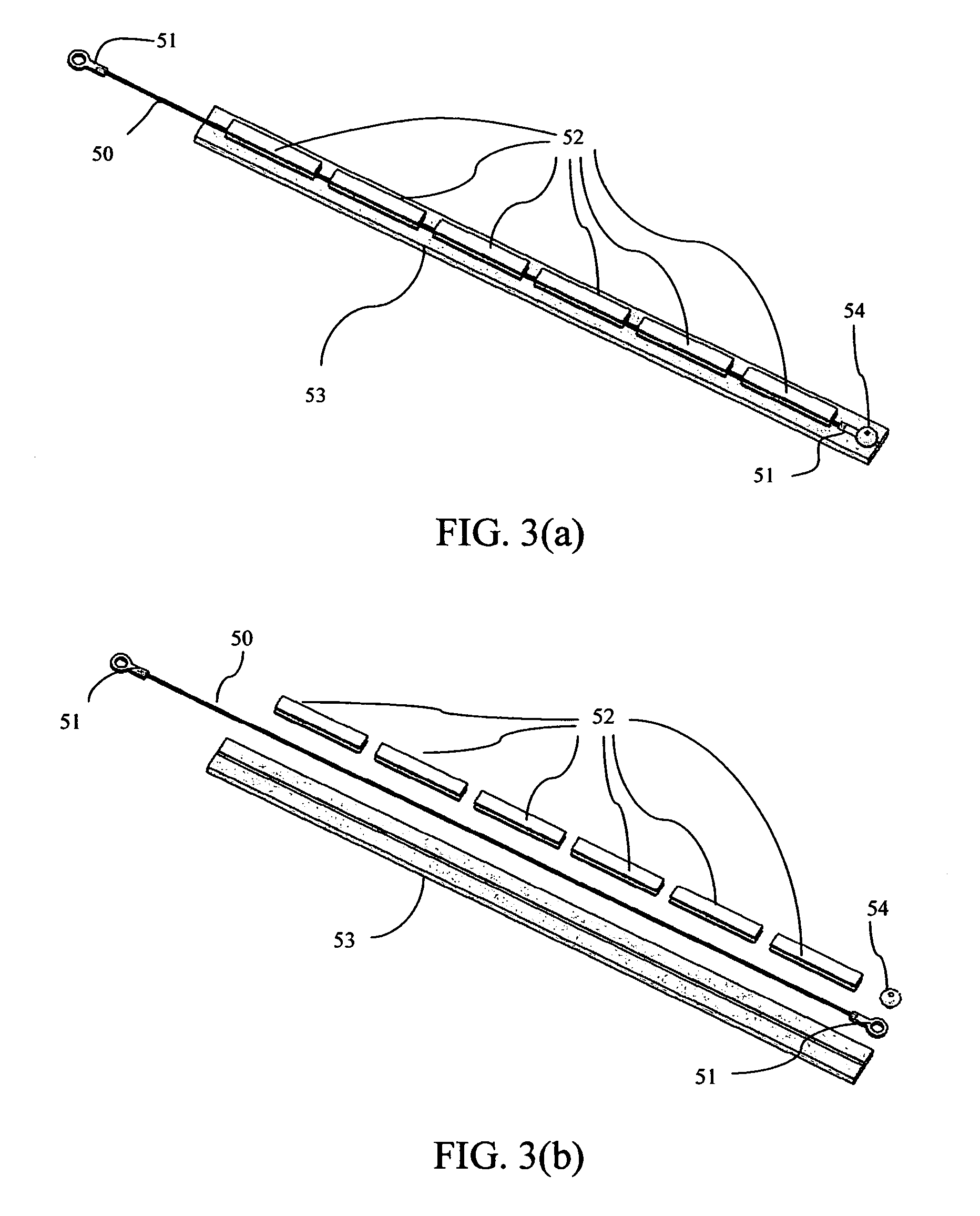
[0081]FIG. 3 shows the preferred embodiment of the actuator. FIG. 3(b) is a exploded view of FIG. 3(a). This embodiment uses thermoelectric devices 52 as the heating segments and plastics 53 as a backing plate. Backing plate can be made of acrylic board, grooved with a depth of 0.01 inch using laser cutter. Other means of grooving can be used, like milling. The SMA actuator 50 is first crimped with ring terminal 51 at both ends. The ring terminals provide means to connect one end of the SMA onto the backing plate, thereby fixing one end, and connect the other end on to any mechanical member that we are trying to control the displacement of. Thermal adhesive tapes(not shown in the figure) are used to attach the thermoelectric device 52 to the backing plate 53. The depth of the groove has to be carefully controlled to keep the thermoelectric device 52 in good contact with the SMA actuator 50. The current can be provided to the thermoelectric device using H-bridge 60 as shown in FIG. 6...

the structure of the environmentally friendly knitted fabric provided by the present invention; figure 2 Flow chart of the yarn wrapping machine for environmentally friendly knitted fabrics and storage devices; image 3 Is the parameter map of the yarn covering machine
Login to View More

PUM

No PUM Login to View More

Abstract

An architecture shape memory alloy (SMA) actuators is presented called Segmented Binary Control (SBC). Instead of controlling the phase transition of the entire SMA wire as a single plant, we divide the SMA wire into many segments, each of which is controlled separately as an ON-OFF finite-state process. SBC produces a displacement as the addition of small displacements generated by the individual segments. Furthermore, the segmented architecture of SMA wires is extended to a multi-axis actuator array by arranging them in a two-dimensional array, so that the multi-axis control may be streamlined and coordinated. Moreover, the 2-D segmentation can be so designed that coordinated gross motion as well as independent fine movements may be generated with minimum complexity and minimum control loops.

Description

CROSS REFERENCE TO RELATED APPLICATIONS[0001]This application claims the benefit of Provisional Patent Application Ser. No. 60 / 565,350 Provisional App filed Apr. 26, 2004 “Segmented Binary Control Of Shape Memory Alloy Actuator Systems Using The Peltier Effect And Segmentation Architecture Of Multi-Axis SMA Array Actuator” by the present inventors.FEDERALLY SPONSORED RESEARCH[0002]The present invention was developed under grant number ISS-0322601 provided by the National Science Foundation. The United States Government has certain rights to this invention.BACKGROUND OF INVENTION[0003]1. Field of Invention[0004]The present invention relates to linear actuators utilizing active materials, more specifically to shape memory alloy actuators for use in controlling the displacement of mechanical systems.[0005]2. Prior Art[0006]Modern, non-electromechanical actuators, such as Shape Memory Alloys (SMA) and Electroactive Polymer (EAP) Actuators, convert the source energy to mechanical energy ...

Claims

the structure of the environmentally friendly knitted fabric provided by the present invention; figure 2 Flow chart of the yarn wrapping machine for environmentally friendly knitted fabrics and storage devices; image 3 Is the parameter map of the yarn covering machine
Login to View More

Application Information

Patent Timeline
no application Login to View More
IPC IPC(8): F01B29/10
CPCH02N11/006F03G7/065
Inventor ASADA, HARRY HARUHIKOCHO, KYU-JINSELDEN, BRIAN
Owner ASADA HARRY HARURIKO
Features
  • R&D
  • Intellectual Property
  • Life Sciences
  • Materials
  • Tech Scout
Why Patsnap Eureka
  • Unparalleled Data Quality
  • Higher Quality Content
  • 60% Fewer Hallucinations
Social media
Patsnap Eureka Blog
Learn More