[0008]An object of the present invention is to provide a postal matter processing method and
system wherein the deficiencies of the prior art are avoided and which allow secure and economical postal matter processing, and wherein the receiving stations are emptied in a
short cycle without maintenance thereof and without a separate handling of the mail in the distributing stations having to ensue with the same frequency as the emptying of the receiving stations.
[0011]It has been found that a common storage container for unfranked but marked mail is more likely to be filled to such an extent that the steps for emptying this container are optimum, even though the filling ensues in a
short cycle. The invention therefore assumes that a common storage container for all unfranked postal matter is most beneficial for the mail dispatcher. Compared to the aforementioned solution of European Application 503 311, the invention has the
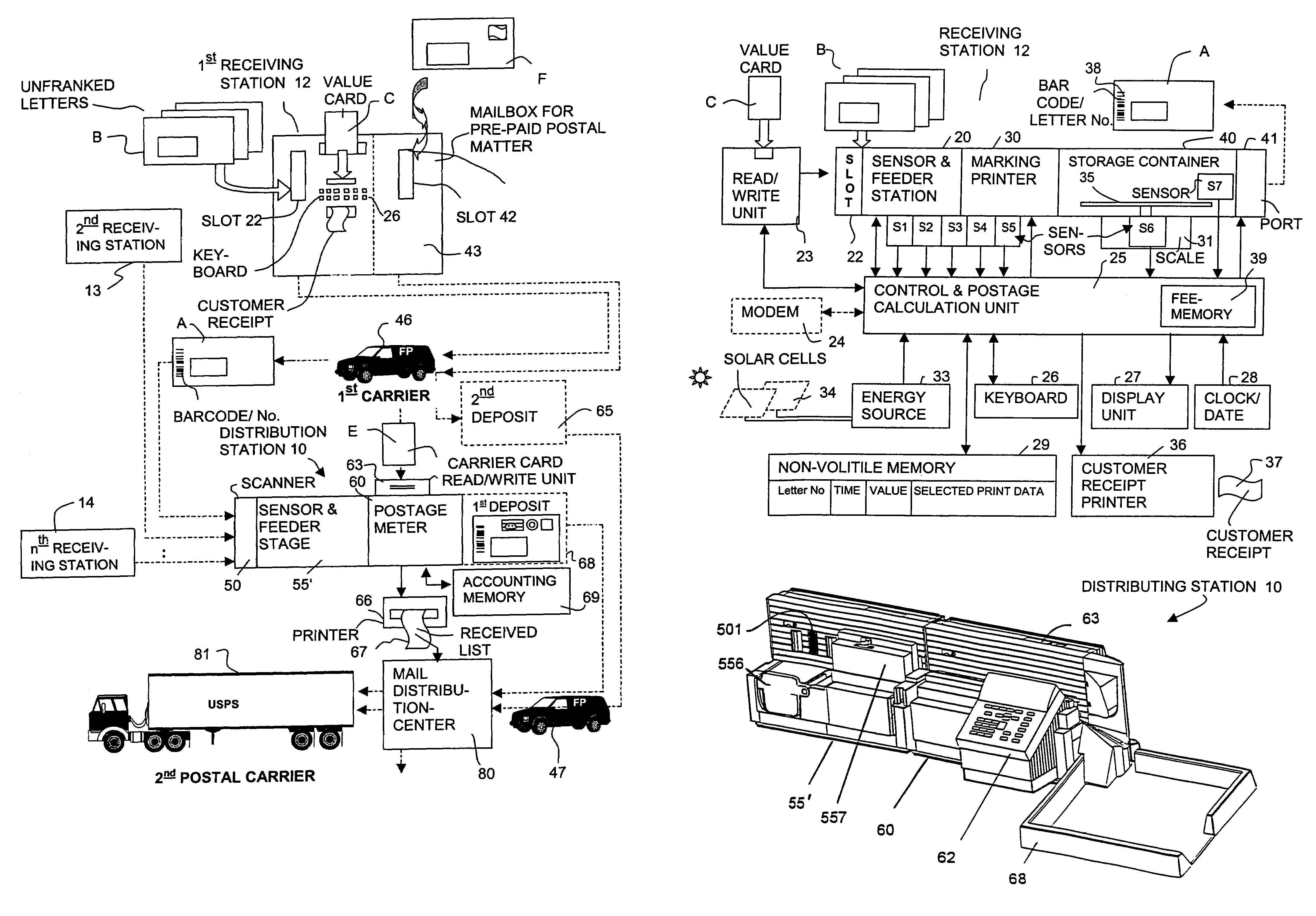
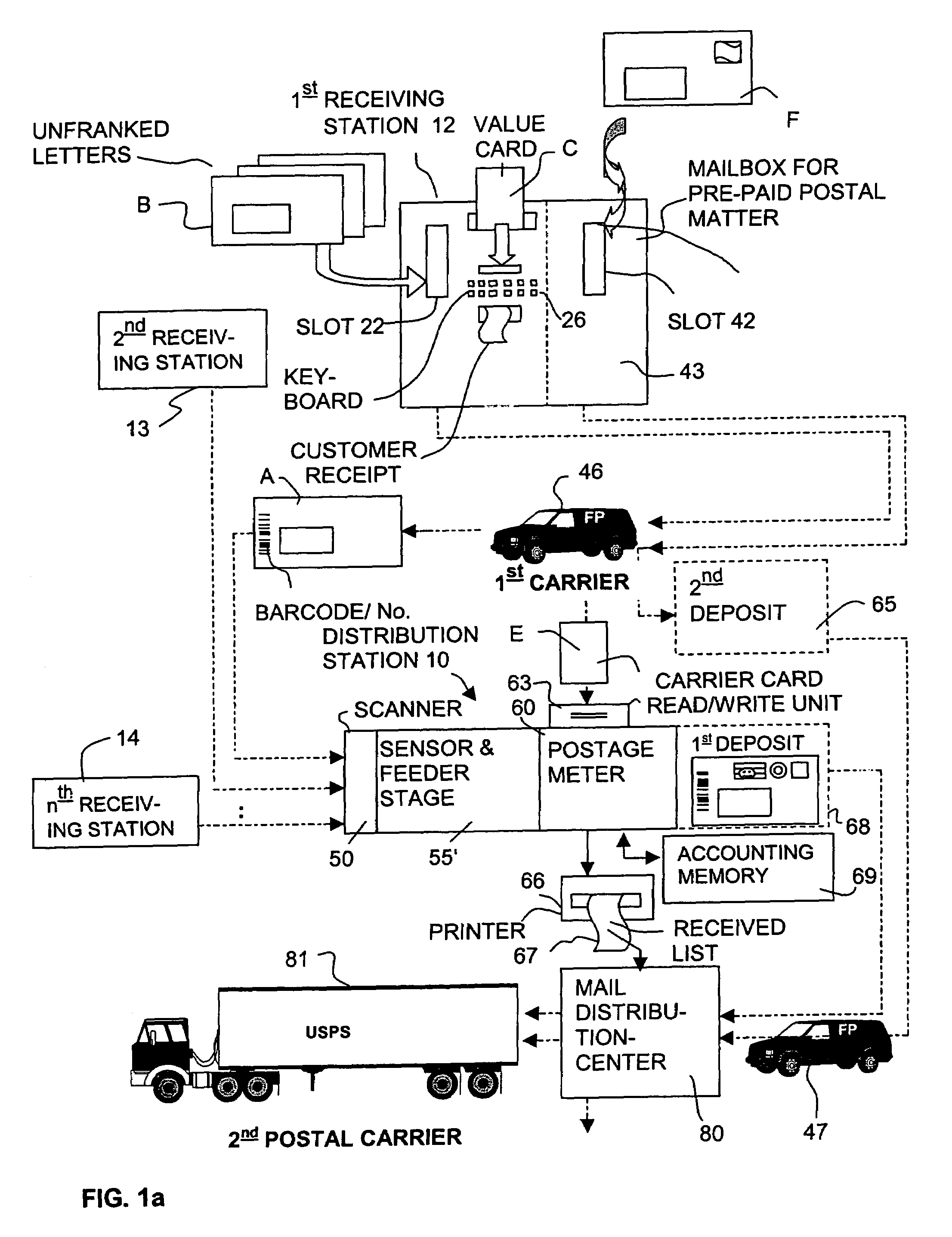
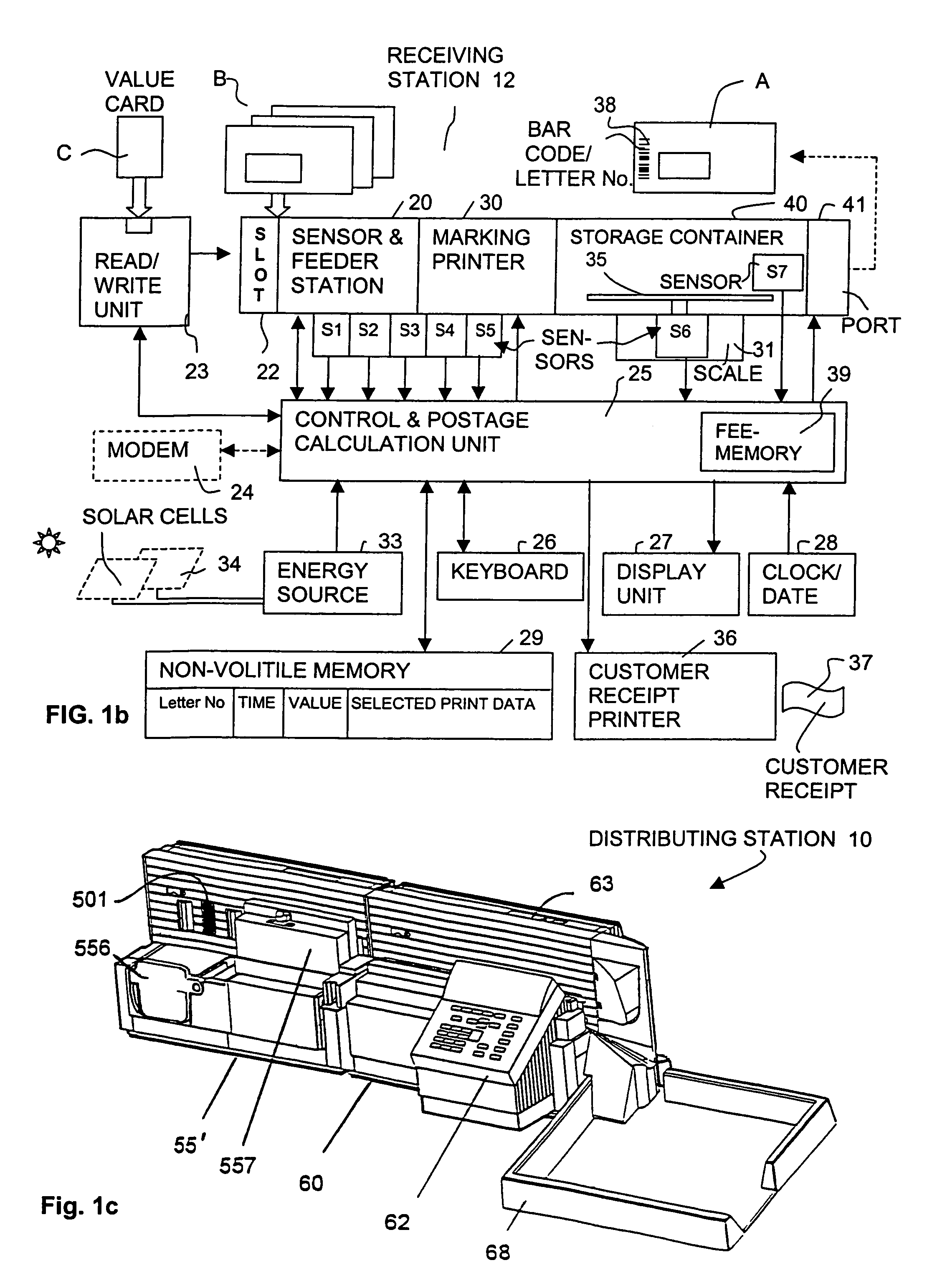
advantage that the mail delivery when receiving mail is not standardized for a specific postal format. The transport stage can be unlocked independently of the postage calculation, so that the dispatcher can deposit all unfranked postal matter through a slot onto a lower guide plate of feeder arrangement. Because the mail feed is not standardized and a printer is utilized for marking the pieces of mail to be separated, attempted fraud is suppressed. The
documentation of the mail deposit is also enabled by an additional document printer. A scale can be integrated in the common storage container, so that later weighing is eliminated. Differing from known systems a printer no longer need be arranged following the scale. This yields a simple structural format for the receiving stations. Alternatively, a scale can be integrated into the distributing
station. The scale in the receiving station is then eliminated. In any case, the mail processing according to the invention ensues staggered such that a marking ensues before the weighing. It is advantageous that the receiving stations need only be equipped with marking printers but not with expensive franking printers. Advantageously, the
stamping of the postal matter to be transported according to the rate schedule of the second carrier can ensue separately from receiving the postal matter. For a first carrier, this has the
advantage of being able to negotiate a quantity discount with a second carrier for the service of delivering franked postal matter. The first carrier also can negotiate a quantity discount with further mail carriers. The franking device of the distributing station can be set for a number of different carriers. Supplying these carriers requires a deposit system in the distributing station with a controllable shunt and a number of deposits, respectively allocated to different carriers. The franking device of the distributing station is programmed to determine the carrier with the most favorable rate schedule for each carrier job. Whereas the first carrier profits from the differences in rates, supplying different carriers has the
advantage for the mail shipper that the rates remain moderate as a result of competition. This, however, is not meant to preclude that the additional input of a carrier requested by the shipper being taken into consideration on the basis of a suitable
user interface with keyboard and display unit in the receiving station.
[0014]It is also advantageous that the shipper can employ a value or a customer card for paying for the service to be provided by the carrier. The debiting by value card is premised on an automatic format and thickness recognition of the pieces of mail. The value card can be a rechargeable money card. The customer card only allows the input of an identification number. A debiting does not ensue from the card but ensues either subsequently from the customer card or an
invoice is prepared. A loss of the customer card is not tragic since money is thus not automatically lost as long as the first carrier is immediately notified who then can block the postage meter
machine for the corresponding identification number. An added advantage is achieved due to the closure mechanism for the slot as protection against willful property damage to the receiving station in combination with the read / write unit. A card inserted into the latter is retained if vandalism is detected by additional sensors. The card owner, and possibly, the person causing the damage, can be determined via the identity number of the card. The keyboard and the display unit also can be protected in a similar way.


 Login to View More
  Login to View More