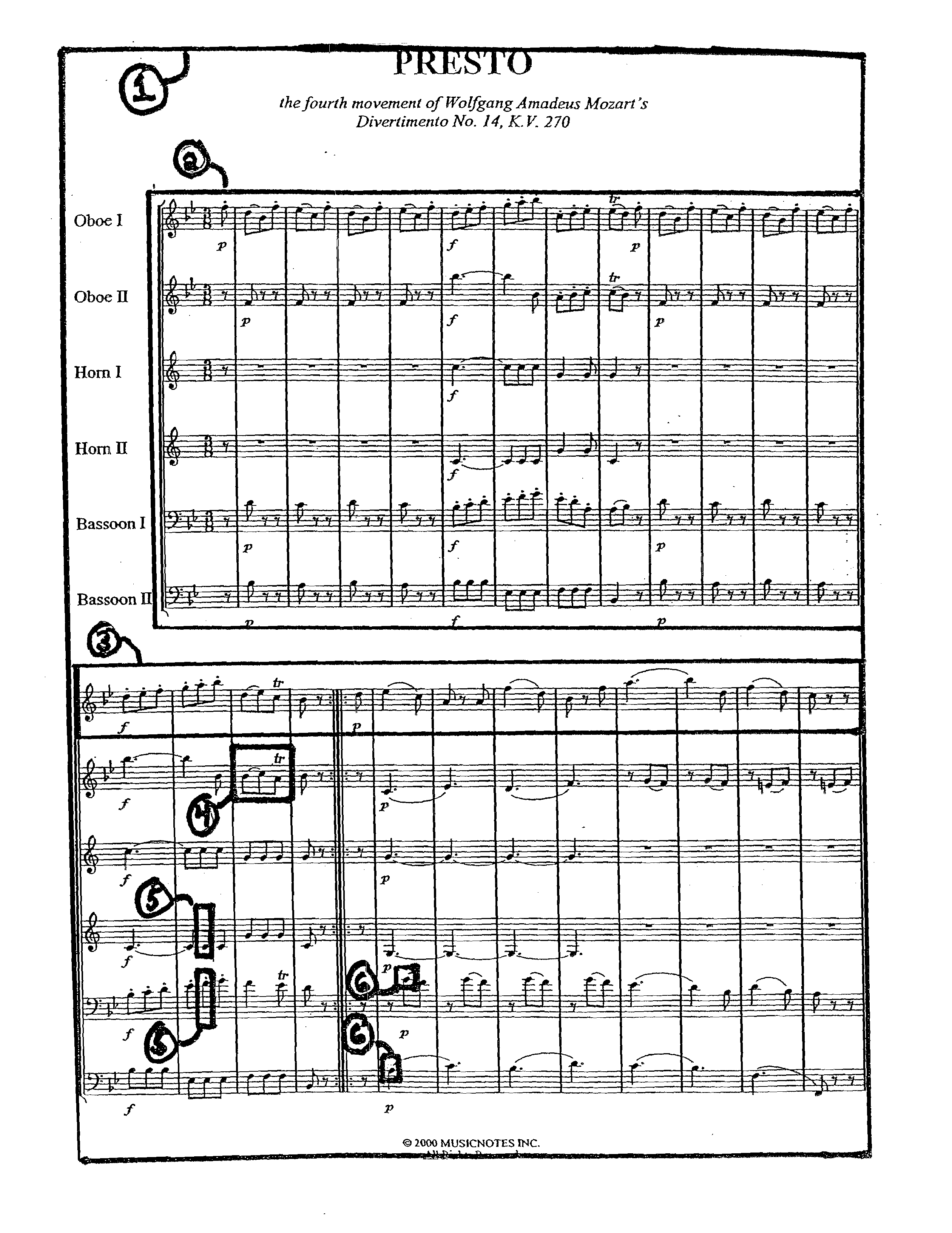
[0008]An important feature of the present invention is a multi-media data subset comprising a hierarchical structure of bounding boxes. Although the bounding boxes are not explicitly shown on the screen when a piece of sheet music is displayed, they are implicitly present in the representation of the music. These bounding boxes may be used to serve a variety of functions. For instance, they may delineate areas of the
graphics that correspond to events in a time
stream. Thus, in the case of sheet music, the bounding boxes are used to position the musical
graphics on the screen to insure that the relevant portions of the music are visible when the music is playing. During playback, the bounding boxes may also be used to locate and hi-light individual notes and instruments in the music. Other functions, such as hot-linking specific areas of the
graphical display to
multimedia functions, and
setting time passages and instrumental tracks from user mouse input, are conveniently performed through these bounding boxes.
[0011]The minimization of the size of a
data file is achieved by separating the set of data pertaining to the bounding boxes and the set of data pertaining to the information that is associated with the bounding boxes. To relate the hierarchical structure of bounding boxes to the interactive
feature data contained in the same file, the multimedia
data set maps each bounding box with a particular notation of an interactive capability. For example, the multimedia data will direct a half middle C note to be played with a certain bounding box on a page.
[0012]Although the multimedia set of data alone without the graphical set may not be very useful to a user, the present invention provides for using the separability of the multimedia and graphical sets of data to allow the user to download the
graphical data set first, and then download the multimedia set at a later time. Since each file encoded in accordance with the method of the present invention consists of logically separate and independent sets and subsets of data, the file can be stripped out of the data not needed during a particular download, which data can be delivered to the user later. The separability of various data sets also provides great flexibility in the inclusion, exclusion, and substitution of various multimedia features. For instance, synchronization of sheet music to a different musical performance may be achieved by substituting a new set of timing values in the
timing data.
[0014]Because many notes in a musical piece have the same
pitch, duration and other elements in common, the data about the notes are consolidated into several categories, and then individual notes refer to the individual categories. Similarly, because most chords used in a piece are repeated many times, all alike chords are given an ID number and are defined only once. Such techniques contribute to compressing the
data file and reduce the time necessary to transmit the file from the server to a user.
[0015]Use of the bounding box abstraction in music representation together with the logical separation of the graphical and multimedia sets of data in a file makes it especially convenient and efficient to link the bounding boxes to the
time sequence in order to synchronize the performance of the music with the corresponding music notation and features displayed on the screen. The present invention synchronizes performing of a musical piece with displaying and highlighting it on a computer screen by building a
time sequence, which maps the
time line of the performance onto the corresponding bounding boxes. The
data file encoding a musical piece contains in it the sequences for each
musical instrument or voice performing the piece. Since time sequences result from mapping the
time line of the performance onto the bounding box
data set, eliminating, therefore, the necessity to relate the
time line to any other information contained in the data file, the size of the file can be kept small and suitable for fast transmissions between the server and the
client sites.
[0028]Speedy and enhanced presentation of
graphical data, such as display of complete graphical objects before transmission of the entire file, to users through standard browsers.


 Login to View More