
High efficiency axial fan
a high-efficiency, axial fan technology, applied in the direction of propellers, propulsive elements, water-acting propulsive elements, etc., can solve the problems of limited high-pressure values, limited axial dimensions of fans constructed in accordance with the above-mentioned patent, and large diameters, etc., to achieve high pressure, low noise value, and good air flow rate
- Summary
- Abstract
- Description
- Claims
- Application Information
AI Technical Summary
Benefits of technology
Problems solved by technology
Method used
Image

Examples
Embodiment Construction
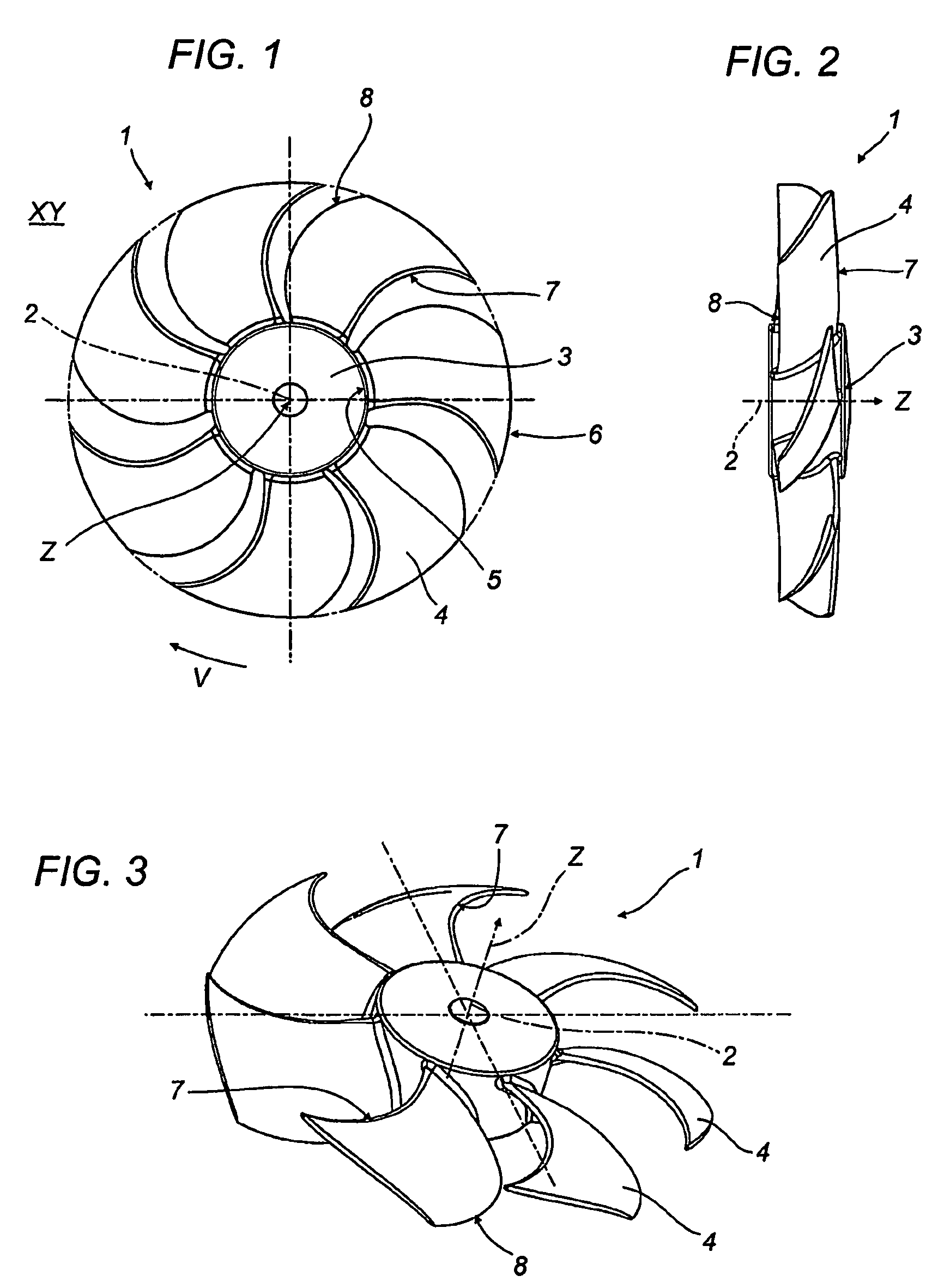
[0021]With reference to the accompanying drawings, the fan 1 rotates about an axis 2 in a plane XY and comprises a central hub 3, with a centre o, to which a plurality of blades 4 are connected, the blades being curved in the fan 1 plane of rotation XY.
[0022]The blades 4 have a root 5, a tip 6 and are delimited by a concave leading edge 7 and a convex trailing edge 8.
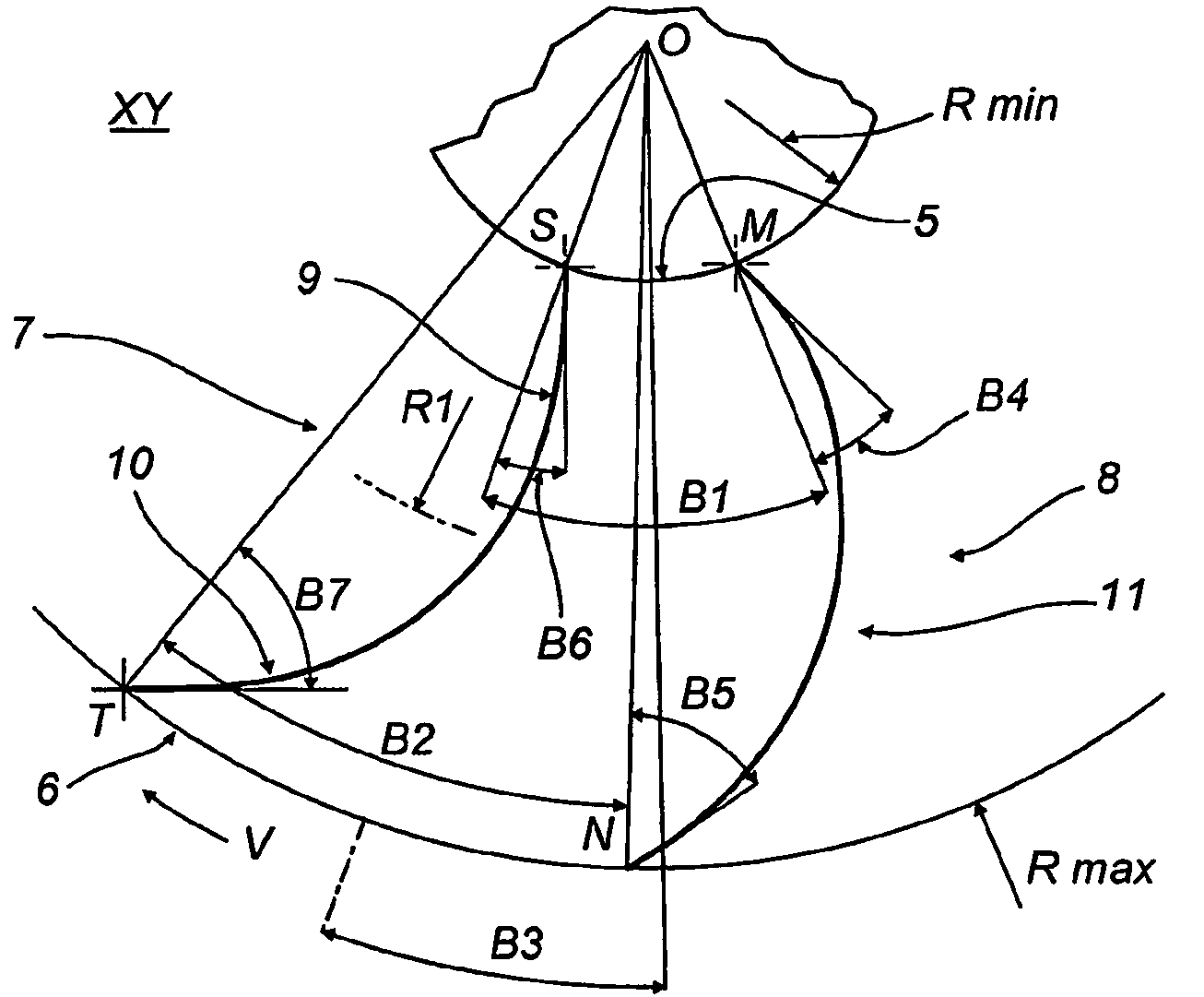
[0023]For the best results in terms of efficiency, flow rate and air pressure, the fan 1 rotates with a direction of rotation V, illustrated in FIGS. 1 and 4, so that the tip 6 of each blade 4 encounters the air flow before the root 5.
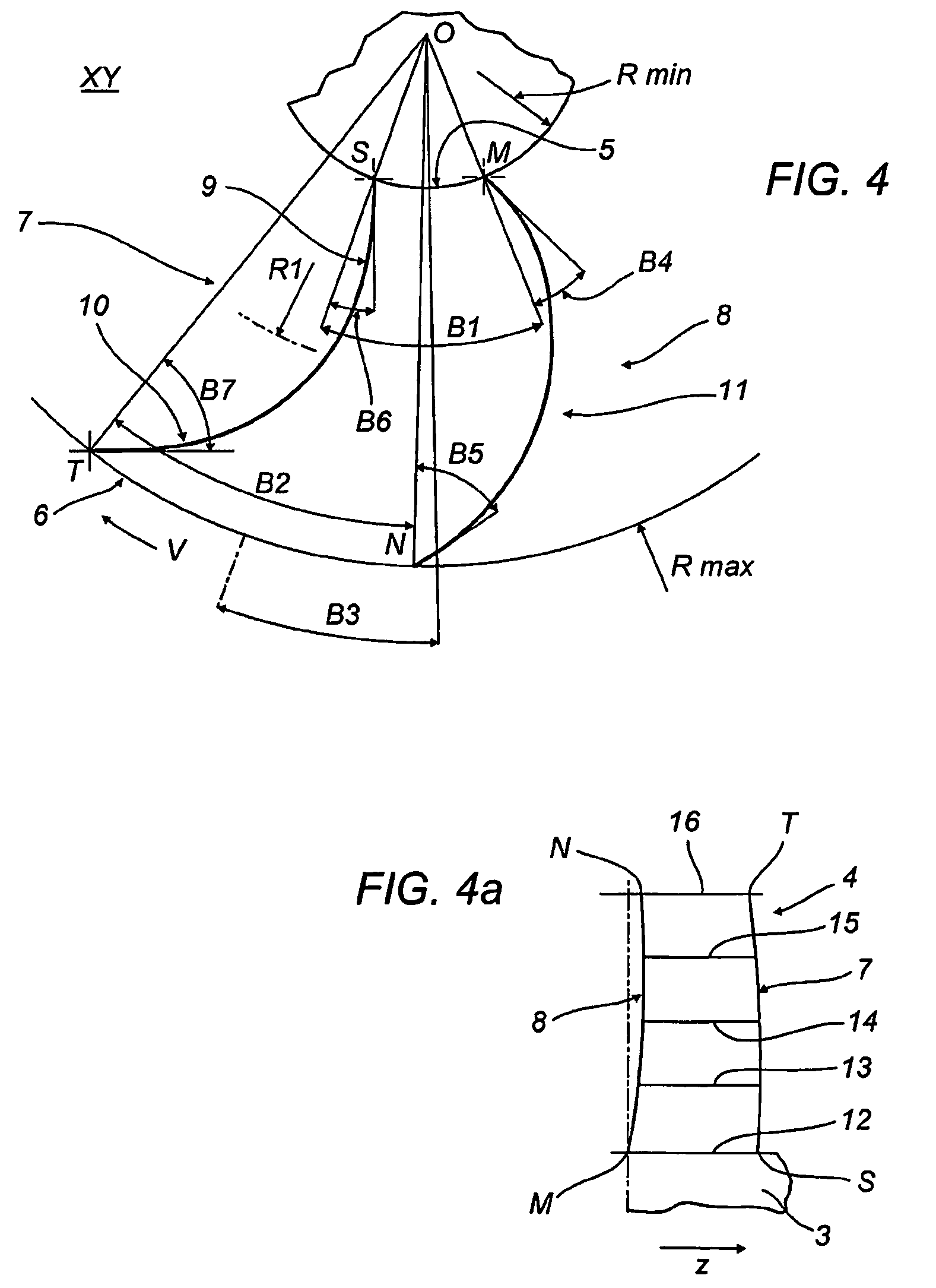
[0024]FIG. 4 illustrates an example of the geometric characteristics of a blade 4 the leading edge 7 is delimited by two circular arc segments 9, 10, and the trailing edge 8 is delimited by one circular arc segment 11.
[0025]In the leading edge 7, a radius labelled R1 is the point of change from one circular arc segment to the other circular arc segment.
[0026]According to the example in FIG...
PUM
 Login to View More
 Abstract
Description
Claims
Application Information
 Login to View More