Check patentability & draft patents in minutes with Patsnap Eureka AI!

Post-silicide spacer removal

a spacer and post-silicide technology, applied in the field of sidewall spacer removal, can solve the problems of limiting the effectiveness of stress transfer to the channel, inadequate ca contact space, adversely affecting subsequent processes, etc., and achieve the effect of limiting the effectiveness of stress transfer

Inactive Publication Date: 2008-07-01
SAMSUNG ELECTRONICS CO LTD +3
View PDF12 Cites 6 Cited by
  • Summary
  • Abstract
  • Description
  • Claims
  • Application Information

AI Technical Summary

Benefits of technology

The invention provides a method for removing sidewall spacers after silicide has been formed in transistor manufacturing. The method uses a non-conformal sacrificial layer that is selectively removed without affecting the silicide. This allows for the safe removal of the spacers without damaging the silicide. The method also includes a selective etching process that attacks the sacrificial layer without attacking the protective layer. The invention provides a safer and more efficient method for removing sidewall spacers in transistor manufacturing.

Problems solved by technology

Once silicide is formed, the spacer is typically left in place where it may adversely affect subsequent processes.
For example, the spacer crowds the limited area between closely spaced gates leaving inadequate room to form good CA contacts.
Also, the presence of the spacer forces the stress liner further from the device channel thereby limiting the effectiveness of stress transfer to the channel.
The problem with simply stripping the nitride spacer after silicide formation is that etchants suitable for nitride removal also erode silicide.
Use of a sacrificial nitride deposited preferentially on the silicide has been attempted but the beneficial effect of protecting the silicide tends to be overwhelmed by the need to etch longer to remove both the spacer and the additional nitride from the gate sidewall.

Method used

the structure of the environmentally friendly knitted fabric provided by the present invention; figure 2 Flow chart of the yarn wrapping machine for environmentally friendly knitted fabrics and storage devices; image 3 Is the parameter map of the yarn covering machine
View more

Image

Smart Image Click on the blue labels to locate them in the text.
Viewing Examples
Smart Image
  • Post-silicide spacer removal
  • Post-silicide spacer removal
  • Post-silicide spacer removal

Examples

Experimental program
Comparison scheme
Effect test

Embodiment Construction

[0013]The embodiments of the invention and the various features and advantageous details thereof are explained more fully with reference to the non-limiting embodiments that are illustrated in the accompanying drawings and detailed in the following description. It should be noted that the features illustrated in the drawings are not necessarily drawn to scale. Descriptions of well-known components and processing techniques are omitted so as to not unnecessarily obscure the embodiments of the invention. The examples used herein are intended merely to facilitate an understanding of ways in which the embodiments of the invention may be practiced and to further enable those of skill in the art to practice the embodiments of the invention. Accordingly, the examples should not be construed as limiting the scope of the embodiments of the invention.

[0014]As discussed above, the problem with simply stripping the nitride spacer after silicide formation is that etchants suitable for nitride re...

the structure of the environmentally friendly knitted fabric provided by the present invention; figure 2 Flow chart of the yarn wrapping machine for environmentally friendly knitted fabrics and storage devices; image 3 Is the parameter map of the yarn covering machine
Login to View More

PUM

No PUM Login to View More

Abstract

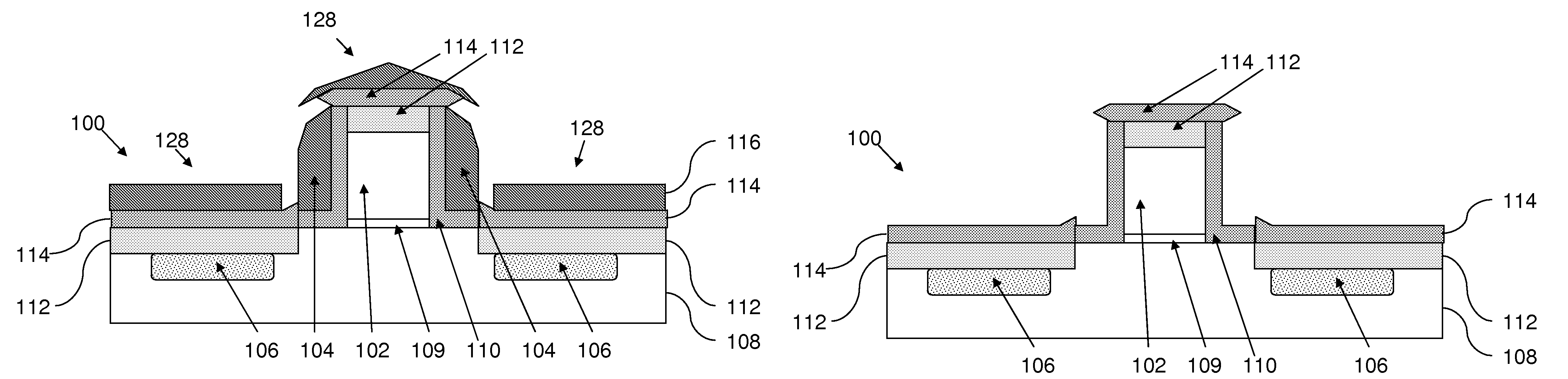
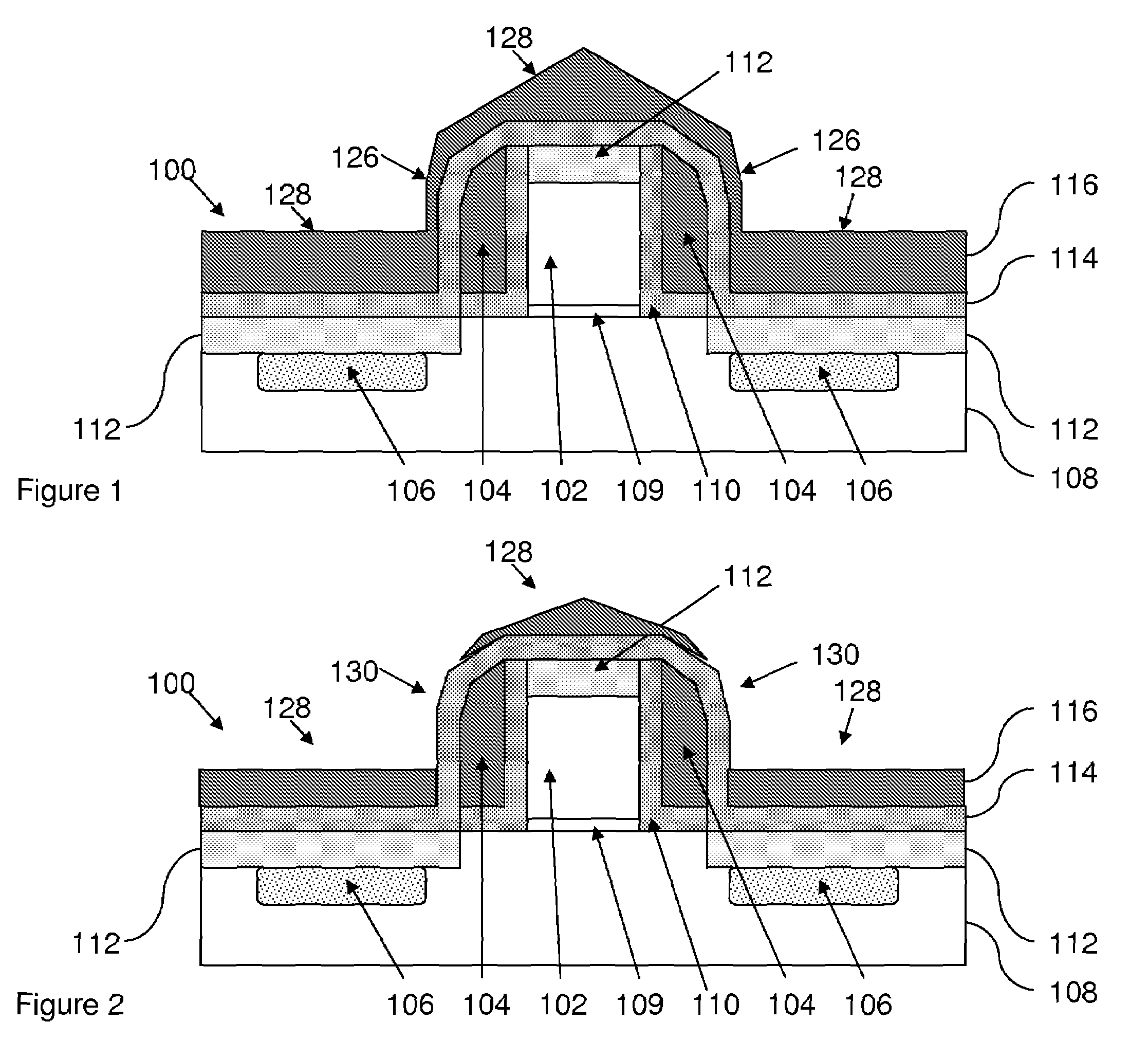
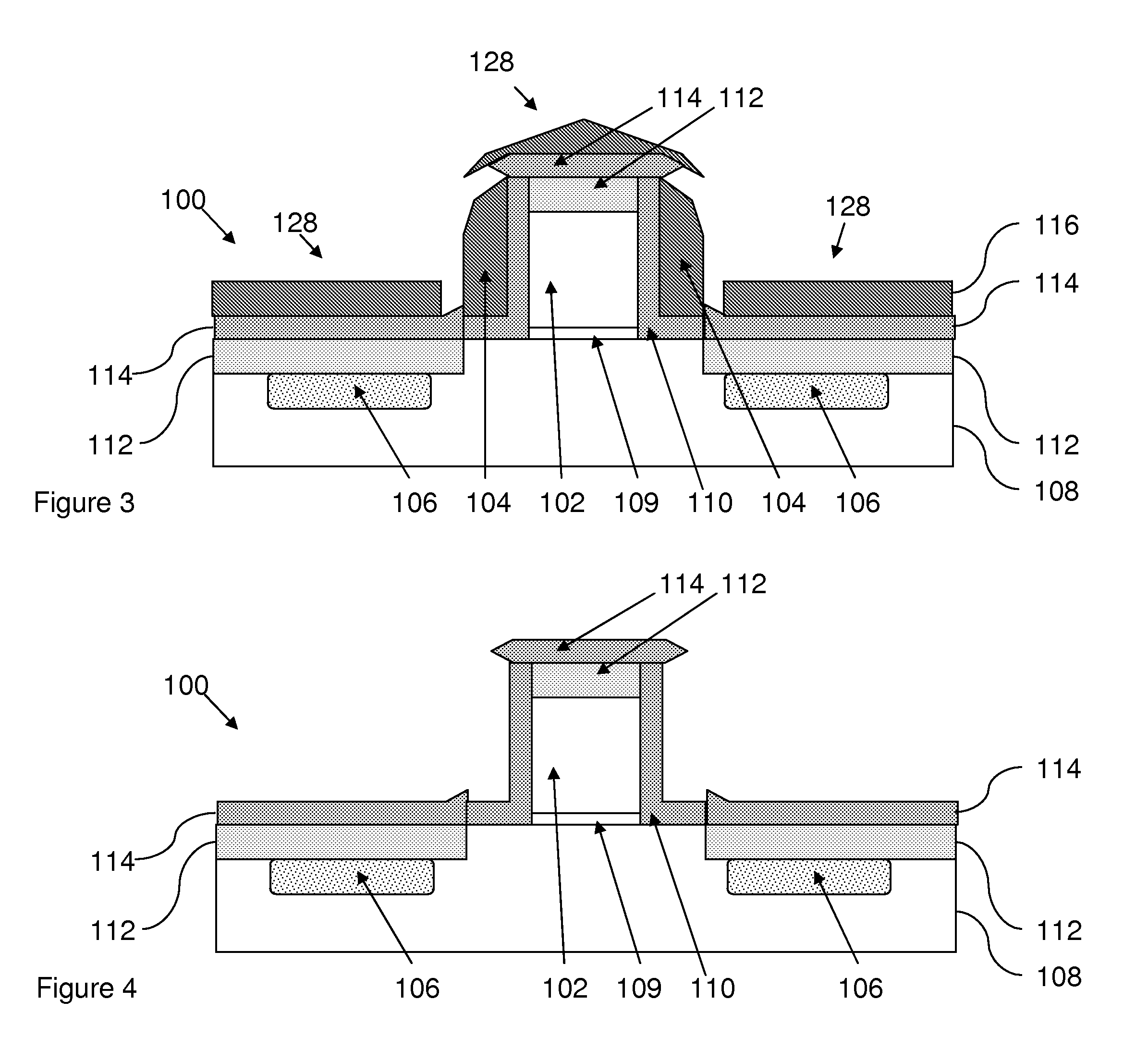
A method forms a gate conductor over a substrate, forms spacers (e.g., nitride spacers) on sides of the gate conductor, and implants an impurity into exposed regions of the substrate not protected by the gate conductor and the spacers. Then the method forms a silicide on surfaces of the exposed regions of the substrate. The method forms a conformal protective layer (e.g., an oxide or other similar material) over the silicide, the spacers, and the gate conductor. Next, the method forms a non-conformal sacrificial layer (e.g., nitride or other material that can be selectively removed with respect to the protective layer) over the protective layer. A subsequent partial etching process partially etches the sacrificial layer such that relatively thinner regions of the sacrificial layer that are over the spacers are completely removed and the relatively thicker regions of the sacrificial layer that are over the substrate are not removed. The next step in the method removes only those portions of the protective layer that cover the spacers, without removing the portions of the protective layer that cover the silicide. As the spacers are now exposed and the silicide is protected by the protective and sacrificial layers, the method can safely remove the spacers without affecting the silicide.

Description

BACKGROUND AND SUMMARY[0001]The embodiments of the invention generally relate to transistor manufacturing and more particularly to a method of removing sidewall spacers after silicide has been formed.[0002]A gate sidewall spacer is generally used to space the source / drain diffusions and silicide away from the device channel region (the shallow extension implant bridges the gap). Once silicide is formed, the spacer is typically left in place where it may adversely affect subsequent processes. For example, the spacer crowds the limited area between closely spaced gates leaving inadequate room to form good CA contacts. Also, the presence of the spacer forces the stress liner further from the device channel thereby limiting the effectiveness of stress transfer to the channel.[0003]The problem with simply stripping the nitride spacer after silicide formation is that etchants suitable for nitride removal also erode silicide. Use of a sacrificial nitride deposited preferentially on the sil...

Claims

the structure of the environmentally friendly knitted fabric provided by the present invention; figure 2 Flow chart of the yarn wrapping machine for environmentally friendly knitted fabrics and storage devices; image 3 Is the parameter map of the yarn covering machine
Login to View More

Application Information

Patent Timeline
no application Login to View More
Patent Type & Authority Patents(United States)
IPC IPC(8): H01L21/33
CPCH01L21/32H01L29/6653H01L29/6656H01L29/665H01L21/18
Inventor DYER, THOMAS W.FANG, SUNFEIYAN, JIANGPANDA, SIDDHARTHALEE, YONG MENGKIM, JUNJUNG
Owner SAMSUNG ELECTRONICS CO LTD
Features
  • R&D
  • Intellectual Property
  • Life Sciences
  • Materials
  • Tech Scout
Why Patsnap Eureka
  • Unparalleled Data Quality
  • Higher Quality Content
  • 60% Fewer Hallucinations
Social media
Patsnap Eureka Blog
Learn More