Supercharge Your Innovation With Domain-Expert AI Agents!

Light emitting element and method of making same

a technology of light-emitting elements and light-emitting elements, which is applied in the direction of basic electric elements, semiconductor devices, electrical equipment, etc., can solve the problems of limited light extraction efficiency, insufficient light extraction efficiency, and low external radiation efficiency of emitted light, and achieves enhanced external radiation efficiency and high optical absorption coefficient

Active Publication Date: 2009-07-14
TOYODA GOSEI CO LTD
View PDF5 Cites 11 Cited by
  • Summary
  • Abstract
  • Description
  • Claims
  • Application Information

AI Technical Summary

Benefits of technology

[0010]It is an object of the invention to provide a light emitting element that allows an enhancement in optical external radiation efficiency while preventing emitted light to be held inside a semiconductor layer with a high optical absorption coefficient, and a method of making the same,

Problems solved by technology

There is, however, a problem in such a light emitting element that a light emitted in a light-emitting layer thereof is held inside a layer with a high optical absorption coefficient, and part of emitted light is absorbed in the layer, whereby the external radiation efficiency of emitted light lowers.
However, the light emitting element of JP-A No, 2003-197961 involves such problem that, though the sapphire substrate is provided with the uneven surface to extract light (herein called intra-layer confined light) confined inside a layer rather than light directly discharged outside from the group III nitride-based compound semiconductor layer, the light extraction efficiency is not sufficient.
Namely, since the light extraction characteristic depends upon the refractive-index difference between the group III nitride-based compound semiconductor layer and the sapphire substrate, the light extraction efficiency is limited
Moreover, since the group III nitride-based compound semiconductor layer has a high optical absorption coefficient, the intra-layer confined light must be attenuated so much therein and therefore the optical radiation efficiency cannot be enhanced.

Method used

the structure of the environmentally friendly knitted fabric provided by the present invention; figure 2 Flow chart of the yarn wrapping machine for environmentally friendly knitted fabrics and storage devices; image 3 Is the parameter map of the yarn covering machine
View more

Image

Smart Image Click on the blue labels to locate them in the text.
Viewing Examples
Smart Image
  • Light emitting element and method of making same
  • Light emitting element and method of making same
  • Light emitting element and method of making same

Examples

Experimental program
Comparison scheme
Effect test

third embodiment

(Composition of LED Element 1)

[0109]FIG. 4 is a cross sectional view showing an LED element in the third preferred embodiment according to the invention.

[0110]The face-up type LED element 1 of the third embodiment is different from the first embodiment in that microscopic convex and concave portions 11C are formed at the interface between the glass member 11 and the n-GaN layer 13 in the first embodiment.

[0111]The convex and concave portions 11C of the glass member 11 are irregularly and finely formed by roughening, etching etc. of the surface of the sapphire substrate 10.

Advantages of the Third Embodiment

[0112]In the third embodiment, the shape of the convex and concave portions need not be controlled as in the first embodiment. Since the amount of the intra-layer confined light inside the GaN layer is much, the intra-layer confined light can be efficiently reflected on the convex and concave portions 11C formed at the interface between the glass member 11 and the n-GaN layer 13. A...

fourth embodiment

(Composition of LED Element 1)

[0114]FIG. 5 is a cross sectional view showing an LED element in the fourth preferred embodiment according to the invention.

[0115]The face-up type LED element 1 of the fourth embodiment is different from the second embodiment in that, when the flat glass member 11 is thermally bonded to the n-GaN layer 13 as explained in the second embodiment, concave (and hollow) portions 13B defined as a tapered air layer are at given intervals between the glass member 11 and the n-GaN layer 13.

[0116]The concave portion 13B is formed on the n-GaN layer 13 corresponding to a convex portion that is previously formed by etching etc. on the sapphire substrate 10 as the underlying substrate for providing the GaN-based semiconductor layer 100. It is exposed at the bottom of the n-GaN layer 13 when the sapphire substrate 10 is lifted off from the n-GaN layer 13.

[0117]The glass member 11 is thermally bonded to the n-GaN layer 13 so as not to fill the concave portion 13B forme...

fifth embodiment

(Composition of LED Element 1)

[0131]FIG. 7 is a cross sectional view showing an LED element in the fifth preferred embodiment according to the invention.

[0132]The face-up type LED element 1 of the fifth embodiment is different from the second embodiment in that the glass member 11 of the fourth embodiment is low-profiled and thermally bonded to the n-GaN layer 13 with the concave portion 13B, and, under the glass member 11, there are sequentially provided an Ag reflection layer 20 with a high reflectivity, a Mo foil 21, and a copper member 22 for heat radiation, where the Mo foil 21 functions to relax a difference in thermal expansion between the Ag reflection layer 20 and the copper member 22.

[0133]The Ag reflection layer 20 is formed by depositing a thin film of Ag by using the deposition method.

Advantages of the Fifth Embodiment

[0134]In the fifth embodiment, since the Ag reflection layer 20 is provided through the low-profiled glass member 11 under the n-GaN layer 13 (i.e., the A...

the structure of the environmentally friendly knitted fabric provided by the present invention; figure 2 Flow chart of the yarn wrapping machine for environmentally friendly knitted fabrics and storage devices; image 3 Is the parameter map of the yarn covering machine
Login to View More

PUM

No PUM Login to View More

Abstract

A light emitting element is provided with a semiconductor layer having a light emitting layer and an uneven surface, and a transparent material formed on the uneven surface. The transparent material has a refractive index lower than a sapphire substrate. Alternatively, a light emitting element is provided with a semiconductor layer including a light emitting layer, and a transparent high-refractive index material layer formed on a light radiation surface of the semiconductor layer. The light emitting element is of a flip-chip type, and the transparent high-refractive index material layer has a refractive index of n=1.6 or more.

Description

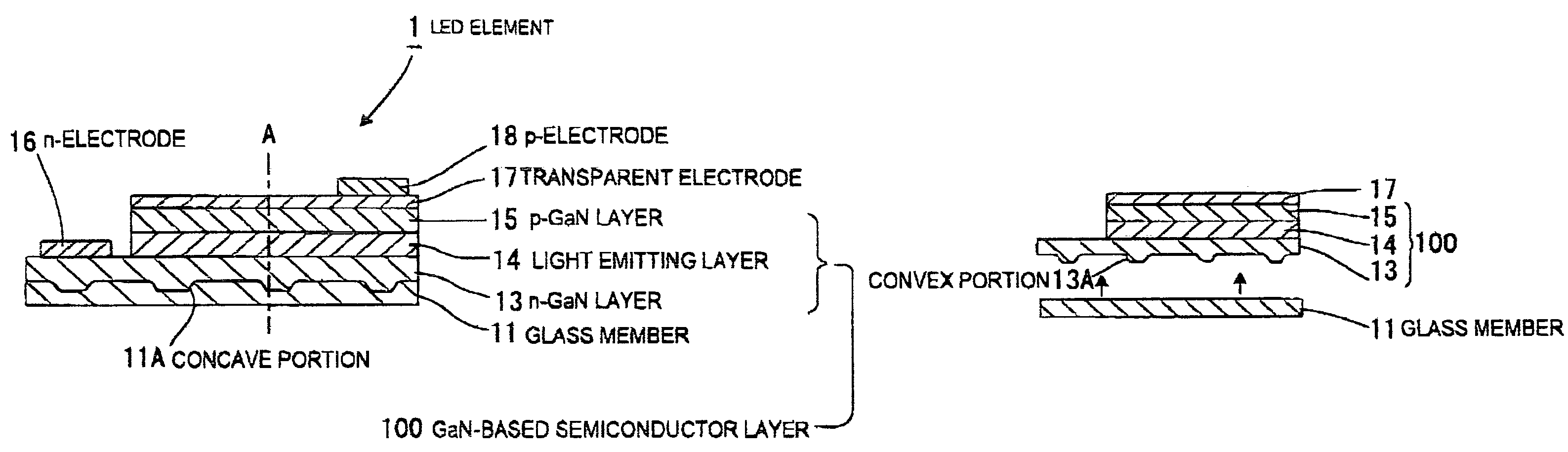
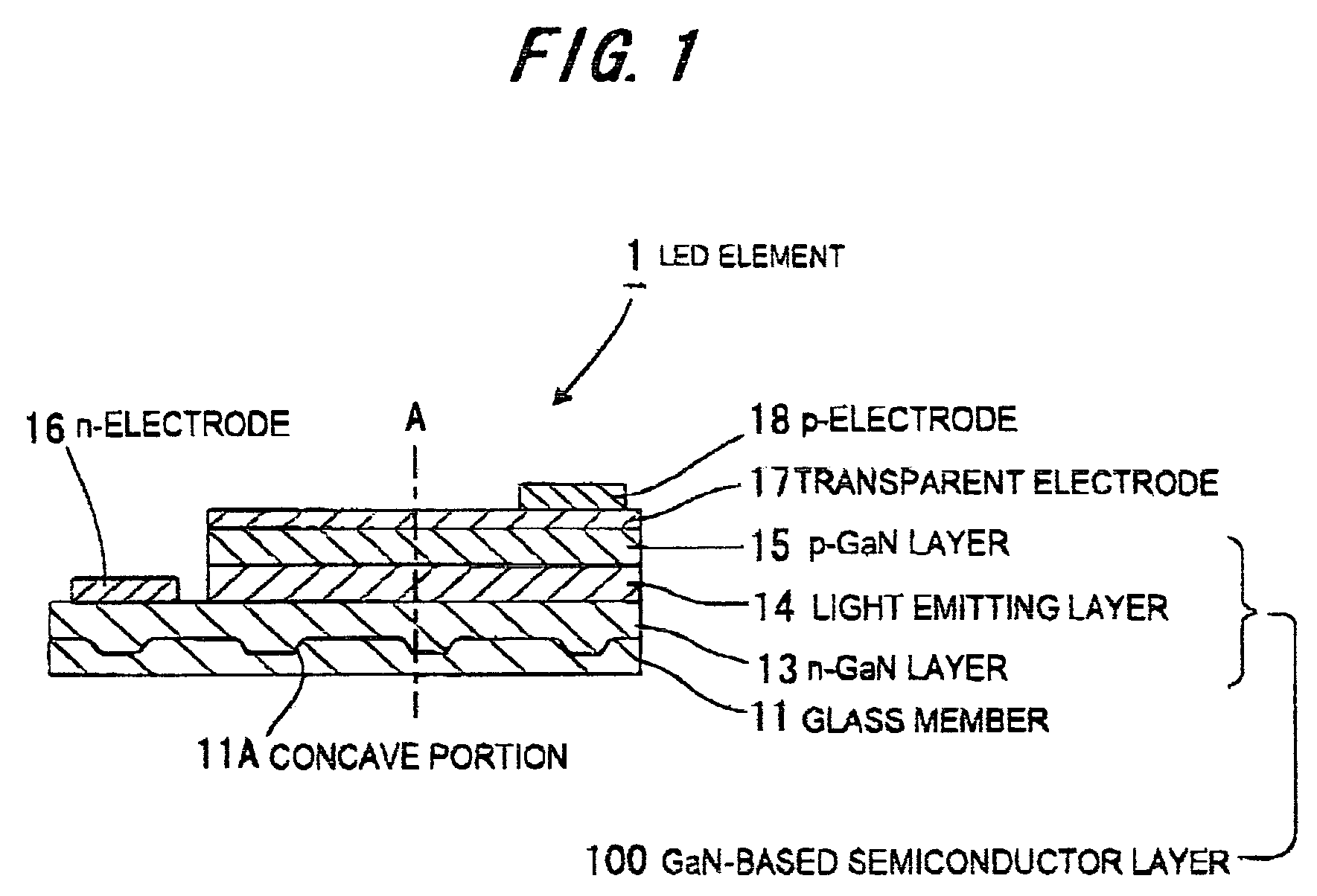
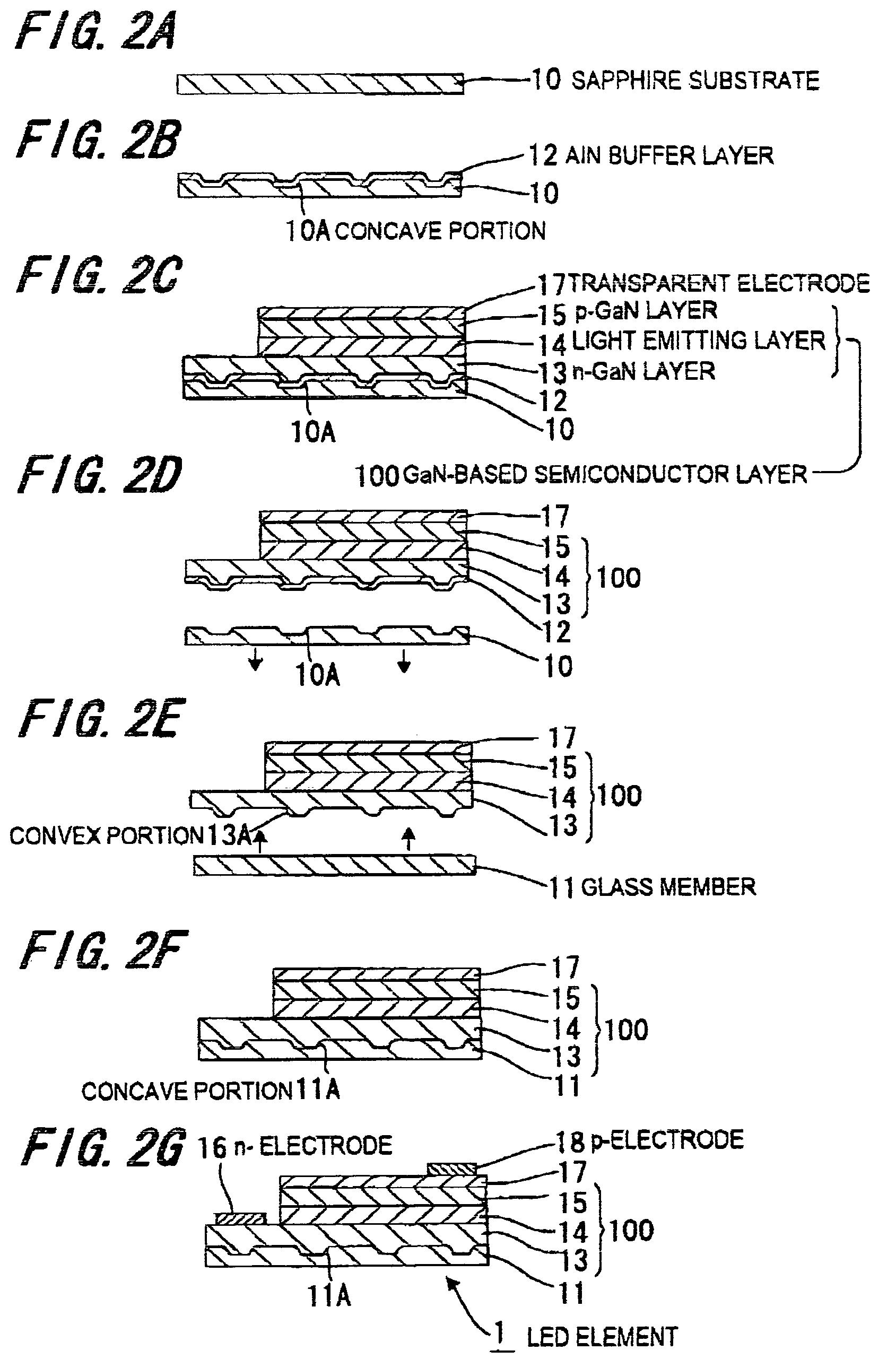
[0001]The present application is based on Japanese patent application Nos. 2004-168773, 2004-187097, 2004-280020 and 2005-133750, the entire contents of which are incorporated herein by reference.BACKGROUND OF THE INVENTION[0002]1. Field of the Invention[0003]This invention relates to a light emitting element (herein also referred to as LED element) and a method of making the same and, particularly, to a light emitting element that allows an enhancement in optical external radiation efficiency while preventing emitted light from being held inside a semiconductor layer with a high optical absorption coefficient, and a method of making the same.[0004]2. Description of the Related Art[0005]Conventionally, a method of making a light emitting element is known in which a semiconductor crystal of group III nitride-based compound semiconductor is grown on a substrate such as sapphire. There is, however, a problem in such a light emitting element that a light emitted in a light-emitting laye...

Claims

the structure of the environmentally friendly knitted fabric provided by the present invention; figure 2 Flow chart of the yarn wrapping machine for environmentally friendly knitted fabrics and storage devices; image 3 Is the parameter map of the yarn covering machine
Login to View More

Application Information

Patent Timeline
no application Login to View More
Patent Type & Authority Patents(United States)
IPC IPC(8): H01L21/60
CPCH01L33/007H01L2224/16225H01L2224/32225H01L2224/73204H01L2924/00H01L2224/05573H01L2224/05568H01L2924/00014H01L2224/0554H01L2224/05599H01L2224/0555H01L2224/0556
Inventor SUEHIRO, YOSHINOBUNAKAJO, NAOKI
Owner TOYODA GOSEI CO LTD
Features
  • R&D
  • Intellectual Property
  • Life Sciences
  • Materials
  • Tech Scout
Why Patsnap Eureka
  • Unparalleled Data Quality
  • Higher Quality Content
  • 60% Fewer Hallucinations
Social media
Patsnap Eureka Blog
Learn More