
Block de-interleaving system
a technology of interleaving and blocks, applied in the direction of interleaving, error correction/detection, transmission, etc., can solve the problems of increasing the area of the circuit and the energy dissipation, affecting the efficiency of continuous memory re-use, and suffering high energy dissipation, so as to reduce the overall number of memory accesses, reduce the size of the adaptation buffer, and accelerate the rate
- Summary
- Abstract
- Description
- Claims
- Application Information
AI Technical Summary
Benefits of technology
Problems solved by technology
Method used
Image

Examples
first embodiment
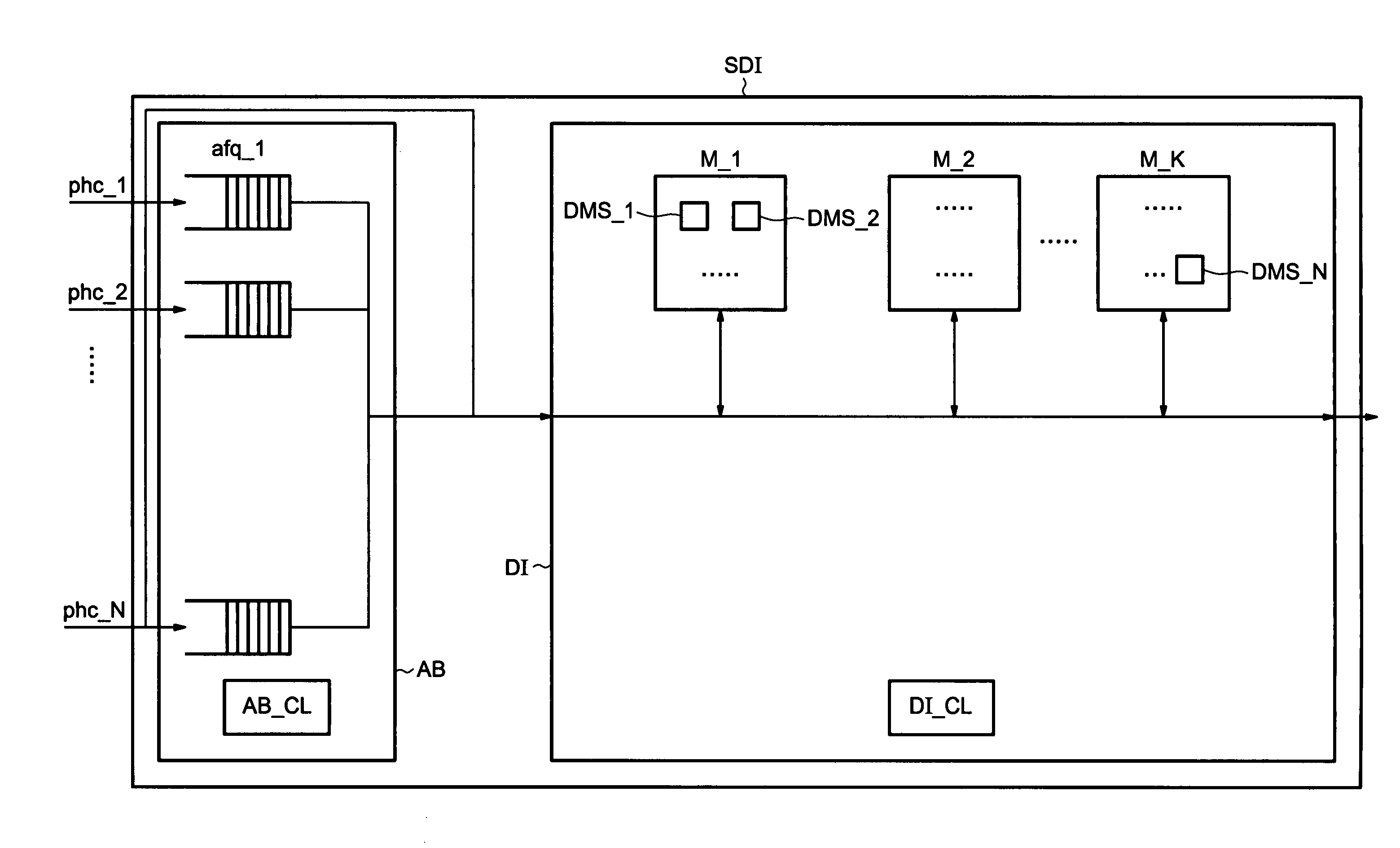
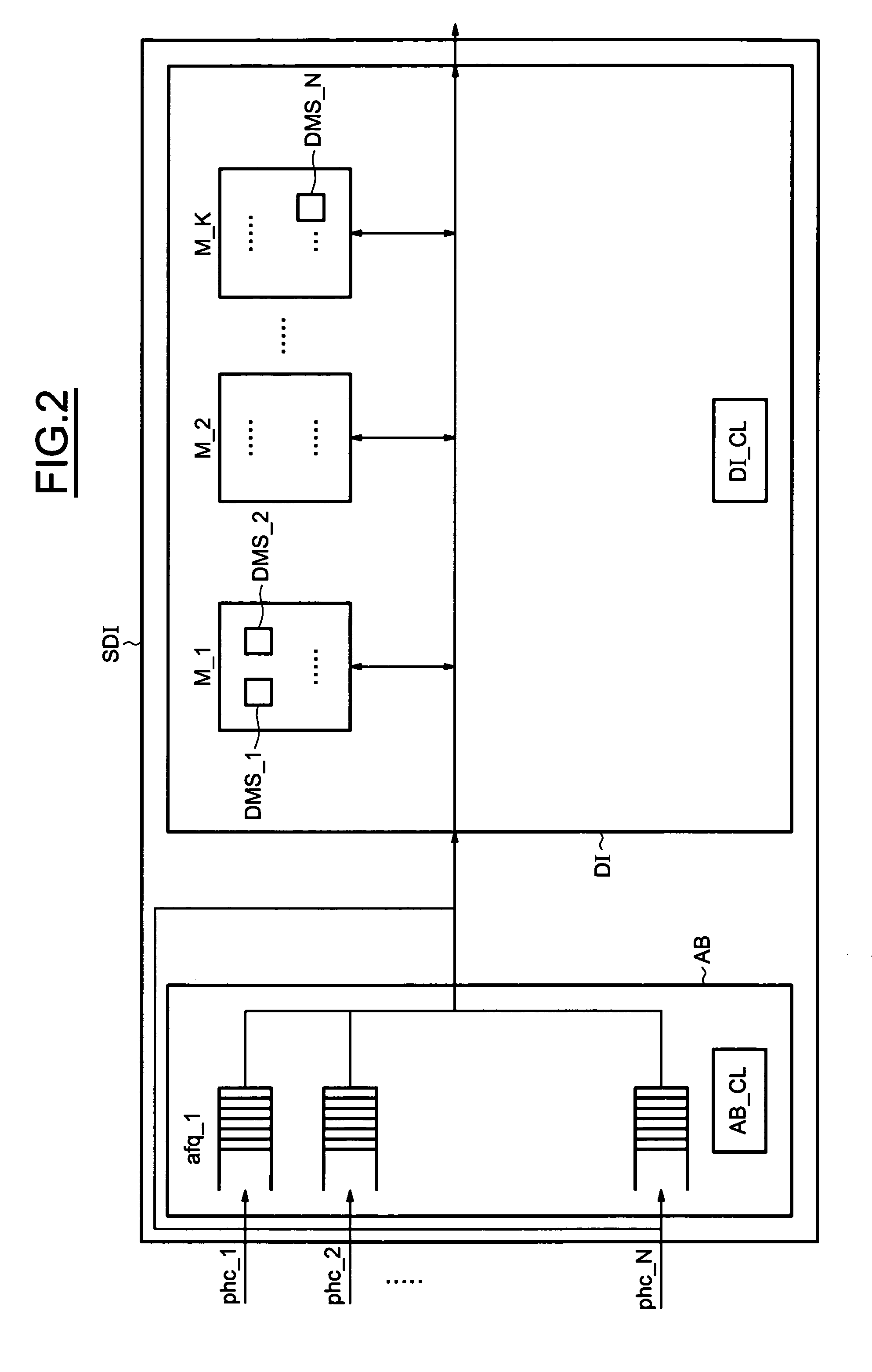
[0024]In a first embodiment, the physical elementary memories have substantially the same memory size, and have the same bandwidth. A memory bandwidth is the size of word for example eight hard bits, which is often referred to as addressable memory. Using at least two physical elementary memories to embody the de-interleaving spaces DMS_1, DMS_2, . . . , DMS_N, permits to increase the number of accesses to the memory per cycle, and so to increase the output throughput of the de-interleaving system SDI. Indeed, with K physical elementary memories, there are K times more accesses per cycle. With the increase of output throughput, the size of the adaptation FIFO queues afq_1, afq_2, . . . afq_N, can be reduced and so the number of accesses to adaptation FIFO queues afq_1, afq_2, . . . afq_N. So, the area and the energy used are decreased.
[0025]The example described in the description is in a CMOS process technology, where the time to access the memory is in the order of a few nanosecon...
second embodiment
[0032]FIG. 5 shows a comparison between the above-cited two embodiments respectively represented in FIGS. 2 and 4. FIG. 5 shows clearly that the second embodiment is better, because it optimizes the area of the physical elementary memories M_1, M_2, . . . , M_K and the area of the adaptation FIFI queues afq_1, afq_2, . . . , afq_N. In this example, the best optimization corresponds to four physical elementary memories with a flexible bandwidth.
[0033]FIG. 6 shows a comparison of energy dissipation per subframe, for the above-cited example, between a four physical elementary memories system with the same bandwidth and a physical elementary memories system with different bandwidth (flexible bandwidth). The FIG. 6 shows that using four physical elementary memories with different bandwidths is better for the energy consumed than with the same bandwidth, whatever the number of active physical channels.
[0034]Finally, the FIG. 7 is a comparison between area and energy used by the two embodi...
PUM
 Login to View More
 Abstract
Description
Claims
Application Information
 Login to View More