
Vectorized software packet forwarding
a software packet and vector technology, applied in the field of network communication, can solve the problems of reducing affecting the speed of forwarding engine, and affecting the speed of forwarding graph, so as to reduce the number of data reads performed in the forwarding graph, increase the vector size, and prevent processing delays
- Summary
- Abstract
- Description
- Claims
- Application Information
AI Technical Summary
Benefits of technology
Problems solved by technology
Method used
Image

Examples
Embodiment Construction
[0034]FIG. 3 is a block diagram of a computer network 300 comprising a collection of interconnected subnetworks and nodes. The network nodes may comprise computers including end nodes 330 and 340, such as a sending end node 320 and a receiving end node 350, and an intermediate network node 400, the latter of which may be a switch or router. The subnetworks 305, 310 included within network 300 are preferably local area networks (LANs) interconnected by the intermediate node 400, although the networks may comprise other communication links, such as wide area networks. Communication among the nodes coupled to the LANs is typically effected by exchanging discrete data packets 100 among the nodes.
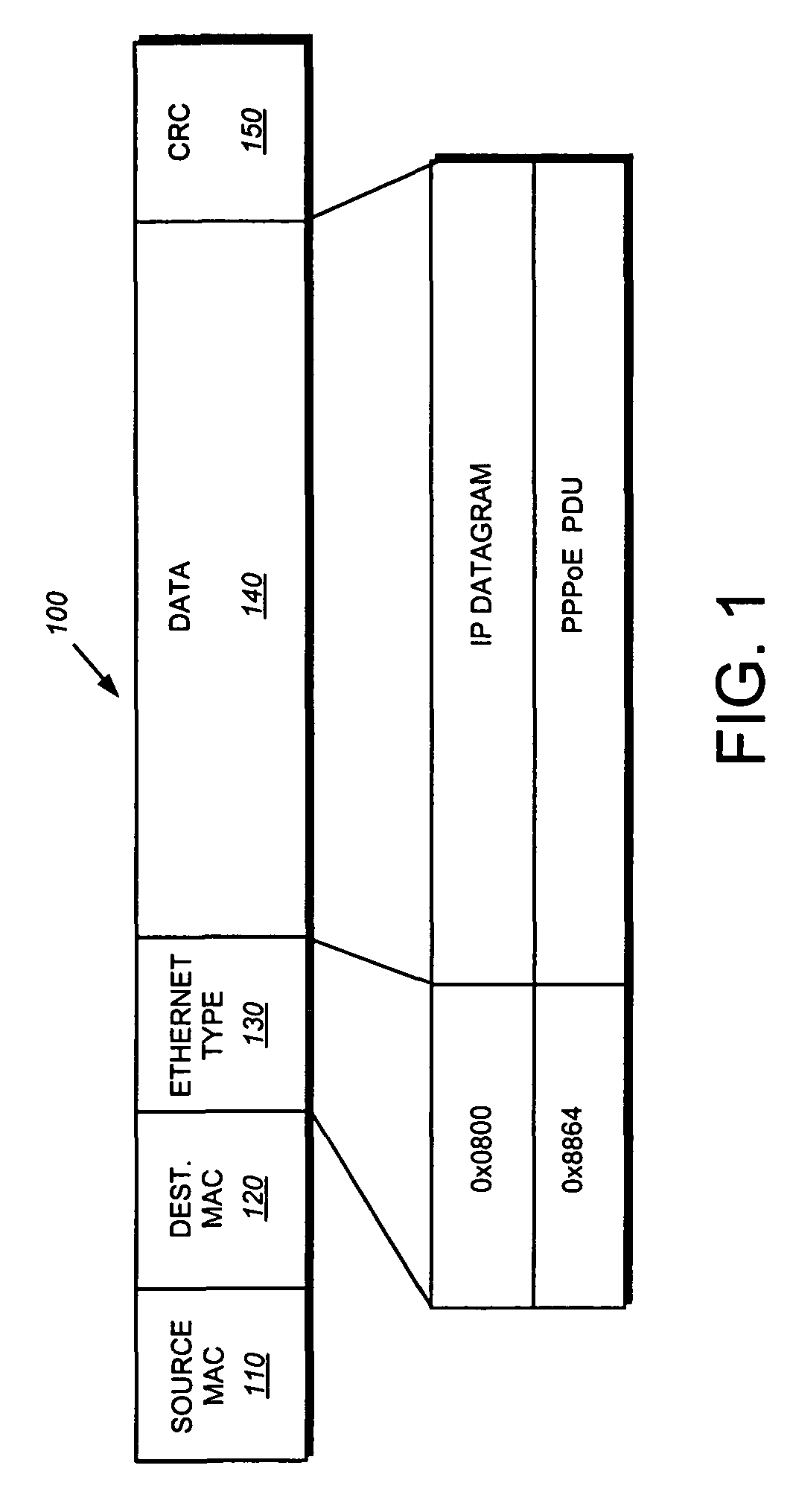
[0035]For example, the sending node 320 generates a data packet 100 by encapsulating “payload” data within headers, such as conventional data link and internetwork headers, as the data passes through different layers of a protocol stack. The packet is then transmitted over the network to the int...
PUM
 Login to View More
 Abstract
Description
Claims
Application Information
 Login to View More