
Use of a biopolymer-based binder for roads, road-related and civil engineering applications
- Summary
- Abstract
- Description
- Claims
- Application Information
AI Technical Summary
Benefits of technology
Problems solved by technology
Method used
Image

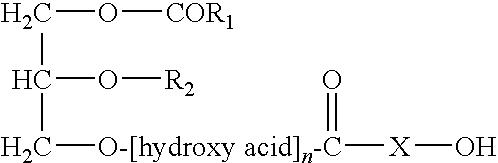
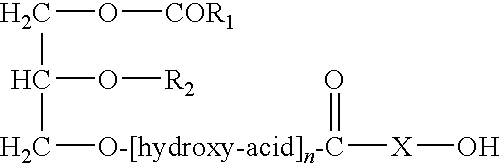
Examples
example
1. Preparing Resins of the Invention
1.1 Resins a)
Components:
[0129]Castor, rapeseed or linseed triglyceride[0130]Glycerol[0131]NaOH (catalyst)[0132]Lactic acid[0133]Sn2Octanoate (catalyst)
Production principle: In a first step, vegetable oil-derived triglycerides are reacted with glycerol in a [glycerol] / [oil] molar ratio of 2. This step is carried out in a glass reactor provided with a mechanical stirring device at 220° C. for 2 hours. The components are combined with soda as a catalyst. The entire triglyceride conversion is controlled by HPLC. At the end of the reaction, the mixture is slowly cooled down. As a result, following this step, a monoglyceride high-content mixture is obtained. Thereafter, in a second step, in a glass reactor provided with a mechanical stirring device and a Dean-Stark, the monoglyceride high-content mixture is reacted for 9 hours at 150° C. in the presence of lactic acid and Sn2Octanoate as a catalyst. The [lactic acid] / [acid+hydroxyl functions] molar rati...
PUM
| Property | Measurement | Unit |
|---|---|---|
| Length | aaaaa | aaaaa |
| Fraction | aaaaa | aaaaa |
| Fraction | aaaaa | aaaaa |
Abstract
Description
Claims
Application Information
 Login to View More