

Privacy-preserving probabilistic inference based on hidden Markov models
a probabilistic inference and privacy-preserving technology, applied in the field of probabilistic networks, instruments, pulse techniques, etc., can solve problems such as methods that are not suited to applications
- Summary
- Abstract
- Description
- Claims
- Application Information
AI Technical Summary
Benefits of technology
Problems solved by technology
Method used
Image

Examples
Embodiment Construction
System Overview
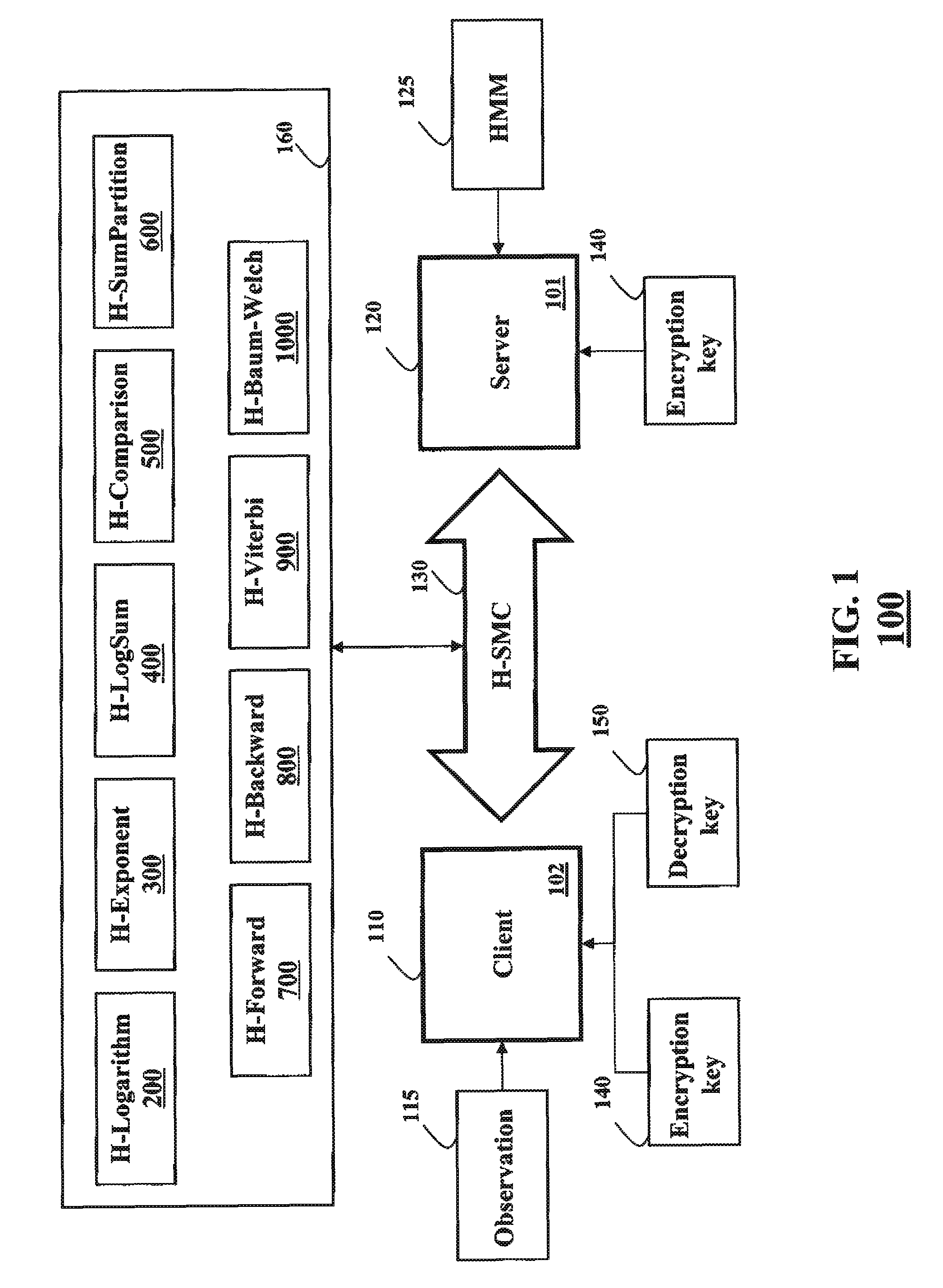
[0074]FIG. 1 shows a system 100 employing some embodiments of the invention. A client 110 stores an observation sequence 115. A server 120 stores a hidden Markov model (HMM) 125. The client also stores a decryption key 150 and an encryption key 140 for an additively homomorphic cryptosystem. The server has only the encryption key 140.
[0075]The client and the server perform a secure multiparty computation (SMC) using at least one property of additive homomorphism, i.e., an H-SMC, to determine a secure probabilistic inference of the observation sequence with respect to the HMM. As referred herein, a prefix “H-” indicates that a communication, a computation, or a method is performed in a secure domain using at least one property of additive homomorphism. For example, the H-SMC 130 can use at least one H-method 160, as described in more details below. The client and the server can be implemented using a processor, such as a processor 101 and / or a processor 102.
[0076]Addit...
PUM
 Login to View More
 Abstract
Description
Claims
Application Information
 Login to View More