
Cutting insert and cutting tool therefor
a cutting insert and indexing technology, applied in metal-working equipment, metal-working equipment, milling equipment, etc., can solve the problems of limited use of conventional clamping methods, shearing of clamping screws, and inability to cut inserts
- Summary
- Abstract
- Description
- Claims
- Application Information
AI Technical Summary
Benefits of technology
Problems solved by technology
Method used
Image

Examples
first embodiment
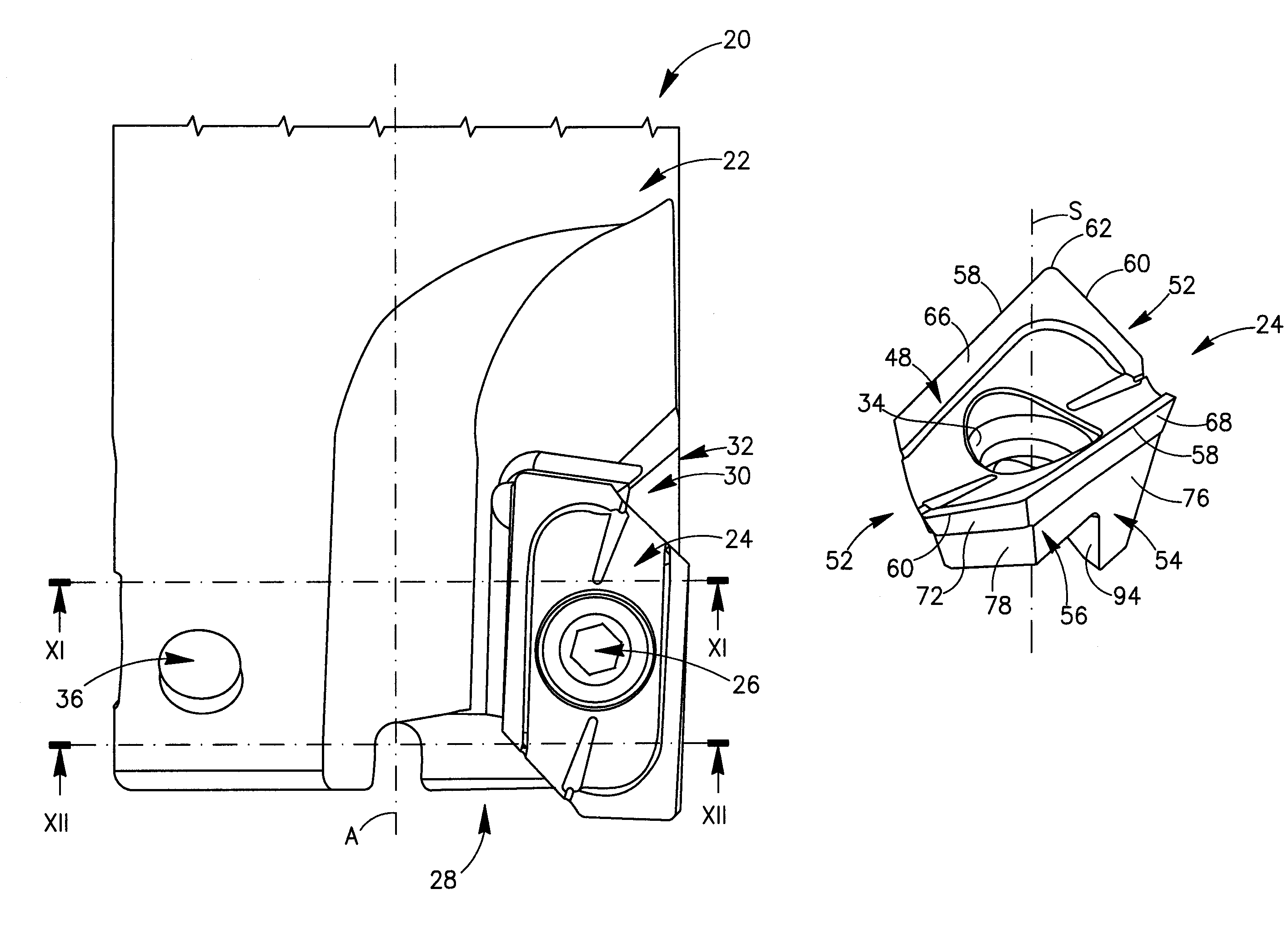
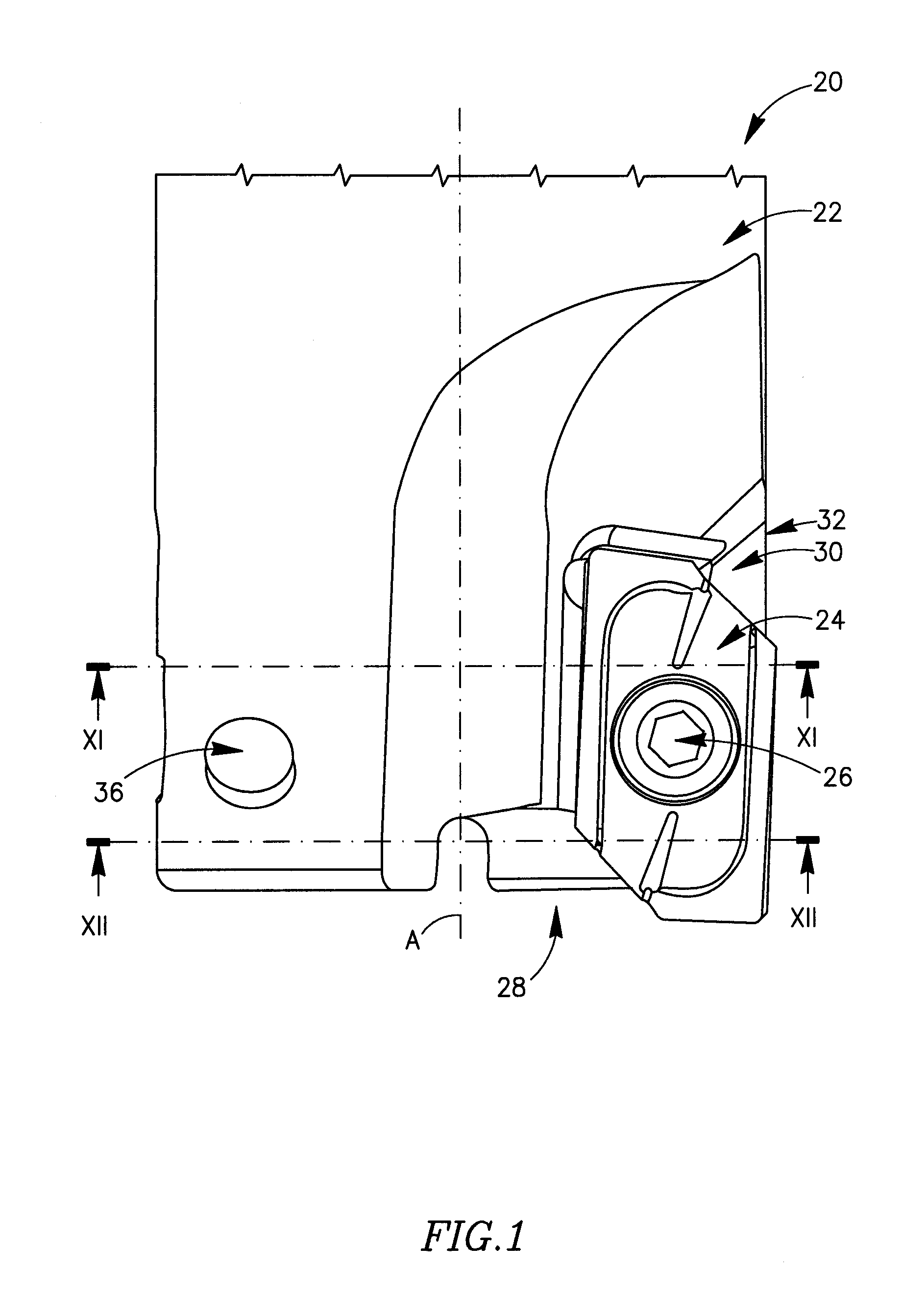
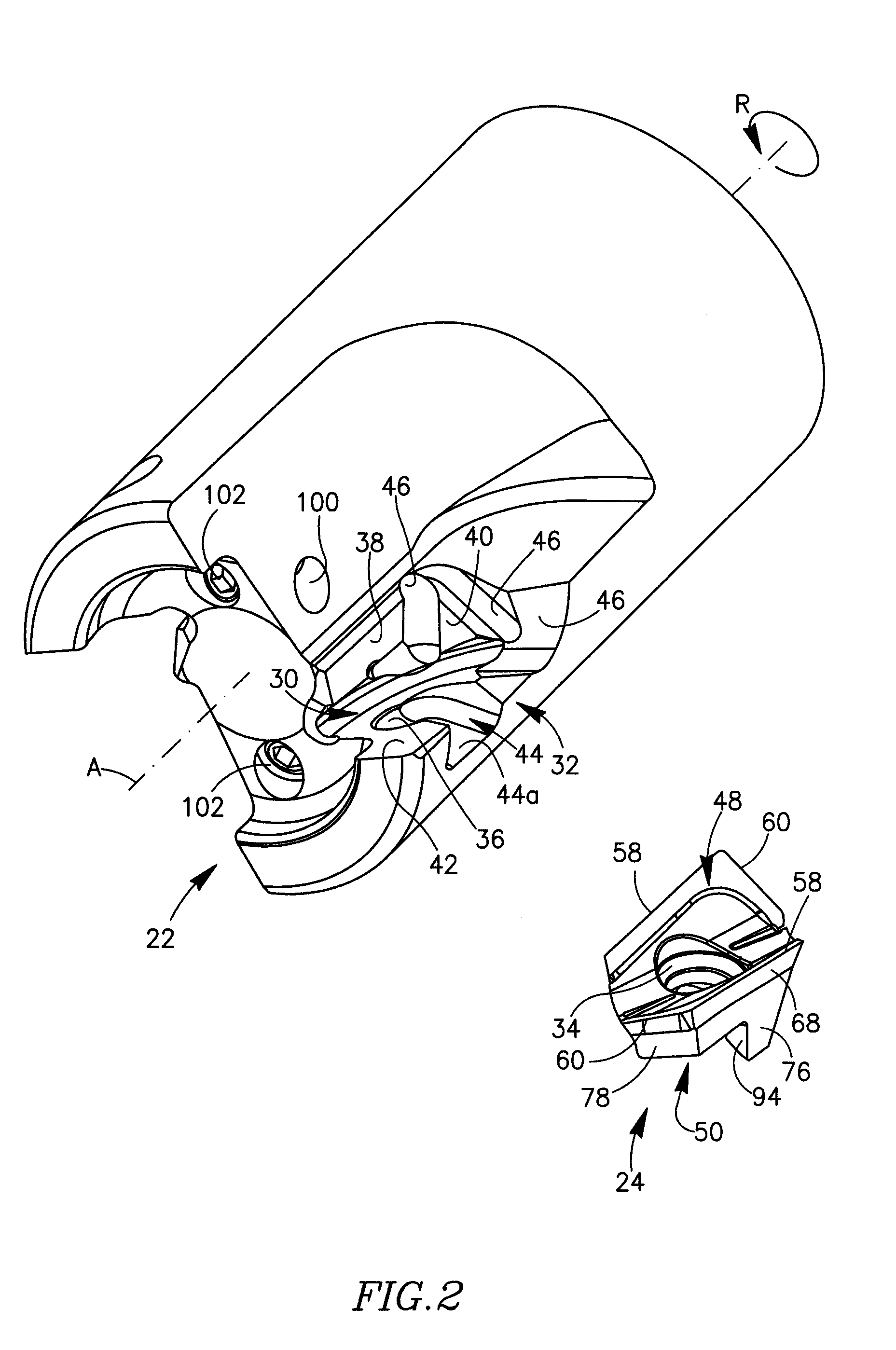
[0060]Attention is first drawn to FIGS. 1 to 12 showing a cutting tool 20 with a longitudinal axis A defining a front-to-rear direction and a direction of rotation R. The cutting tool 20 comprises a tool holder 22, two cutting inserts 24 and two clamping screws 26 in accordance with the present invention. The tool holder 22 has a front cutting portion 28. The front cutting portion 28 of the tool holder 22 has two pockets 30 formed at a perimeter 32 of the tool holder 22. However, other embodiments of the invention may have one, three or more pockets 30. Each of the pockets 30 opens tangentially forwardly and radially outwardly toward the perimeter 32. Since the two pockets 30 are identical, only one of them will be described.
[0061]A given cutting insert 24 is removably secured in the pocket 30 of the tool holder 22 by means of a clamping screw 26. The cutting insert 24 has a general shape of a hexagonal prism as seen in a top view and a bottom view of the cutting insert 24. In other...
second embodiment
[0077]In accordance with the present invention as shown in FIG. 13, the cutting insert 124 has only one base abutment plane 184 and thus, only one set of base abutment surfaces. As seen in FIG. 13, the base abutment plane 184 contains a major base abutment surface 180, it being understood that the base abutment plane 184 also contains a minor abutment surface (not shown in FIG. 13) not unlike minor abutment surface 82.
[0078]The lower surface 50 of the cutting insert 24 is further provided with a pair of intermediate surfaces 92 and a pair of transition surfaces 94 that join between the differently inclined first and second major base abutment surfaces 80, 86. As best seen in FIGS. 3 and 4, the transition surfaces 94 are directed transversely to the side abutment surfaces 76, and transversely to the first and second major base abutment surfaces 80, 86.
[0079]The upper surface 48 of the cutting insert 24 is provided with an optional arrangement of chip guiding means 96. Since the upper...
PUM
| Property | Measurement | Unit |
|---|---|---|
| angle | aaaaa | aaaaa |
| non-zero angle | aaaaa | aaaaa |
| non-zero angle | aaaaa | aaaaa |
Abstract
Description
Claims
Application Information
 Login to View More