

Anti-back-out fastener for applications under vibration
a technology of anti-back-out and vibration, which is applied in the direction of fastening means, pins, washers, etc., can solve the problems of elongation of studs or bolts, inconvenient use of threads, and thin wall construction, etc., and achieves the effect of greater inclination
- Summary
- Abstract
- Description
- Claims
- Application Information
AI Technical Summary
Benefits of technology
Problems solved by technology
Method used
Image

Examples
Embodiment Construction
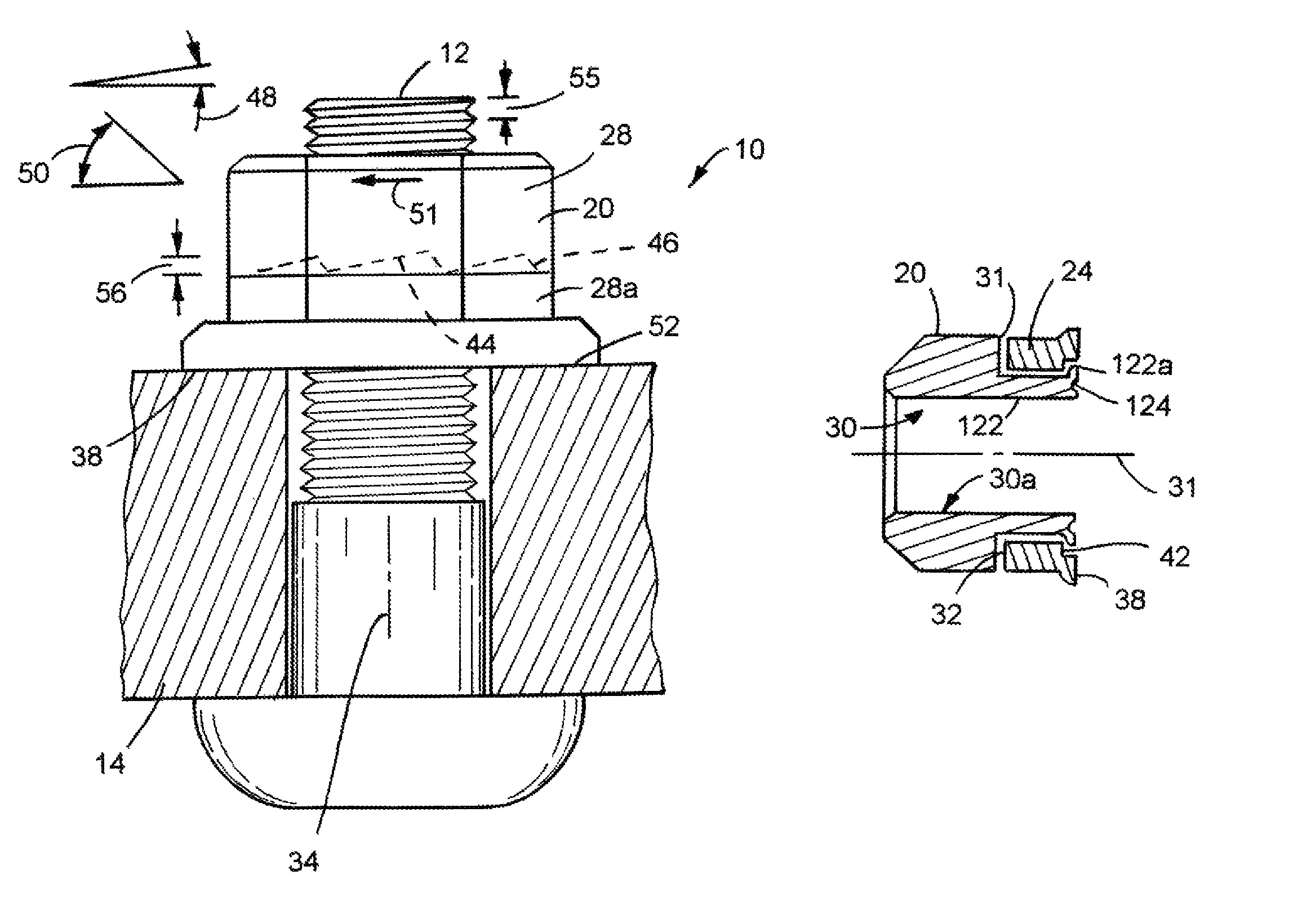
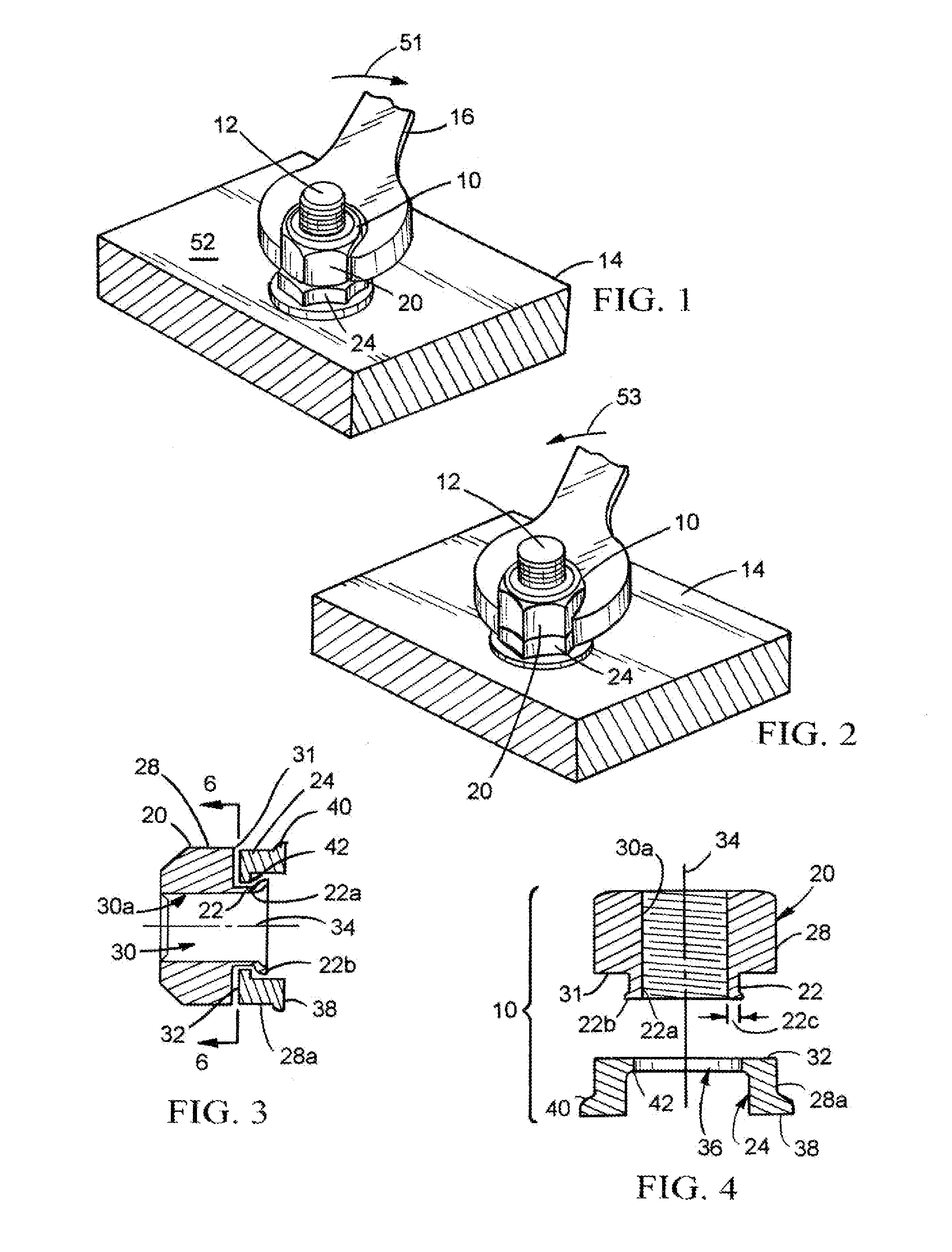
[0054]Referring now to the drawings, wherein the showings are for the purpose of illustrating certain exemplary embodiments only and not for the purpose of limiting the same, a cam locking fastener 10 is mounted on a threaded stud 12 which is secured to a workpiece 14. A wrench 16 is used for tightening the fastener 10 on the stud in the clockwise direction to apply a load on the workpiece. The wrench is rotated in the opposite direction for loosening the fastener means and releasing the load on the workpiece.
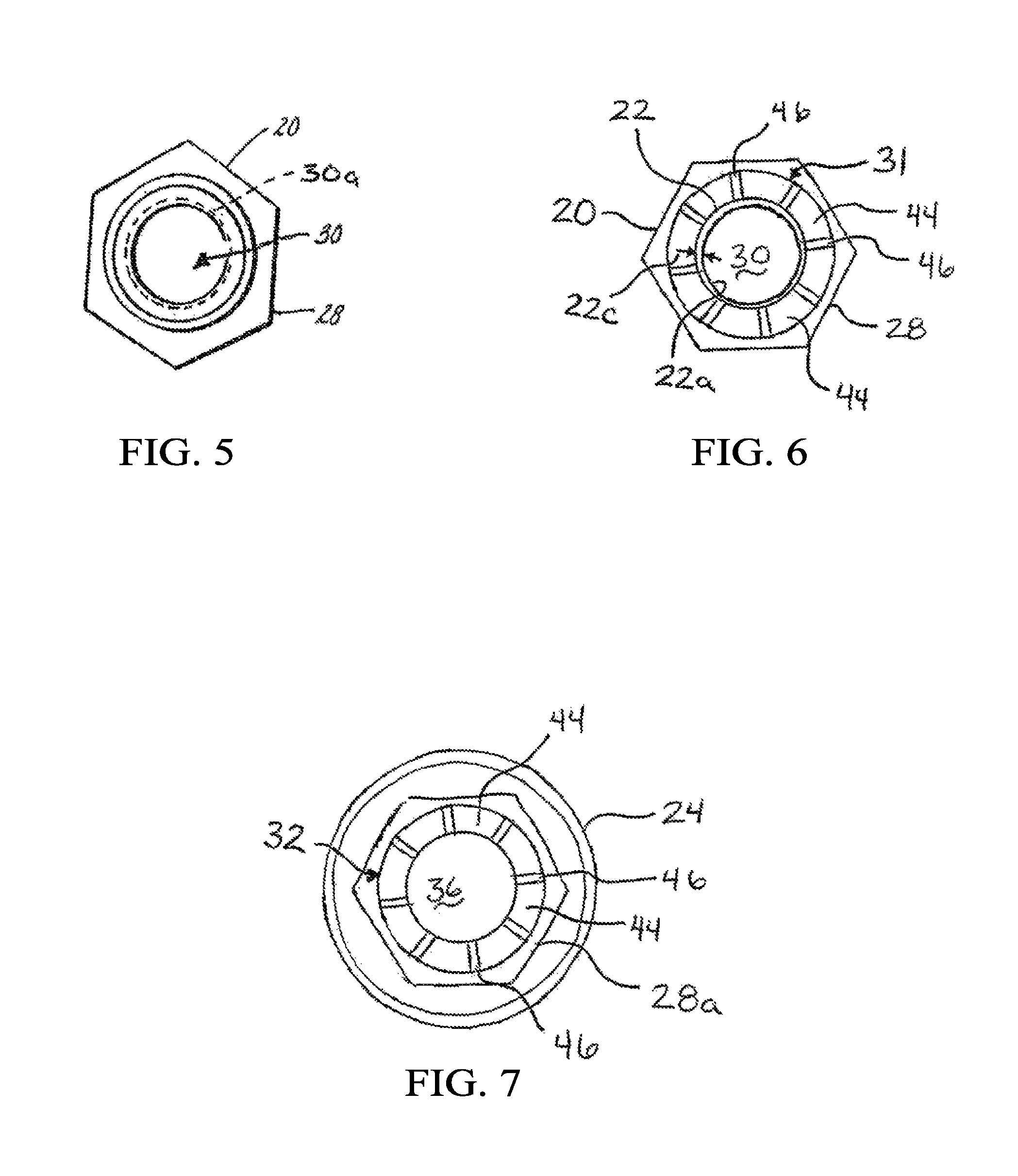
[0055]Fastener 10 comprises a nut 20 having a tubular skirt 22, and a locking. Referring to FIGS. 1, 2, 5 and 8, the nut has a six-sided conventional hexagonal external configuration 28 engaged with a conventional nut-receiving opening in wrench 16. Nut 20 has a through opening 30 having an internal threaded surface 30a meshed with the continuous helical thread on stud 12 by application of a wrench 16 to flat multi-sided external surfaces 28. In the preferred embodiment, fasten...
PUM
 Login to View More
 Abstract
Description
Claims
Application Information
 Login to View More