Check patentability & draft patents in minutes with Patsnap Eureka AI!

Transient condition management utilizing a posted error detection processing protocol

a technology of error detection and processing protocol, applied in the field of data processing, can solve the problems of high inherent bit error rate on the interconnect, complex error codes such as ecc and crc, and increase access latency,

Inactive Publication Date: 2015-06-16
INT BUSINESS MASCH CORP
View PDF17 Cites 6 Cited by
  • Summary
  • Abstract
  • Description
  • Claims
  • Application Information

AI Technical Summary

Benefits of technology

This patent describes a technology that allows a memory system to detect if there are any temporary conditions that could cause delays in servicing memory requests. When a temporary condition is detected, the memory system identifies which memory request is affected and signals the request source to issue a new read request for the same target address. This results in faster recovery times and improved performance of the memory system.

Problems solved by technology

However, these higher bit rates result in higher inherent bit error rates on the interconnects, thus requiring more robust error-correcting code (ECC) and / or cyclic redundancy check (CRC) codes to ensure a reasonable level of data integrity.
Further, complex error codes, such as ECC and CRC, tend to increase access latency due to the need for deeper error correction logic pipelines for error detection and correction.
Another trend impacting processor chip design is that DRAM access latency, while continuing to slowly improve over recent years, has not kept pace with increases in processor core clock rates.
Thus, external memory access latency, as measured relative to processor clock rates, has actually degraded.
However, limits in overall chip sizes forces a tradeoff between the number of processor cores and the amount of cache memory on the chip.
Consequently, the opportunity to improve effective memory access latency simply by increasing on-chip cache capacity is limited.

Method used

the structure of the environmentally friendly knitted fabric provided by the present invention; figure 2 Flow chart of the yarn wrapping machine for environmentally friendly knitted fabrics and storage devices; image 3 Is the parameter map of the yarn covering machine
View more

Image

Smart Image Click on the blue labels to locate them in the text.
Viewing Examples
Smart Image
  • Transient condition management utilizing a posted error detection processing protocol
  • Transient condition management utilizing a posted error detection processing protocol
  • Transient condition management utilizing a posted error detection processing protocol

Examples

Experimental program
Comparison scheme
Effect test

Embodiment Construction

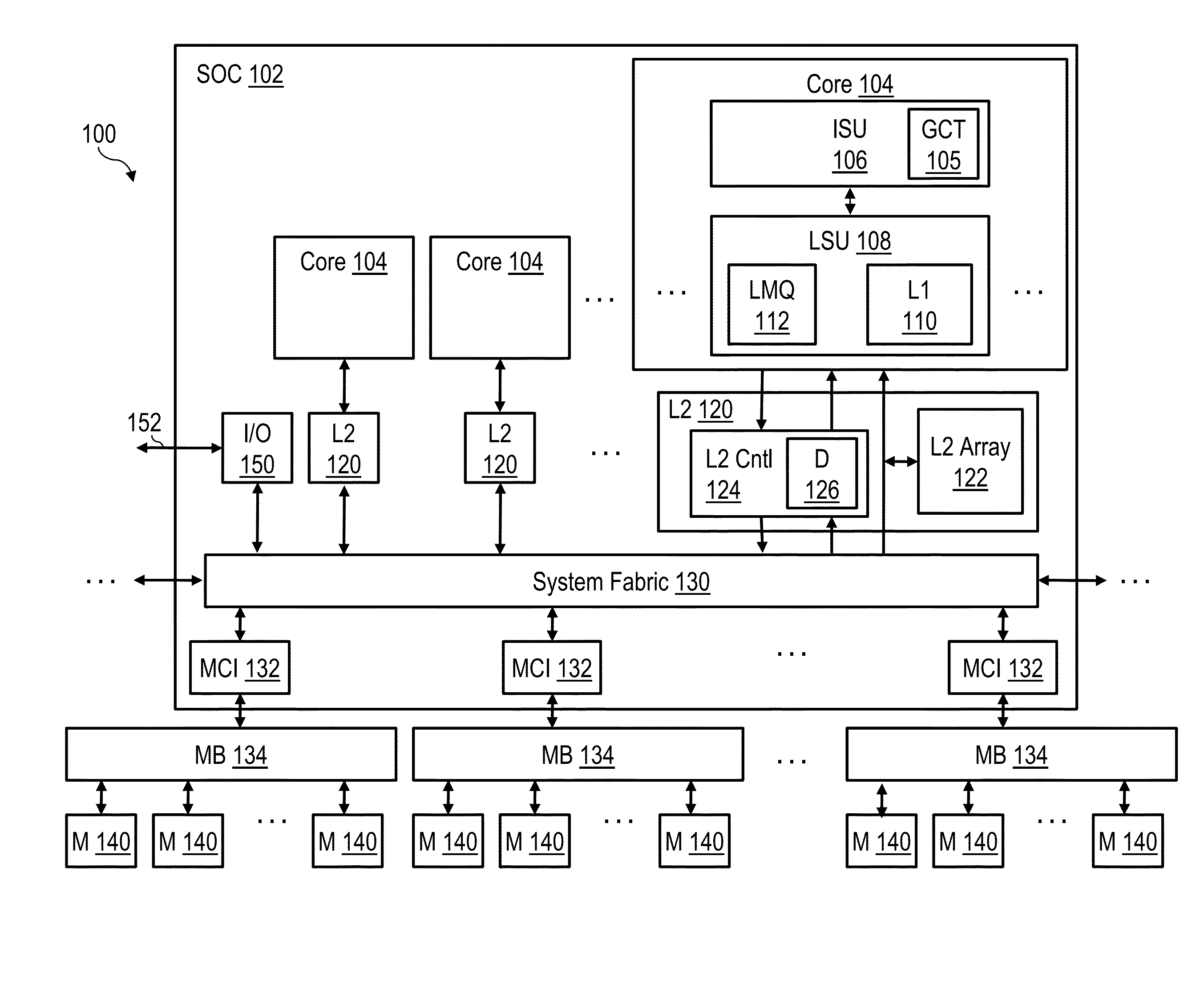
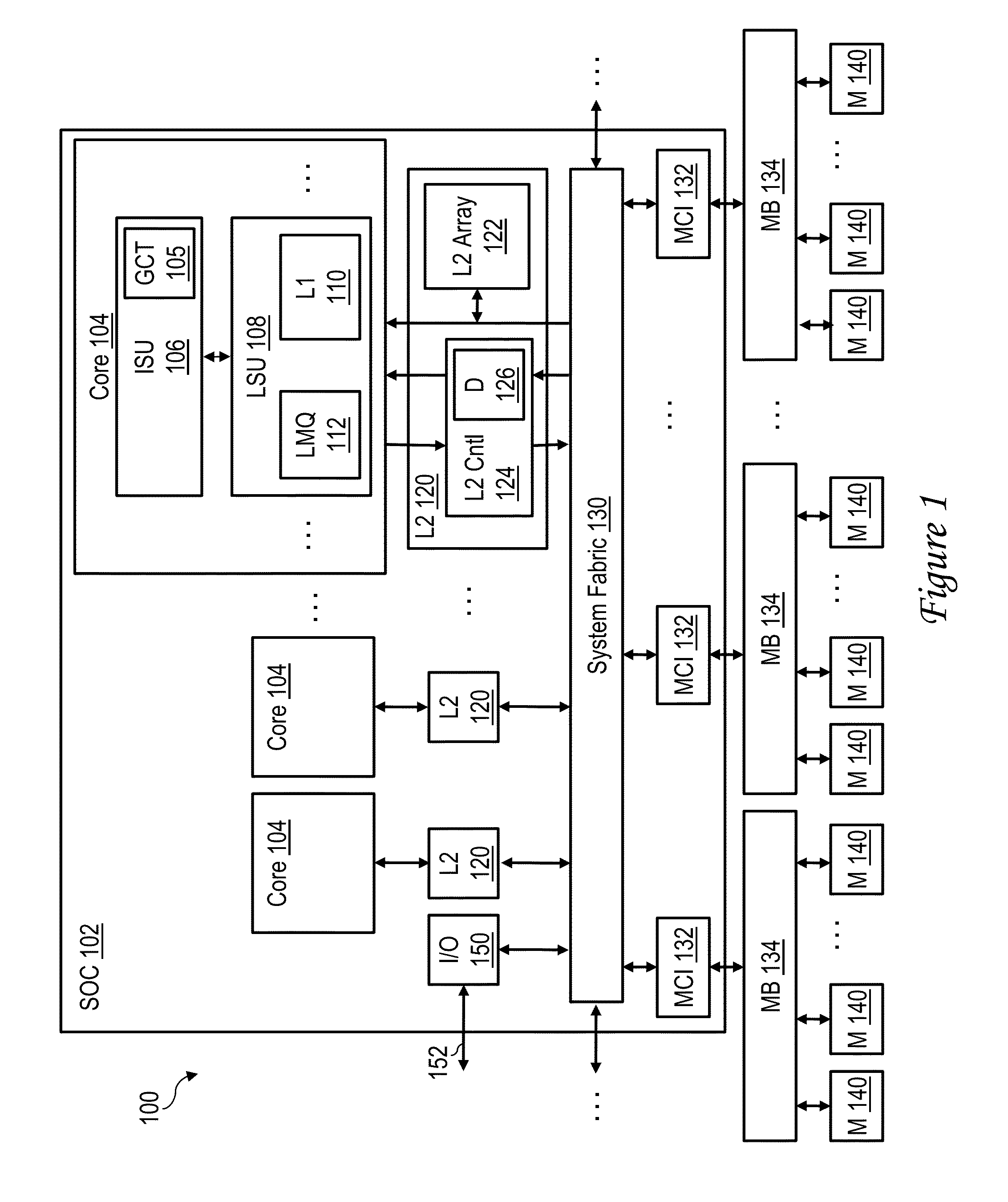
[0020]With reference now to the figures and with particular reference to FIG. 1, there is illustrated a high level block diagram of an exemplary data processing system 100 that is one of the numerous possible embodiments of a data processing system in accordance with the principles and techniques disclosed herein. Data processing system 100 may be implemented, for example, with one of the IBM Power servers, a product line of International Business Machines Corporation of Armonk, N.Y.

[0021]In the depicted embodiment, data processing system 100 includes at least one system-on-a-chip (SOC) 102, and as indicated by elliptical notation, possibly numerous SOCs 102 coupled by system fabric 130 integrated within the SOCs 102. Each SOC 102 is preferably realized as a single integrated circuit chip having a substrate in which semiconductor circuitry is fabricated as is known in the art. Each SOC 102 includes multiple processor cores 104 that independently process instructions and data. In som...

the structure of the environmentally friendly knitted fabric provided by the present invention; figure 2 Flow chart of the yarn wrapping machine for environmentally friendly knitted fabrics and storage devices; image 3 Is the parameter map of the yarn covering machine
Login to View More

PUM

No PUM Login to View More

Abstract

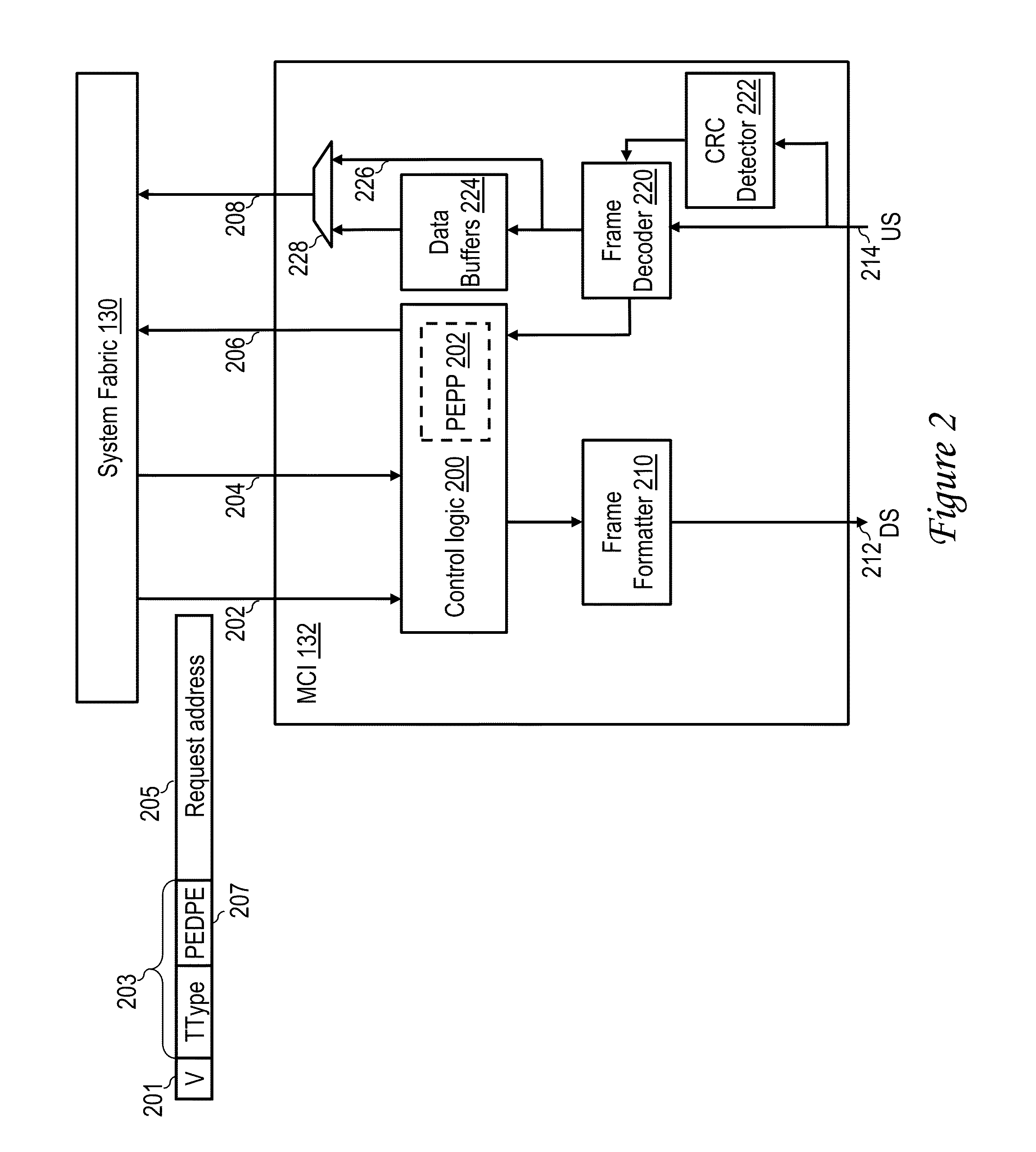
In a data processing system, a memory subsystem detects whether or not at least one potentially transient condition is present that would prevent timely servicing of one or more memory access requests directed to the associated system memory. In response to detecting at least one such potentially transient condition, the memory system identifies a first read request affected by the at least one potentially transient condition. In response to identifying the read request, the memory subsystem signals to a request source to issue a second read request for the same target address by transmitting to the request source dummy data and a data error indicator.

Description

BACKGROUND OF THE INVENTION[0001]The present invention relates in general to data processing. In some aspects, the present invention relates to decreasing effective data access latency by varying the timing of error detection processing in a memory subsystem of a data processing system. In other aspects, the present invention relates to improving utilizing of processing resources by speculatively finishing instructions associated with high latency operations.[0002]In processor chip design, the trend has been to include an ever increasing number of processor cores per processor chip. Increasing the number of processor cores increases the volume of data consumed by execution of the processor cores, and accordingly places pressure on the bit rates of chip-to-chip interconnects and external memory (e.g., dynamic random access memory (DRAM)) to supply the required volume of data. However, these higher bit rates result in higher inherent bit error rates on the interconnects, thus requirin...

Claims

the structure of the environmentally friendly knitted fabric provided by the present invention; figure 2 Flow chart of the yarn wrapping machine for environmentally friendly knitted fabrics and storage devices; image 3 Is the parameter map of the yarn covering machine
Login to View More

Application Information

Patent Timeline
no application Login to View More
Patent Type & Authority Patents(United States)
IPC IPC(8): H03M13/00G06F11/10G06F11/07
CPCG06F11/0751G06F11/1004G06F11/073
Inventor DODSON, JOHN S.GOODMAN, BENJIMAN L.GUTHRIE, GUY L.RETTER, ERIC E.STARKE, WILLIAM J.STUECHELI, JEFFREY A.
Owner INT BUSINESS MASCH CORP
Features
  • R&D
  • Intellectual Property
  • Life Sciences
  • Materials
  • Tech Scout
Why Patsnap Eureka
  • Unparalleled Data Quality
  • Higher Quality Content
  • 60% Fewer Hallucinations
Social media
Patsnap Eureka Blog
Learn More