
Oscillator
a crystal unit and oscillator technology, applied in the field of crystal units, can solve problems such as bad quality of tuning fork crystal units
- Summary
- Abstract
- Description
- Claims
- Application Information
AI Technical Summary
Benefits of technology
Problems solved by technology
Method used
Image

Examples
embodiment 1
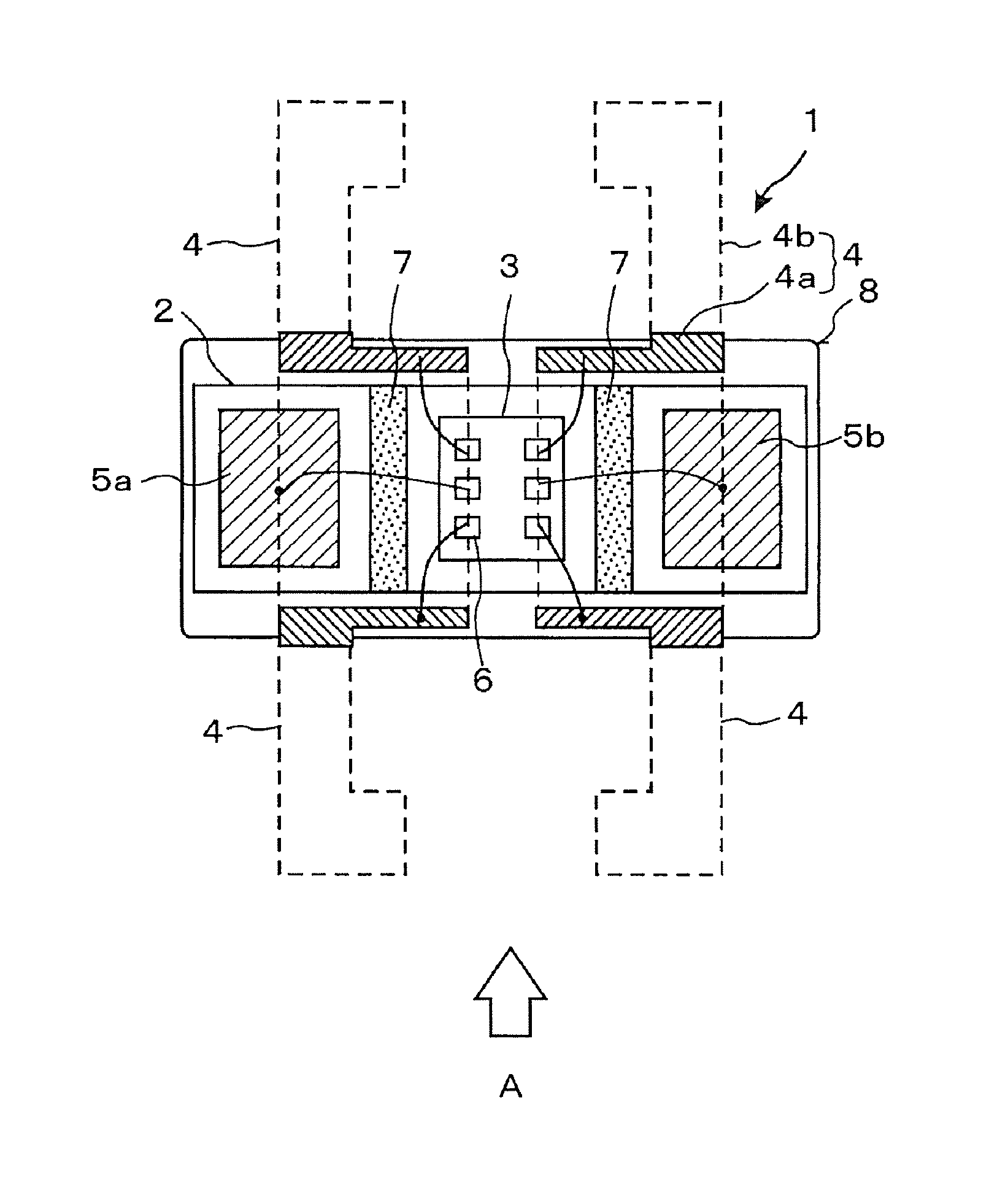
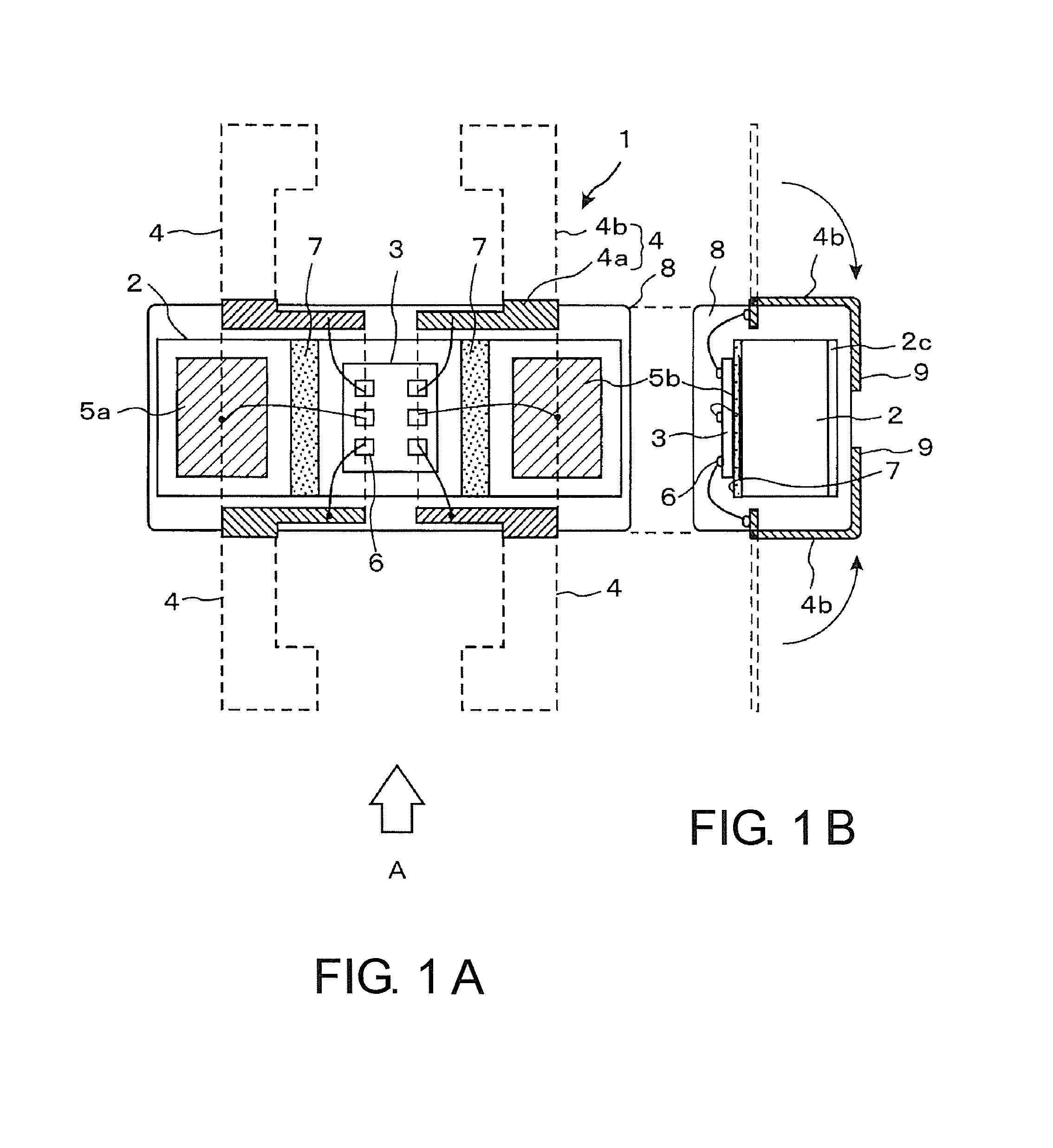
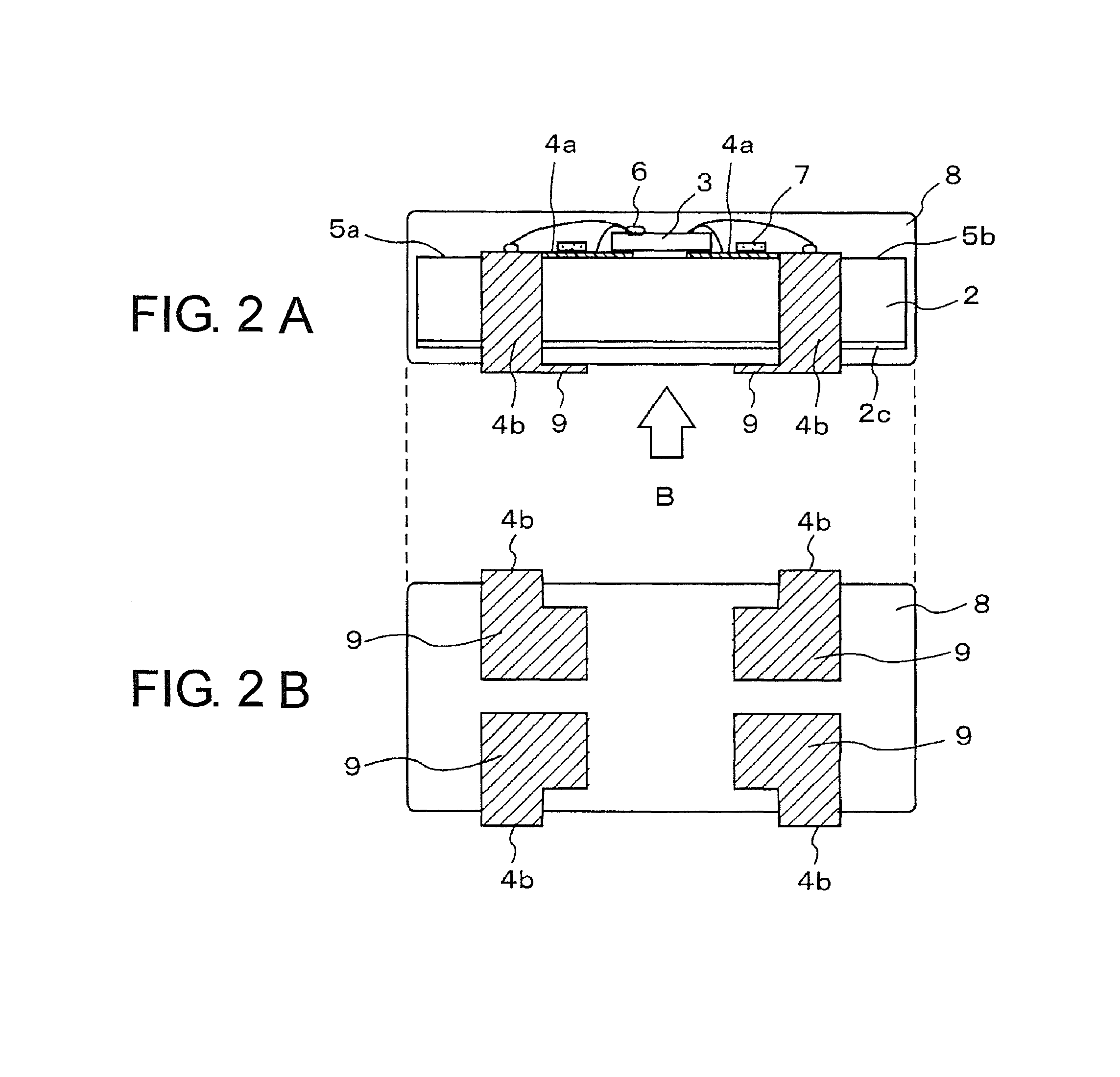
[0028]FIGS. 1A and 2B are explanatory drawings of Embodiment 1 of the oscillator according to this disclosure. FIG. 1A is a top view of the oscillator, and FIG. 1B is a side view in the short side of the oscillator. Similarly to FIG. 1A, FIG. 1B, FIG. 2A, and FIG. 2B is an explanatory drawing of Embodiment 1 of the oscillator according to this disclosure. FIG. 2A is a side view in the long side viewed from the direction of arrow “A” in FIG. 1A. FIG. 2B is a bottom view viewed from the direction of arrow “B” in FIG. 2A.
[0029]In FIG. 1A, FIG. 1B, FIG. 2A, and FIG. 2B, reference numeral “1” indicates the oscillator, reference numeral “2” does the tuning-fork crystal unit, and reference numeral “3” does the IC chip. The tuning-fork type crystal unit 2 includes a concave ceramic container internally housing the tuning-fork type resonator (the tuning-fork type crystal resonator). After housing the tuning-fork type resonator, the opening portion of the concave ceramic container is sealed w...
embodiment 2
[0037]FIGS. 3A and 3B are explanatory drawings of Embodiment 2 of the oscillator according to this disclosure. FIG. 3A is a top view of the oscillator, and FIG. 3B is a side view in the short side of the oscillator. Like FIG. 3A, FIG. 3B, FIGS. 4A, and 4B is explanatory drawings of Embodiment 2 of the oscillator according to this disclosure. FIG. 4A is a side view in the long side viewed from the direction of arrow “A” in FIG. 3A, and FIG. 4B is a bottom view of the oscillator viewed from the direction of arrow “B” in FIG. 4A.
[0038]In FIG. 3A, FIG. 3B, FIG. 4A and FIG. 4B, functional portions same as those in Embodiment 1 are designated as the same reference numerals. The difference in the oscillator between Embodiment 1 and Embodiment 2 is the configuration of the adhesive agent flow prevention film 7 disposed between the crystal terminals 5a, 5b and the IC chip 3. The other configurations are similar to those in Embodiment 1. Hence the explanation is omitted.
[0039]The adhesive age...
embodiment 3
[0043]FIGS. 5A and 5B illustrate a side view in the short side and a bottom view describing Embodiment 3 of the oscillator according to this disclosure. FIG. 5A is a side view in the short side of the oscillator in Embodiment 3, and FIG. 5B is a bottom view of the oscillator viewed from the direction of arrow “C” in FIG. 5A. The oscillator according to Embodiment 3 has the structure equal to the tuning-fork crystal unit in any of Embodiment 1 above-described in FIGS. 1A and 1B and Embodiment 2 above-described in FIGS. 3A and 3B.
[0044]The feature point of Embodiment 3 which is different from Embodiment 1 and Embodiment 2 is the structure of the mounting terminal. In Embodiment 1 and Embodiment 2, as illustrated in FIGS. 1A and 1B, for example, the structure in which, after the cut off process of the unnecessary portion of the lead frame 4, the mounting terminal forming portion 4b is folded parallel along the back surface of the tuning-fork type crystal unit 2 so as to join the mounti...
PUM
 Login to View More
 Abstract
Description
Claims
Application Information
 Login to View More