[0011]Accordingly, through use of the approach of the present invention the area associated with the power supply line structure can be significantly reduced, whilst still enabling the current carrying constraints to be met. As a result, the size of the interface cells can be reduced, hence enabling a reduction in the overall size of the integrated circuit.
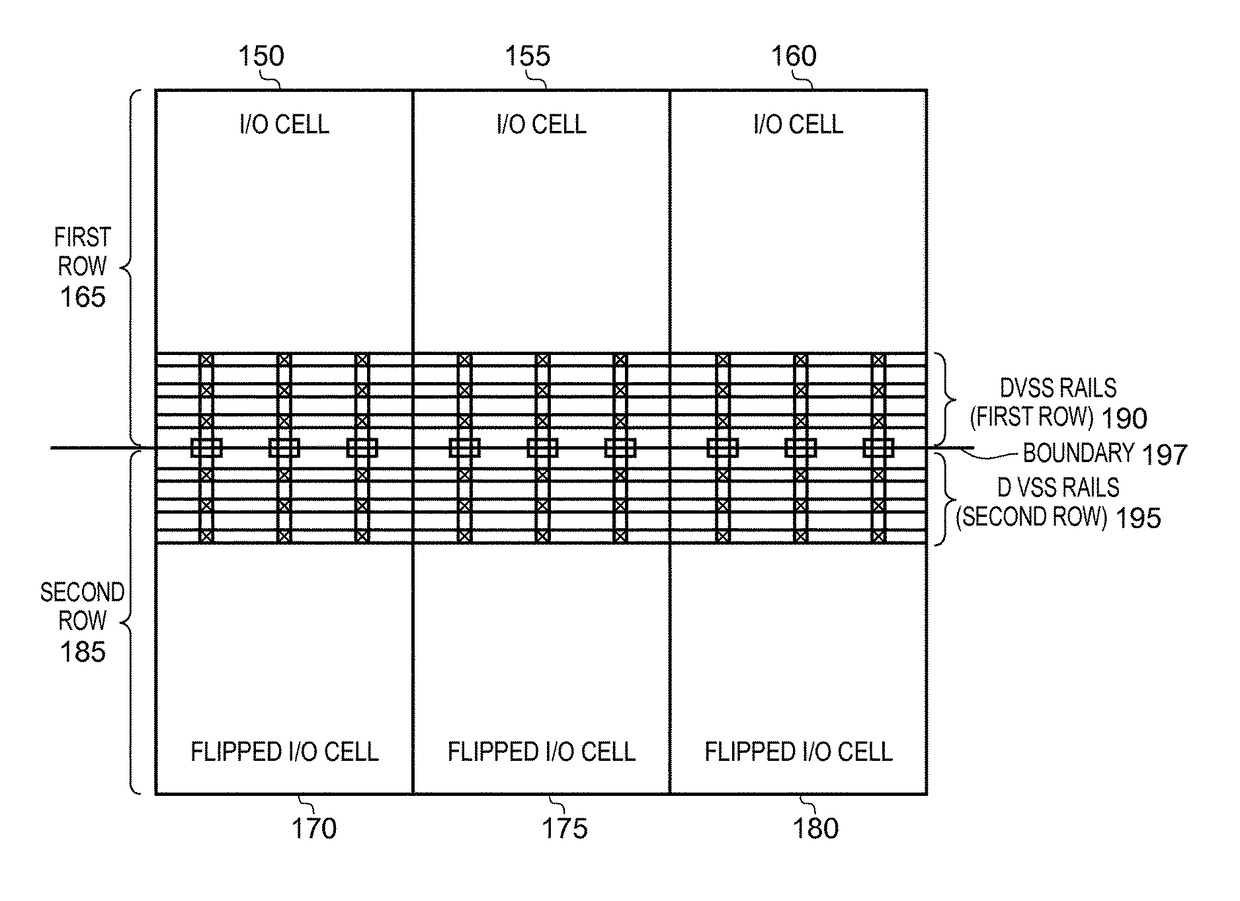
[0013]Within such embodiments, for each pair of interface cells a connection may be provided between the second supply line portions of the interface cells of the pair, such that for each interface cell in the pair the current carrying structure external to that interface cell is provided by the second supply line portion of the other interface cell in the pair. Accordingly, the second supply line arrangement provided by interconnecting the second supply line portions of the paired interface cells provides sufficient current carrying capabilities to support the current carrying constraints of the interface circuitry. Such an approach provides a particularly compact and efficient design.
[0014]There are a number of ways in which the second supply line portion of each interface cell can be configured. In one embodiment, within each pair of interface cells, the interface cells are configured such that their second supply line portion is provided adjacent said edge boundary. This improves the ease with which the second supply line portion in one interface cell can be connected to the second supply line portion in the other interface cell of the pair.
[0015]The interface cells within each pair may be configured differently so as to facilitate the interconnection of their second supply line portions. However, in one embodiment, each pair of interface cells is formed from two identical interface cells, and at the time of providing the pair of interface cells within the interface circuitry the orientation of one interface cell in the pair is flipped in the length dimension with respect to the orientation of the other interface cell of the pair, such that for both interface cells in the pair the second supply line portion is provided adjacent said edge boundary. Such an approach enables the same interface cell design to be used for both interface cells in each pair whilst still allowing the second supply line portions to be readily interconnected.
[0022]In one such embodiment, the pad access terminal is positioned between the first end and the second supply line portion, the connection path between the pad access terminal and the bump connection extends in a direction towards the functional circuitry, and the current carrying structure is provided in an area of the redistribution layer at least party overlying the second supply line portion. In such an arrangement, the area of the redistribution layer at least partly overlying the second supply line portion is not used to form the connection path between the pad access terminal and the bump connection, and accordingly the current carrying structure can readily be provided in that area without placing any additional constraints or complexity on the provision of the connection paths within the redistribution layer. Further, it is relatively straightforward to then connect the current carrying structure to the second supply line portion, for example using appropriate via connections.
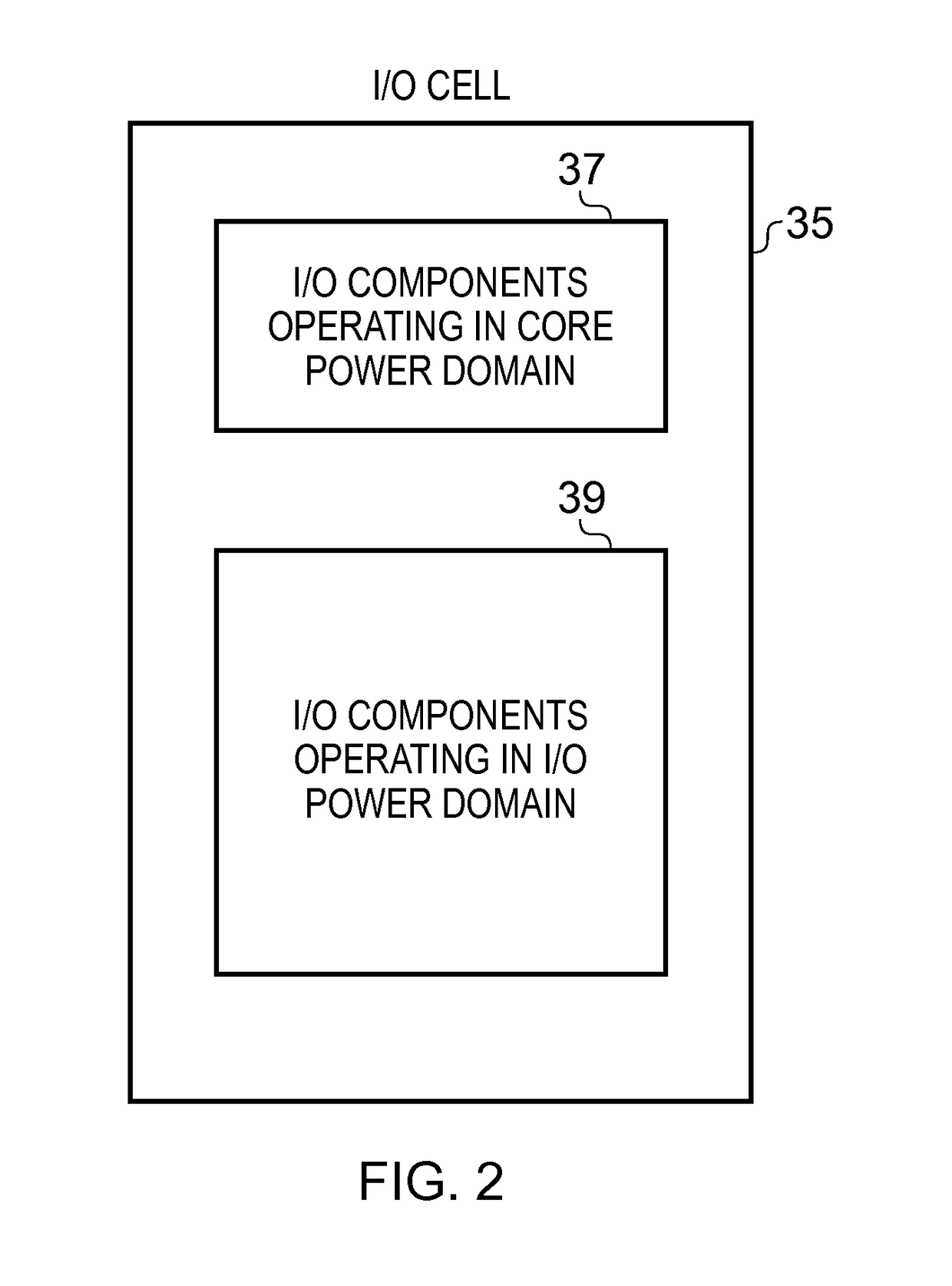
[0024]Whilst the interface circuitry is predominantly arranged to operate from a first power supply, the functional circuitry itself may operate from a different power supply, referred to herein as a second power supply. In some such embodiments, at least some of the interface cells will then comprise additional interface components configured to operate from the second power supply. In such instances, the power supply line section of each interface cell may be configured to further include supply line portions used to provide the second power supply to the additional interface components. Hence, in such embodiments the power supply line structure is required to provide multiple different power supplies, and thus the area requirements of the power supply line structure can be particularly problematic. Accordingly, in such embodiments, the use of the above described techniques is particularly beneficial, since it can enable a significant reduction in the area associated with the supply lines provided for one of the power supplies.


 Login to View More
  Login to View More