
Method for preparing paper-pulp moulded board and mould there used
A pulp and board technology, applied in papermaking, fiberboard, textiles and papermaking, etc., can solve problems such as difficulty in obtaining tensile strength and bending strength, unreasonable design of molding machines and molds, disordered and disordered paper fiber directions, etc. Achieve the effect of being conducive to recycling, ideal economic and social benefits, and process simplification
- Summary
- Abstract
- Description
- Claims
- Application Information
AI Technical Summary
Problems solved by technology
Method used
Image

Examples
Embodiment Construction
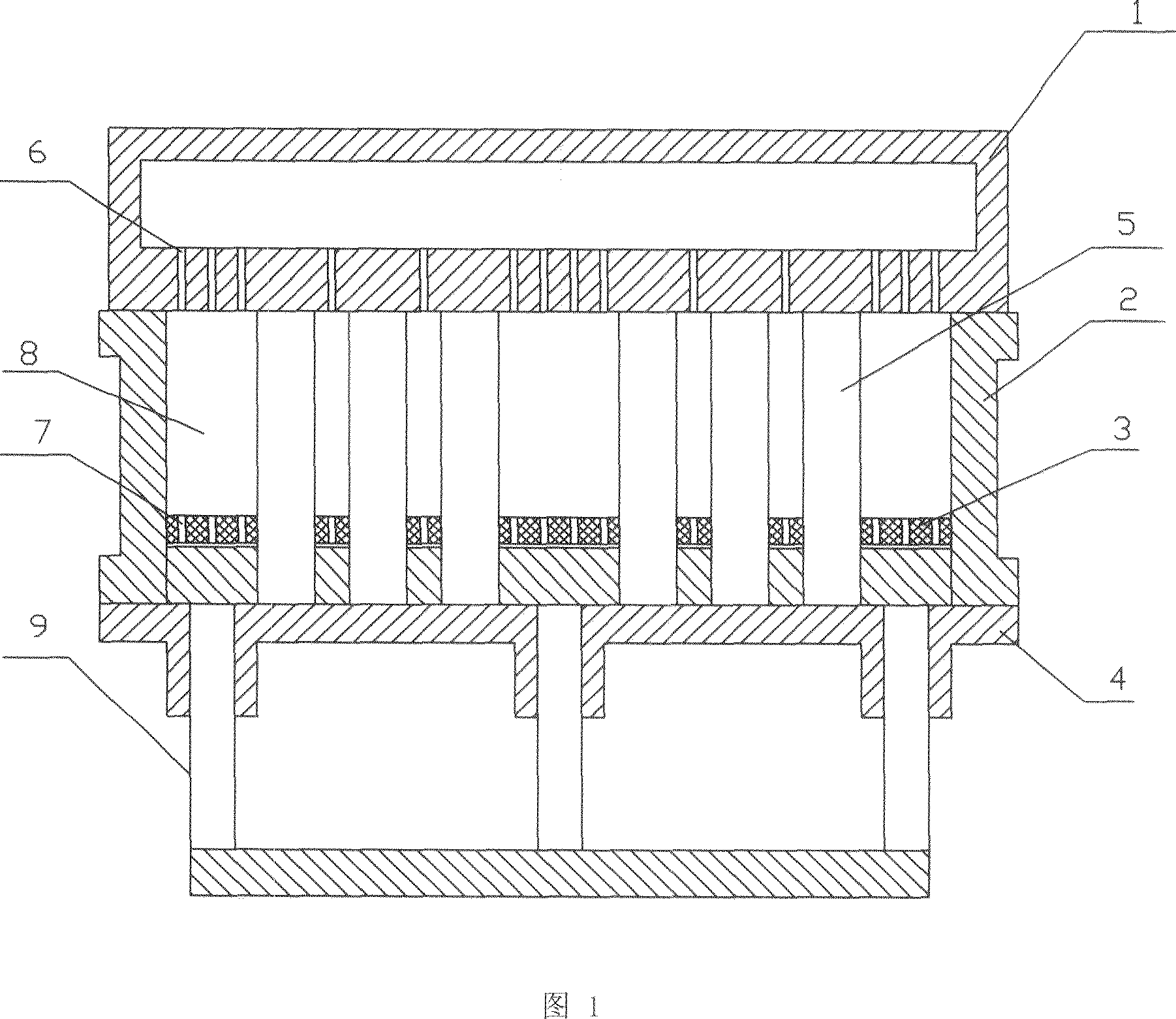
[0013] Now in conjunction with Fig. 1, mold and preparation method of the present invention are described in further detail:
[0014] The cover plate 1 or the surrounding frame 2 is fixed on the frame of the forming device, and the pressure block 3 moves up and down under the action of the push rod 9, and the cover plate 1, the surrounding frame 2 and the pressure block 3 form a closed mold cavity with variable space 8. When the mold cavity 8 is in the maximum space, inject quantitatively crushed pulp of a certain concentration (not more than 6%) therein, and the briquetting block 3 squeezes the pulp under the action of the push rod 9, and the water in the pulp passes through the The drainage holes 7 and the drainage holes 6 on the cover plate are discharged, and the paper fibers are deposited horizontally along the surface of the mold. When compacted and formed, the paper fibers form a single horizontal layered structure; pull up the surrounding frame 2 or the cover plate 1, ...
PUM
 Login to View More
 Abstract
Description
Claims
Application Information
 Login to View More