This helps you quickly interpret patents by identifying the three key elements:
Problems solved by technology
Method used
Benefits of technology
Problems solved by technology
This film has excellent stain resistance and discoloration resistance in a short period of time such as 3 days after application, but has the problem of staining the adherend (remaining peeling marks) over a long period of time such as more than 1 month after application.
Also, for pellet processing, it cannot be said that sufficient consideration has been given
Method used
the structure of the environmentally friendly knitted fabric provided by the present invention; figure 2 Flow chart of the yarn wrapping machine for environmentally friendly knitted fabrics and storage devices; image 3 Is the parameter map of the yarn covering machine
View more
Image
Smart Image Click on the blue labels to locate them in the text.
Viewing Examples
Smart Image
Click on the blue label to locate the original text in one second.
Reading with bidirectional positioning of images and text.
Smart Image
Examples
Experimental program
Comparison scheme
Effect test
Embodiment
[0087] Next, the present invention will be described in further detail with examples given.
[0088] Among them, the evaluation items and evaluation methods of the adhesive of the present invention are as follows.
[0089] [E1] Stain resistance to adherents
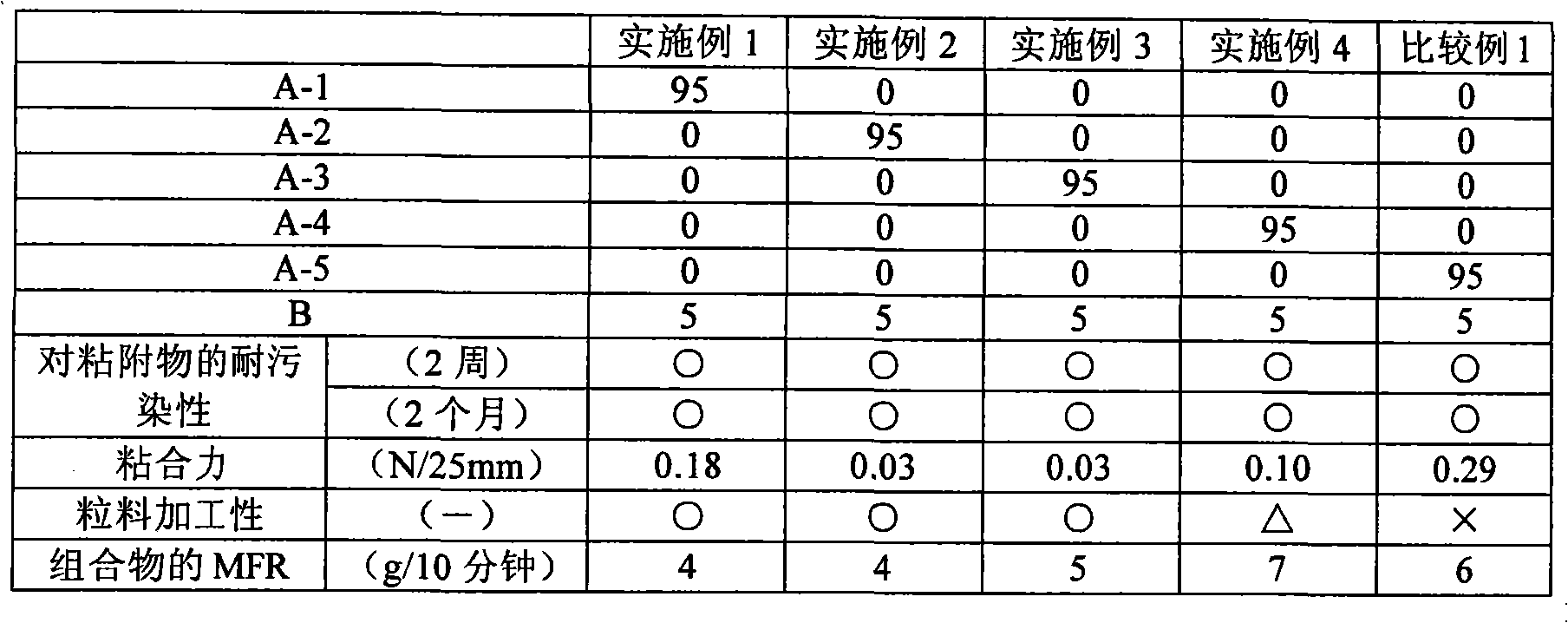
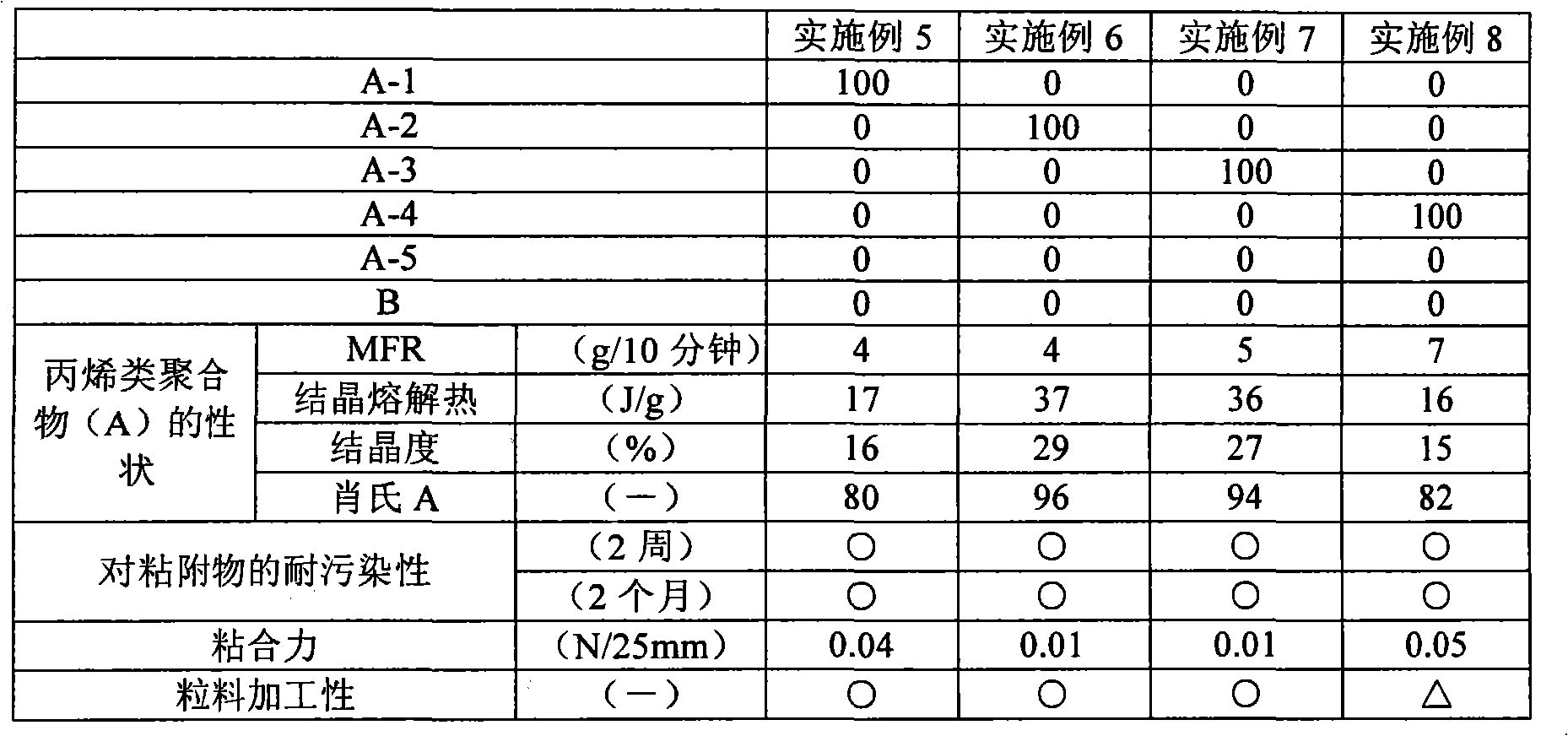
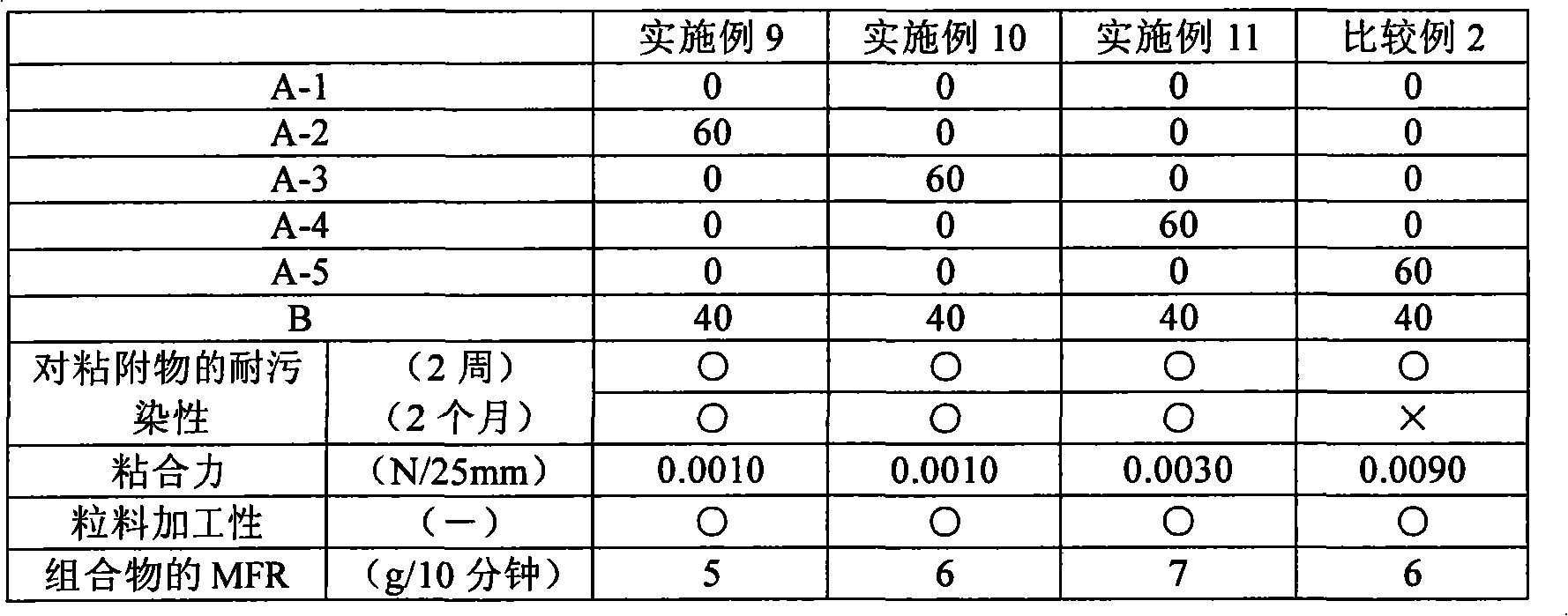
[0090] Using a rubber roller, stick the adhesive layer of the adhesive film sample on a black ceramic tile (manufactured by INAX Co., Ltd., trade name INTERIOR TILE INAX, model SPKC-100, color number L06-J, a square with a side length of 100) (room temperature ) to prepare test samples. The test samples were placed in a thermostatic chamber under an atmosphere of 40° C., aged for two weeks and two months, respectively, and the adhesive film samples were peeled off from each test sample, and whether there was transfer on the tile surface was visually evaluated. The evaluation criteria are as follows.
[0091] ○: No pollution,
[0092] ×: Contaminated.
[0093] [E2] Adhesion
[0094] The adhesive force was measure...
Synthetic example 1
[0114] Synthesis of metallocene compounds
[0115] Diphenylmethylene(3-tert-butyl-5-methyl-cyclopentadienyl)(2,7-di-tert-butylfluorenyl)zirconium dichloride According to International Publication No. 2004-087775 pamphlet The synthesis sequence described in Example 3c was synthesized.
Synthetic example 2
[0117] Preparation of propylene-ethylene-butene copolymer (A-1)
[0118] At normal temperature, after adding 780 ml of dry hexane, 70 g of 1-butene and triisobutylaluminum (1.0 mol) to the 2000 ml polymerization device fully replaced by nitrogen, the internal temperature of the polymerization device was raised to 55 ° C, and Propylene was pressurized so that the pressure in the system was 0.7 MPaG. Then, the pressure in the system was adjusted to 0.72 MPaG with ethylene. Next, the diphenylmethylene (3-tert-butyl-5-methyl-cyclopentadienyl) (2,7-di-tert-butylfluorenyl) prepared in Synthesis Example 1 was added to the polymerizer ) zirconium dichloride 0.001mmol and a toluene solution obtained by contacting 0.3mmol of aluminum-converted methylalumoxane (manufactured by Tosoh Fine Chem Co., Ltd.), at an internal temperature of 55°C, the internal pressure of the system was maintained at 0.72MPaG with ethylene While performing polymerization for 30 minutes, 20 ml of methanol was a...
the structure of the environmentally friendly knitted fabric provided by the present invention; figure 2 Flow chart of the yarn wrapping machine for environmentally friendly knitted fabrics and storage devices; image 3 Is the parameter map of the yarn covering machine
Login to View More
PUM
Property
Measurement
Unit
crystallinity
aaaaa
aaaaa
melt flow index
aaaaa
aaaaa
melt flow index
aaaaa
aaaaa
Login to View More
Abstract
Propylene-based polymers (A) are provided which, when used as pressure-sensitive adhesives to various adherends, show a desired initial adhesion and will not contaminate the adherends and which have excellent pellet handling properties. Pellets of the invention contain the propylene-based polymers (A). Pressure-sensitive adhesives of the invention contain the propylene-based polymers (A). The propylene-based polymer (A) includes 65 to 80 mol% of a structural unit derived from propylene, 5 to 10 mol% of a structural unit derived from ethylene and 15 to 25 mol% of a structural unit derived from a C4-20 +--olefin (wherein these percentages are calculated based on 100 mol% of the total of the structural unit derived from propylene, the structural unit derived from ethylene and the structural unit derived from a C4-20 +--olefin) and has a heat of crystal fusion of 5 to 45 (J / g) as measured by DSC. Compositions of the invention contain the propylene-based polymers (A).
Description
technical field [0001] The present invention relates to propylene-based polymers suitable for use as adhesives, and to propylene-based polymer compositions. That is, the present invention relates to a propylene-based polymer which, when used as an adhesive or an adhesive sheet on various adherends, exhibits necessary initial adhesive force, suppresses contamination of adherends for a long period of time, Furthermore, the pellets are excellent in processability; the present invention also relates to a propylene-based polymer composition containing the propylene-based polymer, pellets composed of the propylene-based polymer, and pellets composed of the propylene-based polymer composition. Furthermore, the present invention relates to an adhesive containing the above-mentioned propylene-based polymer. Background technique [0002] In order to protect metal, glass, or synthetic resin plates, and products and components composed of these members, a surface protective film in whi...
Claims
the structure of the environmentally friendly knitted fabric provided by the present invention; figure 2 Flow chart of the yarn wrapping machine for environmentally friendly knitted fabrics and storage devices; image 3 Is the parameter map of the yarn covering machine
Login to View More
Application Information
Patent Timeline
Application Date:The date an application was filed.
Publication Date:The date a patent or application was officially published.
First Publication Date:The earliest publication date of a patent with the same application number.
Issue Date:Publication date of the patent grant document.
PCT Entry Date:The Entry date of PCT National Phase.
Estimated Expiry Date:The statutory expiry date of a patent right according to the Patent Law, and it is the longest term of protection that the patent right can achieve without the termination of the patent right due to other reasons(Term extension factor has been taken into account ).
Invalid Date:Actual expiry date is based on effective date or publication date of legal transaction data of invalid patent.


 Login to View More