Front-end probe mechanism of reactor pressure vessel checking machine

A pressure vessel and inspection machine technology, which is applied in the fields of reactors, nuclear reactor monitoring, nuclear power generation, etc., can solve the problems such as the obstruction of the movement range of the ultrasonic probe, the unreliable detection results, and the impact on the comprehensive scanning of the area to be tested.

CN101894592AInactive Publication Date: 2010-11-24CGNPC INSPECTION TECH +2
5 Cites 11 Cited by

Patent Information

Authority / Receiving Office
CN · China
Patent Type
Applications(China)
Current Assignee / Owner
Publication Date
2010-11-24
Estimated Expiration
Not applicable · inactive patent

Smart Images

  • Figure 1
    Figure 1
  • Figure 2
    Figure 2
  • Figure 3
    Figure 3
Patent Text Reader

Abstract

The invention relates to a front-end probe mechanism of a reactor pressure vessel checking machine. The front-end probe mechanism comprises an ultrasonic probe body, a probe support framework framed outside the ultrasonic probe body, and a wall support frame in rotary connection with the probe support framework through a third rotating shaft; the probe support framework comprises an inner frame in rotary connection with two opposite sides of the ultrasonic probe body through a first rotating shaft respectively and an outer frame in rotary connection with two opposite sides of the inner frame through a second rotating shaft respectively; a torsion spring is also sleeved on the third rotating shaft; one end of the torsion spring is connected with the wall support frame, while the other end is connected with the outer frame; and the first rotating shaft, the second rotating shaft and the torsion spring provides a rotating freedom for the ultrasonic probe body on a spherical surface so that the ultrasonic probe body is tightly coupled with the spherical surface to be detected. The probe mechanism overcomes the defect of detection data loss due to poor coupling of the probe body and the spherical surface, and lays a foundation for safe operation of a nuclear power station.
Need to check novelty before this filing date? Find Prior Art

Description

technical field

[0001] The invention relates to a nuclear power plant reactor pressure vessel weld seam detection device. Background technique

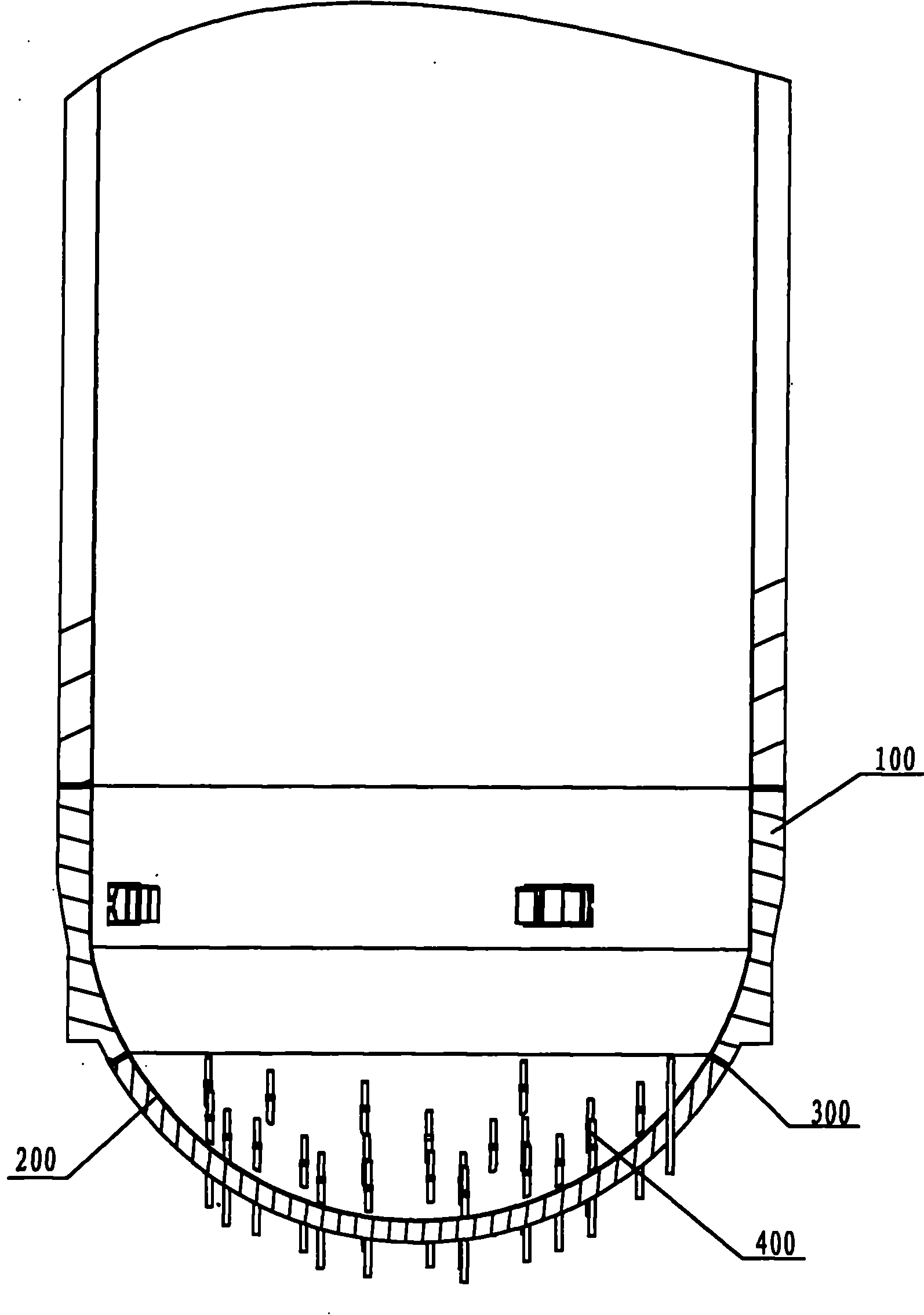
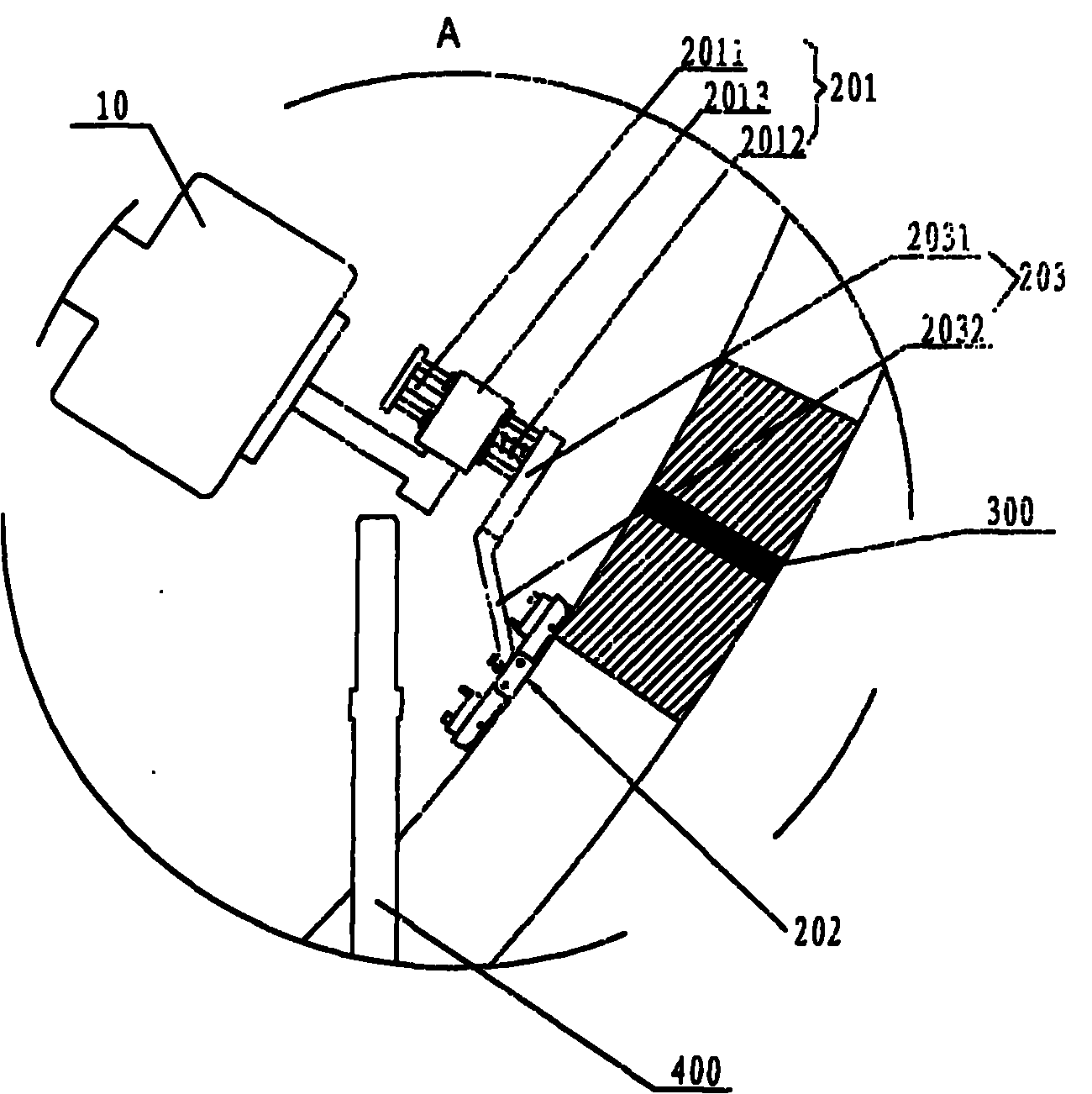
[0002] The lower part of the nuclear reactor pressure vessel is welded by a cylindrical body 100 and a hemispherical lower head 200, such as figure 1 As shown, therefore, there is a weld 300 at the connection between the two under the pressure vessel. According to the relevant inspection specifications of nuclear power plants, the area of ​​50mm on both sides of the weld ( image 3 (shown in the shaded part in the middle) for flaw detection inspection. At the same time, the surfacing layer on the surface also needs to be scanned with the weld as the center line and 250 mm on both sides. In the prior art, there are ultrasonic principles for detection The principle of the inspection machine is to extend the probe into the bottom of the pressure vessel for scanning. Since the area to be scanned is a spherical surface, the installation...

Examples

Embodiment Construction

[0020] Below in conjunction with accompanying drawing, illustrate in detail the specific content of the present invention:

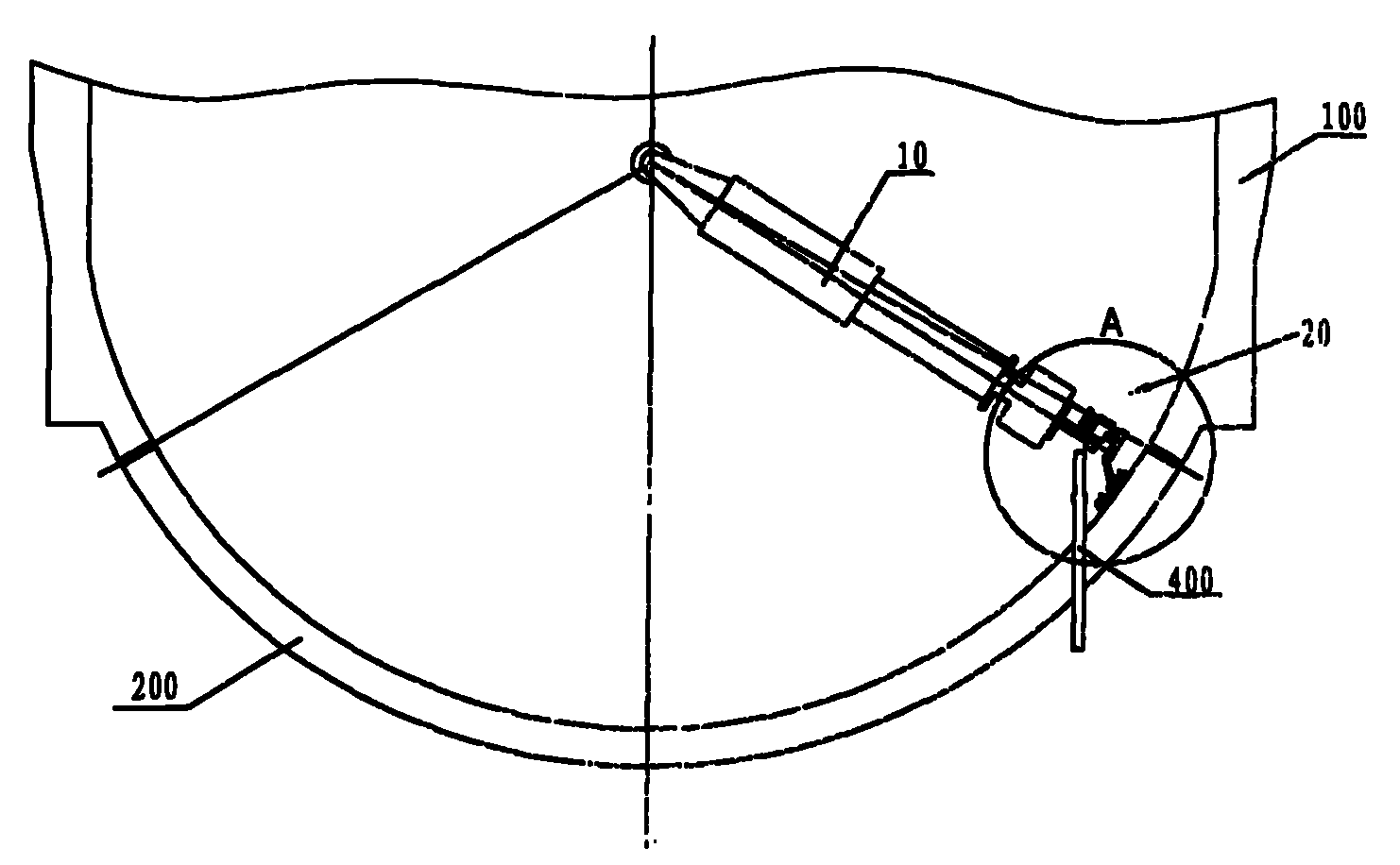
[0021] figure 2 and image 3 It shows the structure and working status of the probe scanning device at the front end of the inspection machine. Since the reactor pressure vessel is a large vessel, the bottom of which is located 20m underwater, and the pressure vessel has relatively large nuclear radiation, and people cannot approach it for operation. Therefore, in order to realize Extend the probe scanning device to the bottom of the container, and set up a large inspection machine (not shown in the figure) outside the container. The core of the inspection machine is to control the position of the probe scanning device and receive the feedback information from the probe. The outside of the inspection machine The mechanical structure and its control system are not the main points of the present invention, which can adopt the structure of the existing in...